






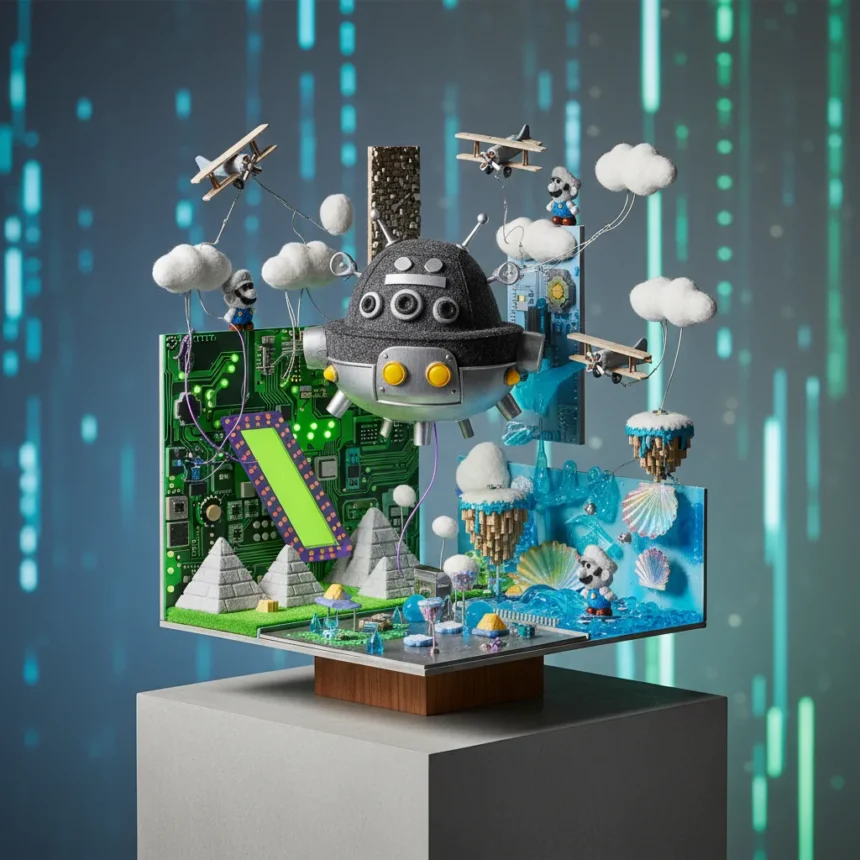
Super Mario Land felt different because Nintendo handed the Game Boy’s flagship platformer to a team that didn’t normally make Mario games. Released in 1989, this six-world adventure became a classic despite abandoning almost everything that defined the Mario series, from its setting to its enemies to its music.
Key Takeaways
- Super Mario Land was developed by Nintendo R&D1 without Shigeru Miyamoto, creating a “skewed approach” to the Mario formula
- The game ditches the Mushroom Kingdom for Sarasaland, ruled by alien Tatanga instead of Bowser
- Only four classic enemies appear; new foes include spiders, robots, ghosts, and Moai heads
- Themed worlds range from Egyptian ruins to submarine levels to a whale’s belly, far more experimental than NES Mario
- Shorter length and easier difficulty made it feel less polished than NES entries, though reviewers called it “quirkier and more interesting”
A Mario Game Made by Non-Mario People
The core reason Super Mario Land felt like an outsider: it wasn’t made by the team that defined Mario. Gunpei Yokoi’s Nintendo R&D1 took the helm without Shigeru Miyamoto’s direct involvement, and the result was a platformer that approached the series from an entirely different angle. This wasn’t laziness or incompetence—it was a deliberate creative choice that produced something genuinely experimental. Jeremy Parish, analyzing the Game Boy’s library, described it bluntly: “Super Mario Land takes a skewed approach to being a Mario platformer. It’s Super Mario as made by a bunch of people who didn’t normally make Super Mario games ultimately coming up with something much quirkier and in some ways more interesting”. That queerness is the game’s identity.
Sarasaland and the Alien Takeover
Super Mario Land abandons the Mushroom Kingdom entirely. Instead, players rescue Princess Daisy from Sarasaland, a foreign kingdom ruled by Tatanga, an alien obscured by a spaceship. This villain choice is telling. Bowser is iconic, recognizable, and feels like a genuine threat. Tatanga is forgettable—you barely see him, and his spaceship-based obscurity makes him feel less like a character and more like a stage hazard. The setting shift matters more than the villain swap, though. Sarasaland isn’t a fantasy kingdom with castles and pipes; it’s a collection of themed worlds that feel genuinely international in a way the Mushroom Kingdom never attempted.
Enemies and Mechanics That Don’t Belong
Super Mario Land reuses only four classic enemies: Goompas, Koopas, Bullet Bills, and Piranha Plants. Everything else is new. Spiders, robots, ghosts, Moai (Easter Island heads), and Fighter Flies (borrowed from the original Mario Bros. arcade game) fill the stages. The Koopa shells here explode like bombs instead of sliding across the screen—you can’t kick them forward the way you could in every other Mario game. Fireballs bounce erratically, like a retro DVD screensaver, rather than traveling in straight lines. These aren’t balance tweaks. They’re deliberate departures from the established Mario vocabulary. A player jumping into Super Mario Land after mastering the NES entries would find their muscle memory working against them.



Themed Worlds That Feel Like a World Tour
Where Super Mario Land truly distinguishes itself is in level design philosophy. The game doesn’t repeat environments. World 1 opens in a Mushroom Kingdom-style forest to ease players in, but then things get strange. Birabuto is Egyptian, full of ancient ruins. Muda is aquatic, with submarine sections. Easton features Moai statues and Easter Island aesthetics. Chai is openly stereotypical Asian, complete with music that matches the theme. Other worlds include a beehive, a toy box, a house, and a whale’s belly. This isn’t world variety in the sense of “ice world, fire world, water world.” This is a game that treats each stage as a distinct cultural or thematic space. The music changes to fit each theme, though it never reaches the polish of NES Mario soundtracks. By the standards of 1989 Game Boy hardware, the ambition is clear. By the standards of what Nintendo had already achieved on NES, it feels slight.
Why Super Mario Land Faded Into Obscurity
The game was impressive at launch. It maximized the Game Boy’s limited graphics by packing genuine creativity into six worlds. But it had weaknesses that became harder to ignore as Game Boy releases improved. The level design, while fun, wasn’t as expertly crafted as the NES titles. The game was shorter and easier, with simpler bonus games at higher exits that awarded only 1-3 extra lives. Corbie Dillard from Nintendo Life summed up the problem: “Super Mario Land was impressive when it was first released for the Game Boy, but given how the length and overall quality of Game Boy releases increased shortly thereafter, it only made this original seem even more inadequate by comparison”. It wasn’t bad. It was just outpaced by its own platform’s evolution.



When Nintendo remade Mario games for new systems, they reached for the NES and SNES classics. Super Mario Advance brought the original Super Mario Bros. to Game Boy Advance. Super Mario 3D Land on the 3DS blended 2D and 3D gameplay but ignored Super Mario Land’s experimental themes entirely. The original Game Boy platformer became a historical footnote, a curiosity from an era when Nintendo was still figuring out what handheld Mario should be.
Is Super Mario Land worth playing today?
Yes, but with expectations adjusted. It’s a short, quirky platformer that rewards curiosity about game design history. The themed worlds and unusual enemies still feel fresh compared to the formula-driven Mario games that followed. Treat it as an oddball experiment, not a masterpiece, and you’ll appreciate what makes it different.
Why did Nintendo use an alien villain instead of Bowser?
The brief doesn’t explain Nintendo’s reasoning, only that Tatanga was chosen and remains the least memorable Mario villain due to being obscured by his spaceship. The creative choice fits the game‘s overall theme of departing from Mario conventions.
How does Super Mario Land compare to the NES Mario games?
Super Mario Land is shorter, easier, and less expertly designed than NES entries. It features fewer familiar enemies, a foreign setting instead of the Mushroom Kingdom, and simpler bonus mechanics. The quirky approach makes it feel more experimental, but the NES games remain more polished and challenging.



Super Mario Land remains a fascinating artifact precisely because it failed to become the template for Mario games. A team outside the core Mario group took the formula and bent it in directions the series never explored again. The alien villain, the themed worlds, the bouncing fireballs, the Moai heads—none of these became Mario staples. Instead, the series went back to what worked, leaving Super Mario Land as gaming’s most interesting oddball, a classic that felt wrong enough to stay memorable.
This article was written with AI assistance and editorially reviewed.
Source: Creativebloq