



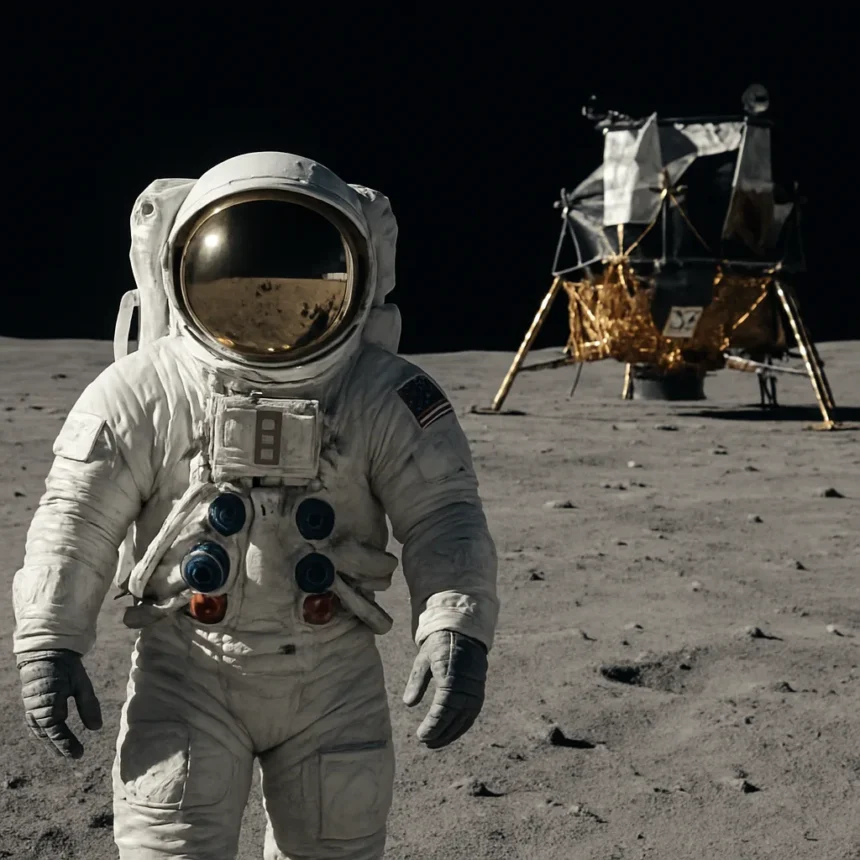
An Unreal Engine 5 lunar recreation built with real NASA data has sparked confusion online, with viewers mistaking the photorealistic 3D scene for an actual photograph from the Artemis II Moon mission. The distinction matters: as AI-generated and edited fake Moon images circulate widely, understanding what is real NASA imagery versus skilled digital art has become essential for anyone following space exploration news.
Key Takeaways
- Created by Simon Blakeney, Technical Account Manager at Epic Games, using Unreal Engine 5’s Lumen rendering system.
- Built from Cesium Moon Terrain data, combining multiple NASA Lunar Reconnaissance Orbiter datasets with highest resolution at polar regions.
- Fake lunar images—both AI-generated and edited—have been widely misattributed to Artemis II, prompting NASA fact-checks.
- Official Artemis II photos appear only on NASA.gov; no viral Moon images match NASA’s actual mission photography.
- Unreal Engine 5 and Cesium tools are free for non-commercial use, enabling high-fidelity 3D reconstructions without licensing barriers.
How Unreal Engine 5 recreates the lunar surface
The Unreal Engine 5 lunar recreation demonstrates how modern game engines can transform raw scientific data into visually convincing environments. Simon Blakeney built the scene using Lumen, Epic Games’ real-time global illumination system, paired with deferred rendering and aggressive optimization settings to stream detailed lunar terrain without performance collapse. The technical approach—Maximum Screen Space Error of 0.1, culled geometry limits, and increased tile-loading parameters—allows the engine to render millions of polygons from NASA’s Lunar Reconnaissance Orbiter datasets in real time.
The data foundation comes from Cesium Moon Terrain, a tileset that consolidates multiple NASA LRO surveys into a single coherent landscape. Rather than inventing lunar features, Blakeney’s scene reproduces actual topography, crater geometry, and surface characteristics captured by NASA instruments. This fidelity is precisely what makes the artwork so deceptively photorealistic—it is built on genuine science, not artistic imagination.
Why fake Moon images spread during Artemis II
The Artemis II Moon flyby in April 2026 triggered a wave of misinformation. Viral social media posts claimed to show official mission photography, but NASA confirmed that all authentic Artemis II images appear exclusively on NASA.gov and official mission channels. Fake examples include AI-generated images bearing Google’s SynthID watermark and heavily processed Earth-based photographs with saturation enhancement, misattributed to the lunar mission.


Photographer Ibatullin, whose Moon images were misappropriated online, publicly stated that his work had been processed from 50 gigabytes of raw data and enhanced with saturation adjustments to reveal mineral composition—techniques incompatible with actual spacecraft photography. The distinction is critical: real NASA mission images undergo strict quality control and archival standards. Edited or AI-generated alternatives lack this institutional backing and often contain telltale artifacts upon inspection.
Unreal Engine 5 lunar recreation versus AI-generated fakes
The Blakeney recreation differs fundamentally from AI-generated Moon imagery. Where AI tools like Google’s can hallucinate crater details or produce geometrically impossible landscapes, the Unreal Engine 5 scene is constrained by actual NASA topographic data. This does not make it a photograph—it is unambiguously 3D artwork—but it grounds the visualization in verifiable science rather than algorithmic invention.



AI-generated fakes, by contrast, prioritize visual plausibility over accuracy. They may include SynthID watermarks (Google’s AI signature) and exhibit subtle inconsistencies in lighting, shadow direction, or crater morphology that trained eyes detect. The Artemis II misinformation campaign exploited the fact that most viewers cannot instantly distinguish between a photorealistic render, an AI image, and an actual spacecraft photograph. Official NASA imagery, by comparison, carries metadata, press release attribution, and publication on secure NASA servers—verifiable markers absent from viral social media posts.
How to identify real Artemis II photography
Distinguishing authentic NASA mission images from fakes requires checking three sources. First, visit NASA.gov directly—all official Artemis II photography is published through NASA’s press releases and mission archive, never through unverified social media accounts. Second, look for metadata and attribution. Real NASA images include mission context, photographer credits, and publication dates. Third, be skeptical of images that appear in isolation on social platforms without institutional links; this is the primary distribution channel for AI-generated and edited fakes.
The Unreal Engine 5 lunar recreation is openly presented as digital art, not photography. Its creator and technical details are public. In contrast, viral fake Moon images often lack clear attribution or falsely claim to be official NASA content. If a Moon image appears on your feed without NASA.gov attribution or institutional context, assume it is either artistic interpretation or misinformation until proven otherwise.
Why this matters for space exploration communication
As 3D rendering and generative AI become more convincing, the ability to verify space mission imagery grows more important. NASA’s commitment to publishing all official Artemis II photography on NASA.gov is a deliberate safeguard against exactly this kind of confusion. Public trust in space exploration depends on clear separation between official documentation and artistic or speculative content.



The Unreal Engine 5 lunar recreation, despite its photorealism, serves an educational purpose when properly attributed. It shows what NASA’s Lunar Reconnaissance Orbiter data reveals about the Moon’s true surface. Misattributed fakes, by contrast, undermine public understanding and fuel conspiracy theories. The distinction is not semantic—it is foundational to informed engagement with space science.
Can I use Unreal Engine 5 to create similar lunar scenes?
Yes. Unreal Engine 5 is free for non-commercial use, as is Cesium Moon Terrain and the underlying NASA LRO data. If you have 3D modeling and rendering experience, you can download these tools and build your own lunar reconstructions. The technical barrier is skill and patience, not licensing cost.
Where can I find official Artemis II Moon photos?
All authenticated Artemis II mission photographs are published exclusively on NASA.gov, including the official Artemis II mission site and NASA press releases. Any Moon image circulating on social media without direct NASA.gov attribution should be treated as unverified until you confirm it through official channels.
Is the Unreal Engine 5 lunar recreation scientifically accurate?
Yes, within the constraints of its data source. The scene reproduces actual lunar topography from NASA’s Lunar Reconnaissance Orbiter, so crater positions, surface elevation, and overall landscape geometry are scientifically grounded. However, it is still a digital render, not a photograph—lighting, color grading, and camera framing are artistic choices, not captured reality.
The Unreal Engine 5 lunar recreation is a masterclass in how scientific data and modern rendering technology can create visually convincing digital environments. It is also a cautionary tale: photorealism alone proves nothing. In an era of sophisticated AI and 3D tools, verifying the source matters more than trusting your eyes. NASA’s commitment to publishing all official Artemis II imagery on NASA.gov remains the gold standard for distinguishing real mission photography from everything else circulating online.
This article was written with AI assistance and editorially reviewed.
Source: Creativebloq