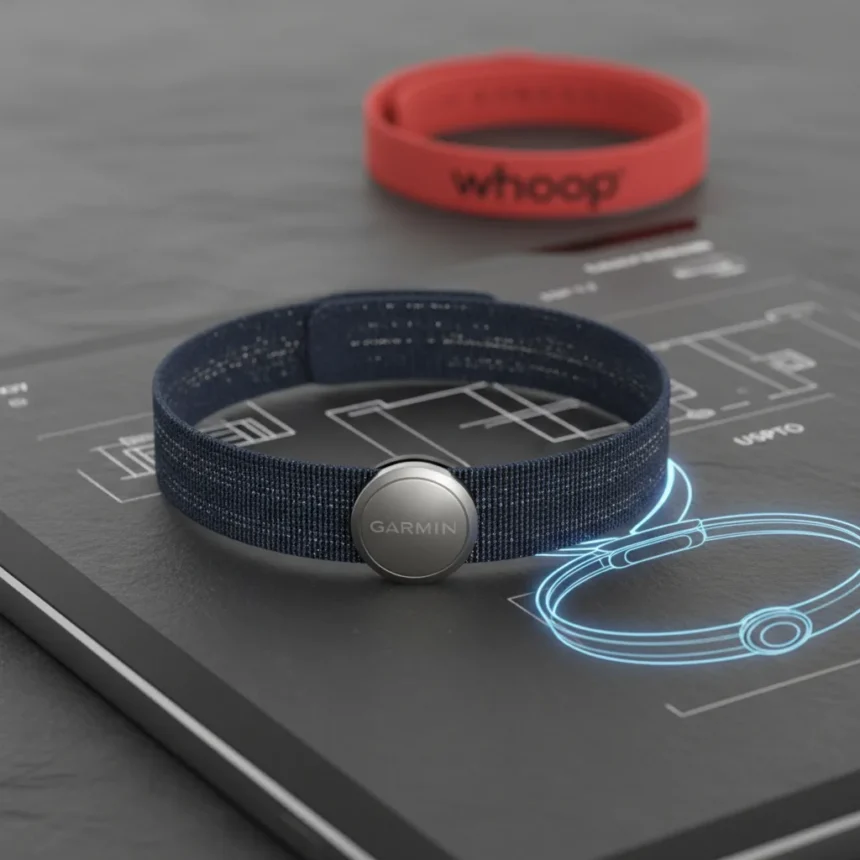
Garmin CIRQA is a screenless recovery-focused smart band positioned as a direct competitor to Whoop, confirmed through a February 2026 USPTO trademark filing and leaked product pages across Garmin’s regional websites. The device represents Garmin’s entry into the booming screenless fitness tracker market—a category Whoop has dominated for years but now faces mounting legal and competitive pressure.
Key Takeaways
- Garmin CIRQA confirmed via February 25, 2026 intent-to-use trademark filing and January 2026 website leaks
- Screenless, app-based recovery band with optical sensors for monitoring stress, alertness, and performance metrics
- Two sizes (S/M, L/XL) in Black and French Grey, with 4–5 month shipping window from January indicating mid-2026 launch
- FCC filing (IPH-04378) shows WiFi, BLE, and ANT+ connectivity; no GPS required
- Whoop’s recent legal wins against similar devices could force Garmin to differentiate design to avoid patent disputes
What the Garmin CIRQA Smart Band Actually Is
The Garmin CIRQA smart band is a wrist-worn recovery tracker designed to monitor bio-signals and physiological data without a display, relying instead on a companion app for insights. Garmin did not call it a simple fitness tracker. The trademark filing describes a device meant to monitor bio-signals, physiological data, and—critically—metrics related to stress recovery, alertness, and performance. This positions CIRQA squarely in Whoop’s territory: a band that prioritizes recovery science over daily step counts or heart rate notifications.
The leaked product pages from Garmin’s US, Canadian, and Latin American websites listed the CIRQA Smart Band in two sizes (S/M and L/XL) with color options in Black and French Grey. The absence of a screen is intentional—Garmin is betting that serious athletes and recovery-obsessed users prefer a minimalist form factor paired with smartphone insights, not a wrist display. The device maintains skin contact for optical sensor readings, a standard approach for recovery trackers that measure heart rate variability and other physiological markers.
Garmin CIRQA vs. Whoop: Why This Matters Now
Whoop has faced mounting legal pressure in recent months. In fall 2025, Whoop won a preliminary injunction against Lexqi, a Chinese manufacturer of a Whoop-like band, in US District Court (Massachusetts), halting US sales of the competing device. Whoop also pursued similar claims against Polar Loop. These legal victories signal that Whoop’s design and patent portfolio are formidable obstacles for any newcomer. For Garmin, this means CIRQA must differentiate itself meaningfully—through sensor accuracy, app intelligence, battery life, or ecosystem integration—to avoid the same legal fate.


Whoop’s dominance rests on a subscription model and a loyal user base among endurance athletes and fitness enthusiasts. Garmin has an advantage here: it already owns a massive ecosystem of sports watches, running apps, and training platforms. CIRQA could integrate with Garmin Connect, Garmin’s fitness platform, giving users a unified view of recovery data alongside their running, cycling, and swimming metrics. Whoop remains a standalone ecosystem, which is both a strength (focused experience) and a weakness (limited integration with other fitness devices).
FCC and Trademark Filings: What They Reveal
The February 25, 2026 USPTO intent-to-use trademark filing is not just name protection—it signals active preparation for market launch. Intent-to-use filings indicate Garmin plans to bring the product to commerce within a defined timeframe, not merely reserve the name. This filing validates the January 2026 website leak as a deliberate roadmap, not an accident.


The FCC filing (IPH-04378) provides technical specifics: CIRQA uses WiFi, Bluetooth Low Energy (BLE), and ANT+ connectivity but no GPS. This is typical for a screenless recovery band—the device streams data to a smartphone or syncs with a base station, eliminating the need for onboard positioning. The FCC filing shows core components were ready nine months prior to the filing submission, and some documentation is withheld until July 19, 2026. Critically, CIRQA has not yet received FCC approval, which means US sales and shipping are currently blocked. International markets may see earlier availability, though Garmin has not officially confirmed regional rollout plans.
When Will Garmin CIRQA Launch?
The January 2026 product page leak listed a 4–5 month shipping window from the leak date, pointing to a May or June 2026 availability. However, this timeline is unofficial and based on leaked information, not Garmin’s formal announcement. The FCC filing status—still pending approval—may delay US availability further. Garmin typically waits for regulatory clearance before shipping to the United States, so a summer 2026 launch is plausible but not guaranteed.
The trademark filing’s intent-to-use status suggests Garmin is confident enough in CIRQA’s readiness to commit to a formal market entry, but the company has not yet announced official pricing, subscription costs, or final availability dates. Until Garmin makes a public statement, all timelines remain speculative.
Does Garmin CIRQA Pose a Real Threat to Whoop?
Yes, but with caveats. Garmin brings two critical advantages: brand recognition among endurance athletes and an existing ecosystem that CIRQA can plug into. Garmin’s sports watches already track recovery metrics like Training Status and Body Battery. CIRQA could deepen that integration, offering users a dedicated recovery band that syncs smoothly with their Garmin watch and app.

Whoop’s strength lies in its subscription model, which generates recurring revenue and funds continuous algorithm refinement. Garmin will need to decide whether CIRQA operates on a similar subscription basis or as a one-time purchase with optional premium features. That choice will shape how seriously athletes view the device. Whoop’s legal wins also raise the bar: Garmin must ensure CIRQA’s design and sensor approach do not infringe on Whoop’s patents, or face costly litigation.
FAQ
What is the Garmin CIRQA smart band designed to track?
CIRQA monitors bio-signals and physiological data focused on stress recovery, alertness, and performance metrics. It is a recovery-first device, not a general fitness tracker, meaning its primary value is helping users understand how well they are recovering from training and stress.
Will Garmin CIRQA work with other fitness apps?
The research brief does not specify third-party app compatibility. Garmin has not publicly disclosed whether CIRQA data will integrate with platforms like Strava, TrainingPeaks, or other fitness ecosystems. Integration with Garmin Connect is likely, but other platforms remain unconfirmed.
How much will the Garmin CIRQA smart band cost?
Garmin has not announced pricing or subscription details for CIRQA. The research brief contains no verified price information, so any cost estimate would be speculation at this stage.
Garmin CIRQA represents a calculated entry into the screenless recovery tracker market at a moment when Whoop’s legal dominance is being tested. If Garmin can differentiate CIRQA through ecosystem integration and sensor accuracy while navigating patent risks, it could capture a meaningful share of athletes seeking recovery insights. For now, the trademark filing and leaked product pages confirm the device is real and coming—the question is whether Garmin’s execution will match Whoop’s years of focus on recovery science.
Edited by the All Things Geek team.
Source: TechRadar