




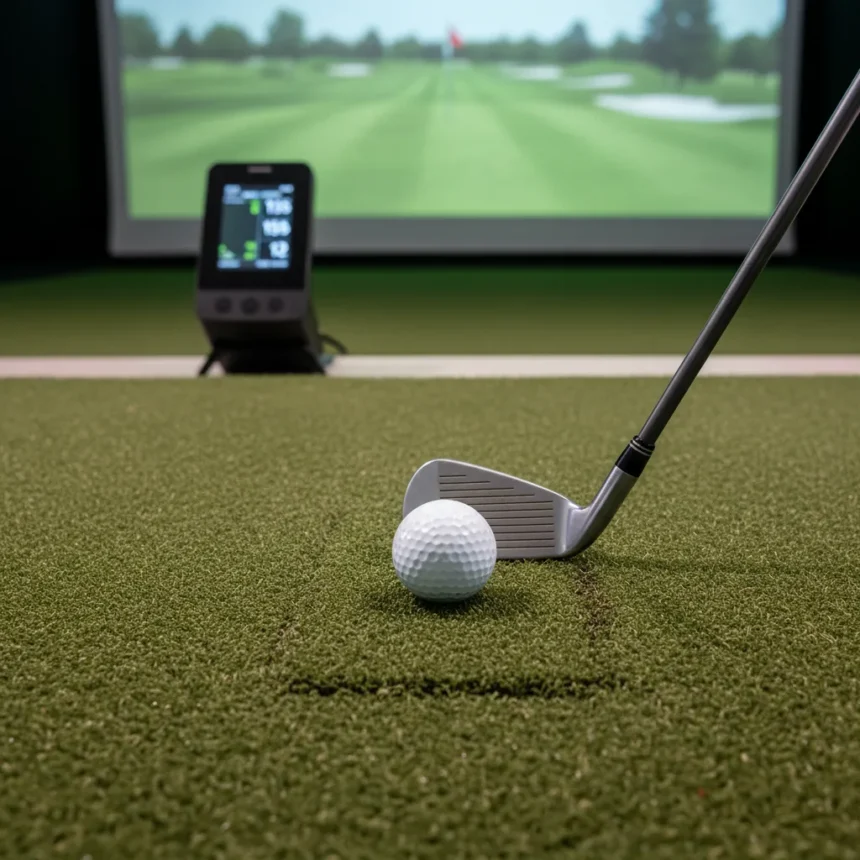
A golf simulator hitting mat is far more than a surface to stand on—it’s the foundation that determines whether your entire home golf setup actually improves your game. While golfers often obsess over launch monitors and screen technology, the mat itself silently controls swing mechanics, joint comfort, and simulator accuracy. Quality mats range from around $200 for budget options to $500–$1,000 for premium models, yet many players discover too late that skimping here sabotages everything else.
Key Takeaways
- Hitting mat quality directly affects swing mechanics and simulator accuracy more than many golfers realize
- Premium golf simulator hitting mats cost $500–$1,000, with budget options starting around $200
- Mat foundation impacts joint comfort and long-term playability in home golf setups
- A quality hitting mat is foundational to overall simulator performance and game improvement
- Choosing the right mat should be a priority before investing in expensive launch monitors
Why Golf Simulator Hitting Mat Quality Shapes Your Swing
The golf simulator hitting mat is the interface between your body and your entire setup. A poor mat forces your joints to absorb impact that a quality surface should cushion, leading to poor swing mechanics and fatigue. This is not a minor ergonomic issue—it’s the difference between a setup that trains good habits and one that ingrams bad ones. When your feet lack proper traction or your knees absorb shock on every swing, your body compensates with unnatural movements that carry over to the course.
Premium mats are engineered to provide consistent strike feedback while protecting your joints. The material composition affects how the mat responds to impact, which in turn influences how your simulator reads the shot. A mat that compresses unevenly or shifts underfoot creates inconsistent sensor data, making it impossible to trust your simulator’s feedback. Conversely, a well-designed mat maintains its integrity through thousands of strikes, ensuring that your swing data remains reliable.
Golf Simulator Hitting Mat Performance vs. Budget Alternatives
Budget hitting mats, often priced under $250, use thinner materials and less sophisticated cushioning systems. While they provide basic impact absorption, they lack the durability and consistency that serious players need. After a few months of regular use, budget mats develop soft spots, uneven wear patterns, and reduced feedback accuracy. This degradation means your simulator becomes less reliable the more you use it—the opposite of what you want from an investment.



Premium mats in the $500–$1,000 range feature multi-layer construction, reinforced strike zones, and materials designed to resist compression over time. These mats maintain consistent ball contact feedback and joint protection even after thousands of swings. The price difference reflects engineering: better materials, thicker cushioning, and construction methods that extend lifespan significantly. For golfers treating their simulator as a serious training tool, the premium mat becomes the most cost-effective upgrade because it makes every other component—the launch monitor, the screen, the software—actually work as intended.
How Hitting Mat Choice Affects Simulator Accuracy
A golf simulator hitting mat influences sensor accuracy more directly than most players realize. Launch monitors and simulators read club and ball data based partly on how the mat responds to impact. An unstable or inconsistent mat creates noise in the data, forcing your simulator to guess at shot parameters. A quality mat provides a stable, predictable strike surface that gives your sensors clean data to work with. This is why upgrading the mat often produces more noticeable improvements in simulator reliability than upgrading to a fancier launch monitor.



The mat also affects how realistic your swing feels, which matters psychologically and mechanically. When you practice on an unstable surface, your body tenses up and makes micro-adjustments to stay balanced. On a quality mat, your swing feels natural, your weight transfer feels smooth, and your feedback loop stays intact. Over time, this difference compounds—practice on a poor mat teaches bad habits, while practice on a quality mat builds confidence and consistency that transfer to the course.
Choosing the Right Golf Simulator Hitting Mat for Your Setup
The best golf simulator hitting mat for your home depends on your budget, play frequency, and space constraints. If you play more than three times per week, a premium mat ($500–$1,000) is not optional—it’s foundational. If you play casually once or twice weekly, a mid-range mat ($300–$500) offers a balance between durability and cost. Budget mats work only if you treat your simulator as an occasional novelty rather than a training tool.
Consider mat dimensions carefully. Larger mats provide more forgiveness for off-center strikes and allow for a more natural stance, but they require more floor space. Smaller mats save space but force tighter footwork. Premium mats often come with edge reinforcement to prevent curling and wear, a feature absent in budget models. Warranty terms also vary—quality mats often include multi-year coverage, reflecting manufacturer confidence in durability.
Is a premium golf simulator hitting mat worth the investment?
Yes, if you plan to use your simulator regularly. A quality mat prevents joint strain, maintains consistent sensor feedback, and lasts years longer than budget alternatives. The $200–$300 premium over a budget mat pays for itself through reduced wear on your body and more reliable training data. Treat it as insurance for your entire simulator investment.



How long does a quality golf simulator hitting mat last?
Premium mats typically last 3–5 years with regular use (3+ times weekly) before showing significant wear. Budget mats often degrade within 12–18 months under the same usage. Longevity depends on strike consistency, maintenance, and mat quality—well-made mats with proper care can last even longer.
Can a cheap hitting mat ruin my simulator’s accuracy?
Not directly, but it degrades accuracy over time. A poor mat creates inconsistent strike feedback, making your simulator less reliable as the mat wears. Additionally, an unstable mat teaches poor swing mechanics that carry over to real golf, defeating the purpose of home simulator training.
Your golf simulator hitting mat deserves the same investment attention as your launch monitor or projector. It’s the forgotten hero of home golf setups—easy to overlook, but impossible to ignore once you understand its impact. A quality mat is not a luxury upgrade; it’s the foundation that makes every other component work as designed.
Edited by the All Things Geek team.
Source: Tom's Guide