






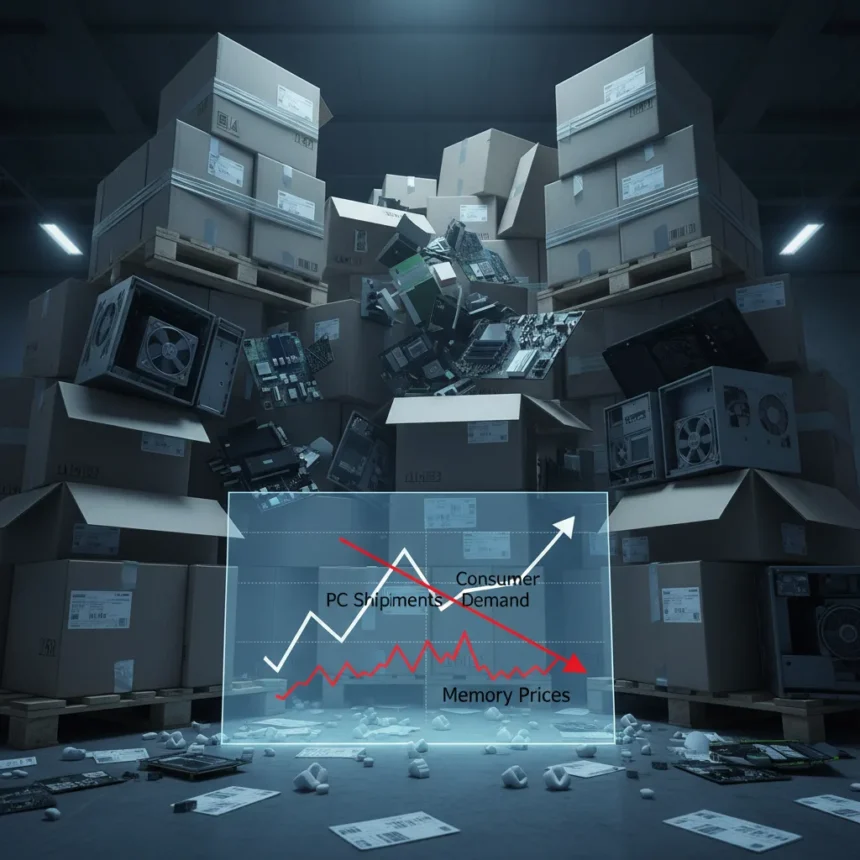
PC shipments rising while demand falls is not good news for consumers—it is a warning sign. Vendors are rushing to ship machines now before memory costs explode and the entire market contracts by double digits, according to Gartner analysis. If you are thinking about buying a PC, the window is closing fast.
Key Takeaways
- PC shipments rose 4% in Q1 2026 as vendors raced to beat memory price increases.
- Global PC shipments will fall 10.4% in 2026 compared to 2025 levels, per Gartner.
- Memory now accounts for 35% of PC bill of materials, up from 15-18% last quarter, per HP earnings.
- Sub-$500 entry-level PCs are predicted to vanish by 2028 as prices rise across all segments.
- IDC expects dramatic PC volume declines starting Q2 2026, with no market recovery until 2028.
The Stockpiling Effect Reshaping PC Shipments Rising Demand Falling
The disconnect between rising shipments and falling demand tells a clear story: PC manufacturers are flooding the market before component costs make every machine more expensive. PC shipments rose 4% in the first quarter of 2026, but this surge masks deeper trouble. Companies are not shipping more because buyers want them—they are shipping more because Q2 onwards will be brutal. Ranjit Atwal, senior director analyst at Gartner, put it plainly: the forecast puts 2026 on track for the steepest device shipment contraction in over a decade.
This pull-forward effect is real and measurable. HP’s Q1 2026 earnings call revealed that memory now accounts for 35% of a PC’s bill of materials, up from just 15-18% in the prior quarter. That staggering jump explains the urgency. Vendors know memory prices are climbing and will keep climbing. Ship now or face razor-thin margins later. The result is a false sense of market health masking a structural collapse about to hit.
Memory Inflation Is Ending the Cheap PC Era
The era of sub-$500 entry-level PCs is over. Gartner predicts the entire segment will disappear by 2028 as memory costs squeeze margins so hard that vendors cannot afford to build low-end machines. This is not hyperbole—it is a direct consequence of memory inflation eroding the economics of budget computing. Today’s cheap PC is tomorrow’s unprofitable product.


PC revenues are expected to grow 1.6% in 2026, but not because the market is thriving. The growth comes entirely from higher average selling prices. Fewer units, higher prices. Vendors will ship fewer machines but charge more per machine to protect profit margins. Gartner’s advice to manufacturers is blunt: accept unit volume declines rather than erode margins chasing price-sensitive buyers, and treat the first half of 2026 as a critical window for optimizing pricing before component inflation compresses profitability further in Q2 and beyond.
When Will Prices Come Back Down?
Do not expect relief in 2027. Gartner and IDC forecasts both point to 2028 as the earliest year the PC market stabilizes and recovery becomes possible. That means two full years of elevated prices, shrinking selection at the budget end, and a market focused on premium and mid-range machines. Smartphone shipments face similar headwinds—Gartner projects a decline of 8.4% in 2026 versus 2025—suggesting this is not a PC-only problem but a device-wide memory shortage driving inflation across consumer electronics.



The practical implication is stark: if you need a new PC, the next six months represent your best opportunity to buy before prices climb and cheap options disappear entirely. After Q2 2026, the market will contract sharply, selection will narrow, and you will be paying more for less.
Is now really the best time to buy a PC?
The data suggests yes, but with caveats. You will find more inventory and better pricing in H1 2026 than you will in 2027 or 2028. However, do not expect massive discounts—vendors are already raising prices to protect margins. Buy if you need a PC; do not expect a bargain.
Why are PC shipments rising if demand is falling?
Vendors are front-loading shipments to beat memory price increases. This is a classic pull-forward effect where companies ship aggressively now to avoid higher costs later, creating an artificial spike in shipments that masks underlying demand weakness.
Will budget PCs disappear completely?
Sub-$500 entry-level PCs are predicted to vanish by 2028 as memory inflation makes them unprofitable to manufacture. The budget segment will likely shift upward, with $600-800 becoming the new entry point, pricing out price-sensitive buyers entirely.



The PC market is experiencing a painful reset. Shipments are rising now, but demand is falling and prices are climbing. The window to buy before the real contraction hits is narrow—measured in months, not quarters. After Q1 2026 closes, the market will shrink, prices will rise, and cheap options will disappear. If you have been putting off a PC upgrade, the data makes the case for acting now rather than waiting for a recovery that will not arrive until 2028.
This article was written with AI assistance and editorially reviewed.
Source: TechRadar