





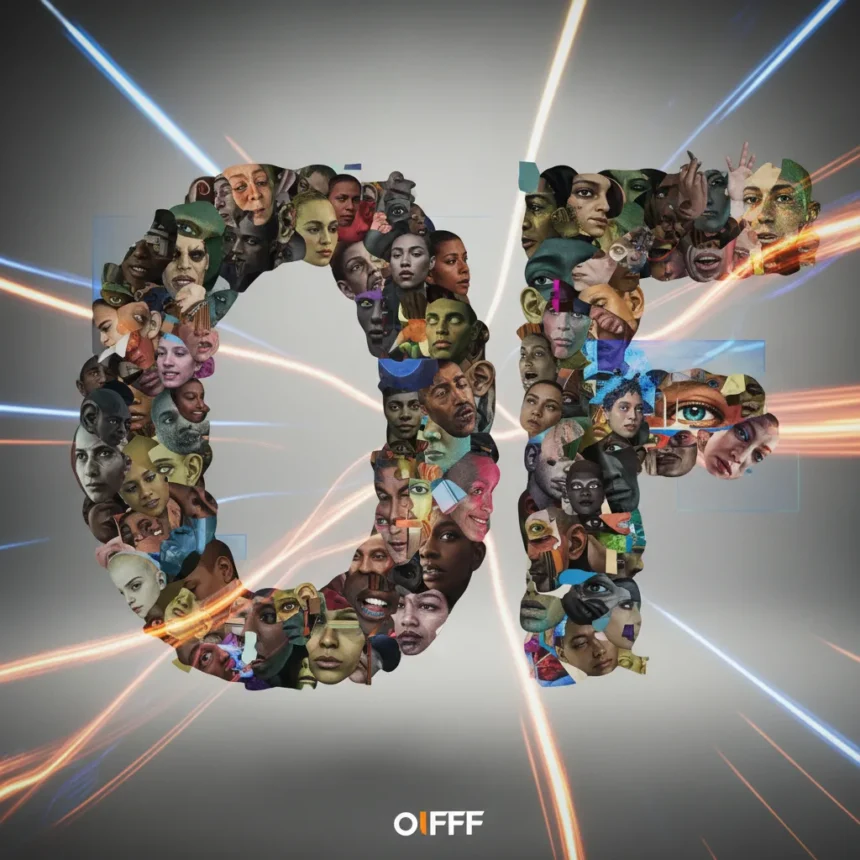
The OFFF 2026 visual identity harvests real human faces, bodies, and movements to create an abstract, magnetic aesthetic that embodies collective creativity. For its 26th edition, the International Festival of Creativity, Art and Digital Design in Barcelona ditched physics-based abstraction in favor of something more human: actual people scanned, photographed, and algorithmically distorted into layered, animated patterns that feel alive and collaborative.
Key Takeaways
- OFFF 2026 visual identity uses harvested real human faces and bodies as its core creative material
- Campaign titled “What We Make It,” created by London-based Uncommon Creative Studio under creative direction by co-founder Nils Leonard
- Main Titles designed by PJ Richardson, screened outdoors on Disseny Hub Barcelona façade
- Festival positions creativity as obsessive curation of references from a living, collaborative community
- Marks departure from 2025’s physics-based “Centre OFFF Gravity” branding by COLLINS
The “Magic Trick” Behind OFFF 2026’s Visual Identity
OFFF 2026’s visual identity operates on a deceptively simple concept: real human forms become the raw material for abstraction. Uncommon Creative Studio describes the approach as a “magic trick” of harvesting actual people—their faces, bodies, poses, and movements—then algorithmically distorting and layering them into magnetic-like patterns that suggest human collaboration without depicting individuals. The result feels both personal and universal, a visual language built from the crowd rather than imposed upon it.
This technique positions creativity itself as an act of collective obsession. The concept portrays creativity as shaped by obsessive collection and curation of references, ideas, and perspectives from a living, collaborative community. Rather than abstract principles, the campaign anchors itself in human presence. Nils Leonard, co-founder of Uncommon Creative Studio, framed the responsibility clearly: “It’s a really nice responsibility to work for them [OFFF attendees as world-shapers]”. That framing—treating festival-goers as world-builders rather than passive audiences—drives the entire visual system.
The Main Titles, designed by PJ Richardson, were screened for the first time outdoors on the Disseny Hub Barcelona façade, transforming the building into a living advertisement for the festival’s human-centric philosophy. The scale and public placement underscore the campaign’s confidence: this is not a subtle identity hidden in print materials, but a declaration visible across the city.


How OFFF 2026 Breaks from Prior Branding Approaches
The previous year’s OFFF 2025 branding, titled “Centre OFFF Gravity,” took a fundamentally different approach. Created by COLLINS (New York/San Francisco), it relied on physics-based abstraction, using magnetism as its conceptual framework. The identity employed two forces—Attraction (a slow-to-intense pull) and Projection (an outward push of ideas)—to create rhythms of expansion and impact. It was elegant, intellectually rigorous, and entirely abstract.
OFFF 2026‘s shift to harvested human forms represents a rejection of that abstraction in favor of embodied creativity. Where COLLINS positioned the festival as a force field governed by invisible physics, Uncommon Creative Studio positions it as a collective body. This is not merely a stylistic preference—it reflects a fundamentally different philosophy about where creativity originates. One says it emerges from universal principles; the other says it emerges from people.



The contrast matters because it shapes how audiences understand their role. COLLINS’ approach positioned attendees as particles within a gravitational field. Uncommon’s approach positions them as the literal source material. That distinction—between passive participants and active creators—runs through every visual choice in the OFFF 2026 identity.
NXT and the Festival’s Emerging Talent Focus
OFFF 2026 extends its community-first philosophy through the NXT emerging talent showcase, now in its third edition. Held on April 16 at The Twist (4th floor, Disseny Hub Barcelona), NXT features student pitches from design schools including Brother Barcelona, IED Barcelona, LCI Barcelona, and MMi. The showcase is free and open to the public, reinforcing the festival’s commitment to accessibility and emerging voices.
This programming choice aligns perfectly with the visual identity’s emphasis on collective creation. By centering student work and emerging talent alongside established creative professionals, OFFF positions itself not as a destination for finished work, but as a space where the creative community actively forms and reforms. The harvested human faces in the visual identity gain additional resonance in this context—they represent the actual people building tomorrow’s creative landscape.
Why This Approach Matters Now
Design festivals face a credibility challenge in 2026. Audiences are skeptical of top-down curation and tired of aesthetics that feel divorced from lived experience. By anchoring its identity in actual human forms and positioning creativity as collective obsession, OFFF 2026 sidesteps that skepticism. The campaign acknowledges that creativity does not emerge from universal principles or individual genius—it emerges from communities of practice, from people obsessively collecting, curating, and building on each other’s ideas.


The harvested human faces also carry a subtle technical message. In an era of AI-generated imagery and synthetic media, the decision to use real human forms—scanned, photographed, captured from actual people—stakes a claim for human authenticity. The distortion and abstraction that follows does not erase that origin; it celebrates it. The algorithm does not create the forms; it amplifies and recombines them.
Is OFFF 2026’s visual identity effective as a branding system?
The visual identity succeeds because it functions on multiple levels. At a distance, the harvested human forms read as abstract, magnetic patterns—visually arresting and memorable. Up close, they reveal their human origin, creating an emotional connection that pure abstraction cannot achieve. As a branding system, it is flexible enough to work across contexts (outdoor installations, digital materials, printed collateral) while maintaining a distinctive visual signature.
How does OFFF 2026’s approach compare to other festival identities?
Most major design festivals rely on either historical continuity (maintaining recognizable visual codes across years) or radical reinvention (complete visual overhauls). OFFF’s approach splits the difference: it maintains the festival’s commitment to latest creative expression while grounding that expression in human presence rather than abstract principle. This balances innovation with accessibility, making the identity feel fresh without becoming alienating.
What does “harvested from actual people” mean technically?
The brief describes the technique as harvesting real faces, bodies, poses, and movements through scanning, photography, or 3D capture, then algorithmically distorting, layering, and animating them into abstract patterns. The exact technical implementation—which scanning technology, which algorithm, which animation software—remains undisclosed, preserving some mystery around the “magic trick.” What matters is the conceptual clarity: real humans are the starting point, not the endpoint.
OFFF 2026’s visual identity represents a clear editorial choice about what creativity means and where it lives. By harvesting real human forms and treating them as the raw material of design, the festival positions itself as fundamentally human-centered. In a creative landscape increasingly dominated by synthetic imagery and algorithmic generation, that choice carries weight. The campaign says: creativity emerges from actual people, their obsessions, their curation, their collaboration. That message, delivered through visuals built from the crowd itself, is the real magic trick.
Edited by the All Things Geek team.
Source: Creativebloq




