





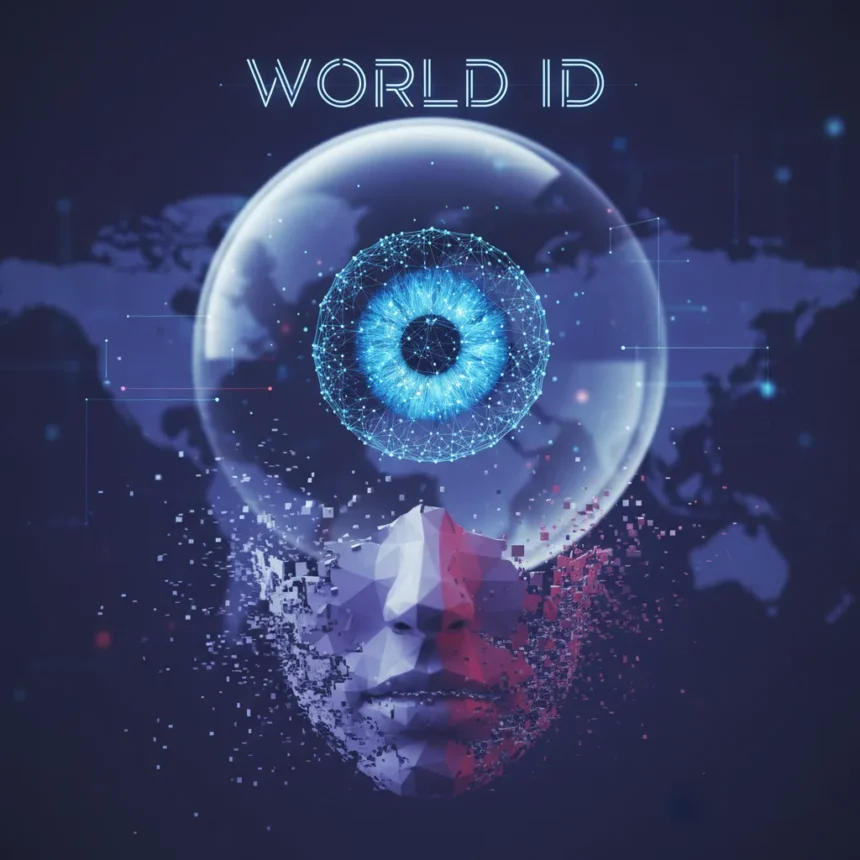
World ID iris scanning represents a bet that facial recognition will soon become obsolete as AI advances, and that iris-based biometrics offer a more tamper-proof path to verifying real humans in an era of deepfakes. Sam Altman-backed World, the firm behind the technology, warns that traditional face verification is fundamentally broken against sophisticated AI video generation, positioning its Orb device and iris-scanning protocol as infrastructure for the AI age.
Key Takeaways
- World ID uses iris scanning via the Orb device to create unique human verification profiles resistant to AI deepfakes.
- Facial recognition systems will likely fail as AI video generation becomes indistinguishable from real footage, according to World.
- World’s Deep Face solution verifies users in video calls on WhatsApp, Zoom, Microsoft Teams, and Apple FaceTime by matching iris scans.
- Co-founder Alex Blania states World aims to partner with governments on online identity protocols without replacing national ID documents.
- The system requires prior World ID registration; verification works through a camera interface on user devices.
Why Facial Recognition is Headed for Collapse
World argues that facial recognition as a security mechanism is doomed. As AI tools like ChatGPT and video synthesis platforms grow more powerful, distinguishing real faces from AI-generated deepfakes becomes nearly impossible. A representative from World stated plainly: “The face thing is probably going to break”. This is not speculative—the threat is already real. Fraudsters use AI video calls to impersonate authority figures, tricking employees into wire transfers by posing as executives. A single convincing deepfake video call can cost a company millions.
Traditional identity infrastructure, Sam Altman argues, was built for a world where AI did not generate human-like content at scale. That world no longer exists. Facial recognition relies on detecting subtle inconsistencies in skin texture, eye movement, and lighting—patterns that advanced AI now replicates convincingly. Iris patterns, by contrast, remain far harder to forge because they require physical proximity to scan and are unique to each person with near-mathematical certainty.
How World ID Iris Scanning Works
World ID iris scanning begins with the Orb, a spherical device that captures high-resolution iris images and creates a cryptographic template of each user’s unique eye pattern. This template becomes the foundation of a “proof of human” credential. Users register once, then use World ID to verify themselves in supported applications without repeatedly scanning their eyes.



The Deep Face solution then layers verification onto existing video calls. When a user initiates a video conversation on WhatsApp, Zoom, Microsoft Teams, or Apple FaceTime, the system can match the video feed against the registered iris scan to confirm the person on screen is genuine. This verification happens on the user’s device—World does not require cooperation from tech platforms themselves. Instead, the camera interface works independently, offering a supplementary verification layer that apps can choose to integrate.
The catch: Deep Face only works for users who have already registered with World ID. A fraudster using a deepfake video cannot pass iris verification because they have no registered iris template. This creates a network effect problem—the system’s security depends on widespread adoption, which remains uncertain.



Government Partnerships and the Path Forward
Co-founder Alex Blania has stated that World’s ambition extends beyond private verification. The firm aims to work with governments on standardized online identity protocols using partial identity data—enough to verify humanity without replacing national documents. This positions World ID as complementary infrastructure rather than a replacement for passport systems or government-issued IDs.
The appeal to governments is clear: a portable, tamper-resistant way to verify citizens online without managing centralized biometric databases. Yet no confirmed government partnerships have been announced. Blania’s framing as cooperation-seeking rather than disruptive suggests World understands the political sensitivity around identity infrastructure, but the gap between ambition and implementation remains wide.
For private users, the value proposition is simpler: protection against deepfake impersonation in high-stakes video calls. For enterprises, it is a tool to prevent social engineering fraud. Neither case requires government buy-in, which may explain why World has focused first on consumer and business adoption rather than waiting for regulatory frameworks.
The Adoption Challenge
World ID iris scanning solves a real problem, but adoption is the true test. Users must visit an Orb location to register, creating friction that facial recognition—which works with any camera—does not have. The system only protects users who have registered, making it less useful in a world where most people have not. And unlike facial recognition, which works passively, iris verification requires explicit user action or platform integration.


Competitors in the identity space—traditional facial recognition, liveness detection, and hardware security keys—have network effects of their own. Facial recognition is already ubiquitous. Changing that requires not just a better technology but a reason compelling enough for millions of people to visit an Orb and for platforms to integrate a new verification layer. World’s argument that faces will “break” is convincing in principle but does not automatically translate to market adoption.
Is World ID the only solution to deepfakes?
No. Other approaches include behavioral biometrics (detecting unusual patterns in typing or mouse movement), blockchain-based identity attestation, and hardware security keys. World ID iris scanning is one option optimized for video call verification. Its advantage is specificity—iris patterns are mathematically unique and difficult to forge. Its disadvantage is friction: users must register in person at an Orb device, and platforms must integrate the verification layer.
Can deepfakes fool World ID iris scanning?
Theoretically, a sophisticated deepfake could include a synthetic iris pattern, but replicating the exact iris texture, blood vessel pattern, and three-dimensional structure in real time during a video call is exponentially harder than generating a convincing face. The iris is a smaller, more complex target for AI to synthesize accurately. That said, World ID’s security ultimately depends on the Orb’s ability to capture genuine iris data during registration—if that process can be compromised, the entire system fails.
When will facial recognition actually break?
World does not specify a timeline, but the warning reflects genuine concern in the security community. AI video synthesis is advancing rapidly. In the next 2-5 years, deepfakes may become common enough that facial recognition alone is insufficient for high-stakes verification. That urgency is why World and others are pushing alternative biometrics now, before the problem becomes acute and reactive solutions scramble to catch up.
World ID iris scanning represents a deliberate bet that the future of human verification is not in the face but in the eye. Whether that bet pays off depends less on the technology itself—which appears sound—and more on whether the world adopts it before facial recognition truly breaks. For now, World is racing against AI to build the infrastructure that might prevent deepfake fraud at scale. The outcome remains uncertain, but the problem it addresses is unmistakably real.
This article was written with AI assistance and editorially reviewed.
Source: TechRadar