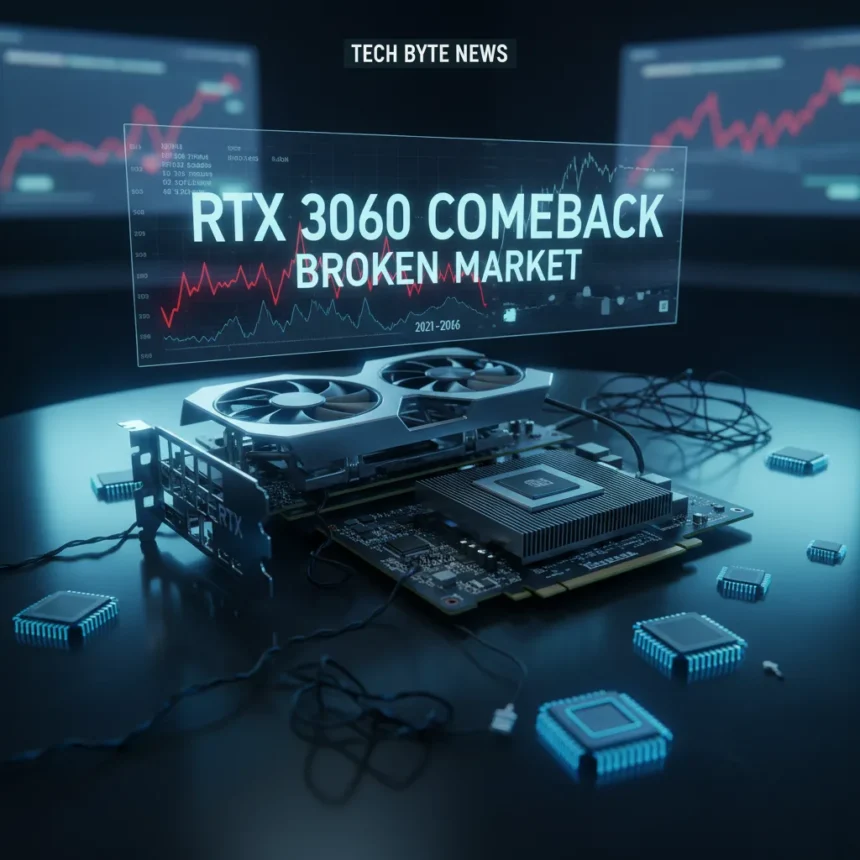
The Nvidia RTX 3060 comeback in 2026 would be a stunning admission: the GPU market is broken. Five years after its original launch, Nvidia is reportedly preparing to resurrect this aging card as early as March 2026 to tackle soaring prices, persistent memory shortages, and the weak value proposition of current-generation entry-level cards. If true, it signals that Nvidia’s newer budget offerings have failed to serve the market it created.
Key Takeaways
- Nvidia RTX 3060 comeback rumored for Q1 2026, potentially March 2026, to address GPU supply and pricing issues.
- RTX 3060 12GB variant expected to compete against RTX 5060’s 8GB limitation, offering larger frame buffer for the same price tier.
- Built on Samsung’s 8nm node, RTX 3060 will deliver roughly 70% of RTX 5060 performance without newer features like DLSS 4.5 FP8 support.
- RTX 5060 currently priced at $339.99, suggesting RTX 3060 relaunch could undercut or match this price point.
- Market revival triggered by AI data center demand starving consumer GPU supply and forcing gamers to overpay for entry-level cards.
Why Nvidia RTX 3060 Comeback Makes Sense in 2026
The Nvidia RTX 3060 comeback isn’t nostalgic marketing—it’s damage control. Nvidia’s current entry-level lineup has created an awkward gap. The RTX 5060, launched at $339.99, ships with only 8GB of VRAM, a limitation that frustrates gamers working with larger datasets or playing memory-intensive titles. Meanwhile, the RTX 3060 originally came in 8GB and 12GB variants, with the 12GB version offering a genuine advantage for budget buyers who want breathing room without paying for mid-range hardware.
The real problem is supply. AI data center demand has diverted GPU manufacturing capacity away from consumer cards, creating artificial scarcity that inflates prices. A relaunch of proven, five-year-old silicon manufactured on Samsung’s 8nm node costs Nvidia far less than designing new entry-level chips. Recycling the RTX 3060 design lets Nvidia fill the 12GB sweet spot without the R&D overhead. It’s pragmatic, if embarrassing.
Nvidia RTX 3060 vs. RTX 5060: The Performance Trade-Off
Performance-wise, the Nvidia RTX 3060 comeback comes with clear compromises. The revived card is expected to deliver roughly 70% of the RTX 5060’s performance, making it suitable for 1080p gaming and light creative work. The RTX 5060, meanwhile, includes multi-frame generation and native FP8 acceleration in DLSS 4.5, features the older RTX 3060 cannot match. For gamers chasing the latest ray-traced frame rates or using AI-accelerated creative tools, the newer card wins decisively.


But here’s where the Nvidia RTX 3060 comeback gets interesting: most budget gamers don’t need those features. They want stable frame rates at 1080p or 1440p without spending $350 on a card with artificial memory constraints. A 12GB RTX 3060 at a similar or lower price than the 8GB RTX 5060 reshapes the value equation entirely. Nvidia is betting that frame buffer size matters more to its target audience than shader count or tensor core improvements.
Market Signals: What the RTX 3060 Comeback Reveals
The Nvidia RTX 3060 comeback also sheds light on a shelved product: the rumored RTX 5050 9GB variant, which was abruptly canceled. That cancellation hints at internal chaos. If Nvidia had a credible 9GB entry-level card in the pipeline, a RTX 3060 relaunch would be redundant. The fact that Nvidia is dusting off five-year-old hardware instead suggests its new-generation roadmap failed to address the budget segment’s real needs.



Leakers and industry observers point to Q1 2026 as the relaunch window, with board partners supposedly receiving cards between March 10-31, 2026. Pricing remains unconfirmed, but market dynamics will set the floor: if supply remains tight and the RTX 5060 stays at $339.99, the RTX 3060 will likely undercut it or match it while offering the 12GB advantage. That’s the only scenario where a five-year-old card makes sense to consumers.
Should You Wait for the Nvidia RTX 3060 Comeback?
If you’re a budget gamer shopping right now, waiting for a March 2026 relaunch is a gamble. These are unconfirmed rumors from leakers, not official Nvidia statements. The company has made no public announcement, and board partner timelines can shift. If you need a GPU today, the RTX 5060 at $339.99 is available now, and its newer architecture and feature set justify the 8GB trade-off for most users.
However, if you can wait and prioritize frame buffer size over latest features, the Nvidia RTX 3060 comeback could offer genuine value. The 12GB variant addresses a real pain point that Nvidia’s current generation ignores. Just don’t expect a dramatic performance leap—you’re buying frame buffer and price, not speed.
Will the Nvidia RTX 3060 comeback actually happen?
Rumors suggest March 2026, but Nvidia has not confirmed this. Leaker reports point to board partners receiving cards in Q1 2026, but timelines shift and plans change. Treat this as a strong signal, not a guarantee. Official confirmation from Nvidia or major board partners would increase confidence significantly.



Why would Nvidia revive a five-year-old GPU instead of launching something new?
AI data center demand has strained GPU supply and manufacturing capacity. Reviving the RTX 3060 on proven 8nm Samsung silicon costs far less than designing and ramping a new entry-level chip. For Nvidia, it’s a fast way to fill the 12GB gap without expensive R&D or production delays.
How does the RTX 3060 12GB compare to the RTX 5060 8GB for gaming?
The RTX 3060 delivers roughly 70% of the RTX 5060’s performance but offers 50% more VRAM. For 1080p and 1440p gaming without ray tracing, the older card is sufficient. The RTX 5060 excels with DLSS 4.5 and multi-frame generation, features the RTX 3060 lacks. Choose based on your resolution and whether advanced DLSS features matter to you.
The Nvidia RTX 3060 comeback is less about innovation and more about market failure. It reveals a GPU industry stretched thin by AI demand, unable to deliver compelling entry-level options, and forced to recycle old designs to fill the gaps. For budget gamers, that’s good news—a proven card with 12GB VRAM at a reasonable price. For Nvidia’s marketing team, it’s a reminder that sometimes the best solution to a broken market is to admit the problem and go backward.
Edited by the All Things Geek team.
Source: Tom's Hardware