





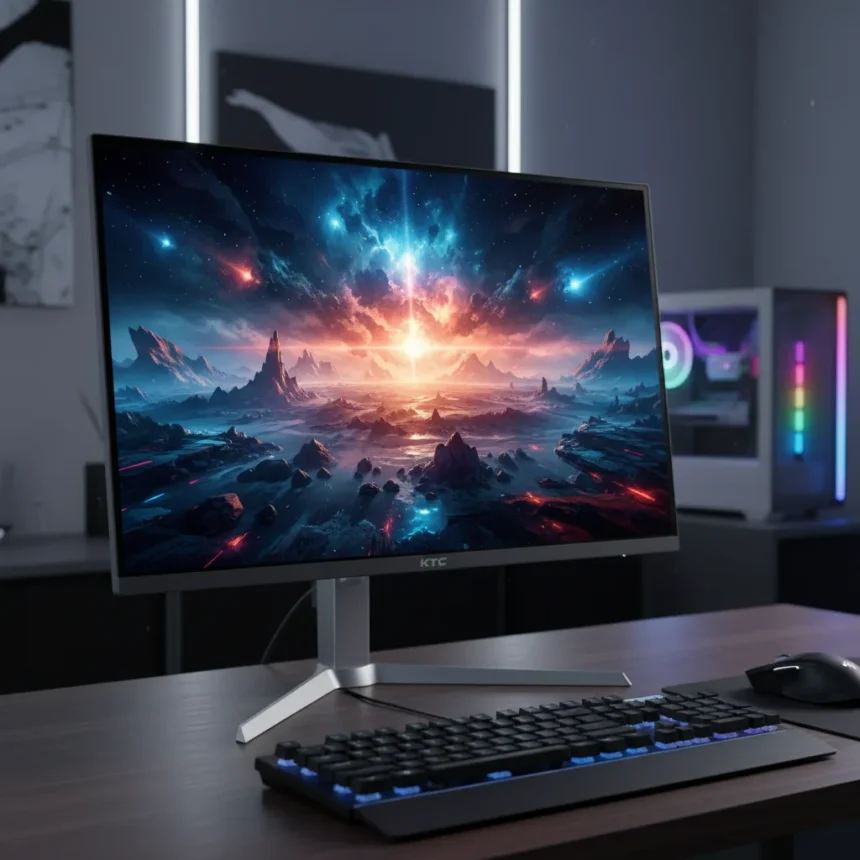
The KTC M27T6S Mini LED gaming monitor is a 27-inch IPS display with 2560 x 1440 QHD resolution, 1,152 local dimming zones, and peak brightness of 1,367 nits in HDR mode, launched in early 2025 and priced at $370 on Amazon. For a monitor under $400, this is exceptional hardware—the kind of spec sheet you’d expect to cost twice as much.
Key Takeaways
- 1,152 Mini LED dimming zones deliver near-infinite contrast with excellent black uniformity in HDR mode.
- Peak brightness reaches 1,367 nits (2% window HDR), enabling true DisplayHDR 1000 performance at budget pricing.
- Quantum Dot enhancement covers 99% DCI-P3 color space with average color accuracy of dE 1.42 post-calibration.
- 200 Hz native refresh rate overclocks to 210 Hz with 1 ms response time and zero VRR stutter across the range.
- At $370, it undercuts the Innocn 27M2V ($500) by $130 while matching or exceeding its brightness and dimming precision.
Why the KTC M27T6S Mini LED Gaming Monitor Matters Now
Mini LED technology has been trapped in the premium tier for three years. The KTC M27T6S breaks that pattern. As 2025 gaming titles—including Black Myth: Wukong expansions—increasingly demand HDR-capable displays, this monitor makes DisplayHDR 1000 certification accessible to mainstream gamers who don’t have a grand to spend. That shift matters because it forces competitors to either drop prices or justify their markup with genuinely different features. Right now, they can’t.
Tom’s Hardware’s testing confirmed what the specs promise: the KTC M27T6S delivered sustained 2% window brightness of 1,152 nits after 10 minutes of continuous use, full-screen SDR brightness of 578 nits, and a contrast ratio that hits infinite when local dimming is enabled. The backlight uniformity showed no hotspots—a critical metric that cheaper Mini LED monitors often botch. This is not a compromise product dressed up in high-end language. It’s a legitimately capable display at a price that makes it the obvious choice for budget-conscious HDR gamers.
Brightness, Color, and the Numbers That Matter
The KTC M27T6S Mini LED gaming monitor proved its mettle in controlled brightness and color testing. In HDR mode, the 2% window peaked at 1,367 nits, while a 10% window sustained 1,028 nits. Full-screen HDR measured 578 nits—lower than peak, but that’s how Mini LED works: it reserves maximum brightness for high-contrast scenes. For SDR content, the monitor delivered 625 nits in a 10% window and 647 nits in a 2% window, both solid figures for desktop work and video editing.


Color accuracy improved dramatically after calibration. Pre-calibration, grayscale averaged dE 3.64 and color averaged dE 4.29—acceptable but not pristine. Post-calibration, grayscale dropped to dE 0.55 and color to dE 1.42, putting the display in professional-grade territory. The Quantum Dot layer covers 99% DCI-P3, 97% Adobe RGB, and 90% Rec. 2020, which means HDR content—especially film and photography—will render with the color fidelity that Mini LED promises. In HDR testing, color accuracy averaged dE 2.85, confirming that the display handles wide-gamut content without drift.
The 1,152 local dimming zones are the real story. Tom’s Hardware’s uniformity test found excellent black levels with an average of 0.0039 nits in HDR mode. That’s the kind of precision that prevents blooming (bright halos around objects on dark backgrounds) and preserves shadow detail in dark scenes. The native IPS contrast sits at 1,202:1, which is typical for IPS panels, but with local dimming enabled, the contrast becomes effectively infinite—the backlight simply turns off behind black pixels. This is where the KTC M27T6S Mini LED gaming monitor separates itself from edge-lit competitors like the Gigabyte M27Q X, which maxes out at 400 nits with no dimming zones.



Gaming Performance and Refresh Rate Flexibility
The KTC M27T6S Mini LED gaming monitor supports 200 Hz natively and overclocks to 210 Hz, with a 1 ms gray-to-gray response time. That’s overkill for a QHD display—most competitive shooters run comfortably at 144 Hz—but the extra headroom ensures smooth motion in fast-paced games without frame pacing hiccups. Input lag measured 3.6 ms at 210 Hz, which is imperceptible in real play.
The monitor supports FreeSync Premium Pro and G-Sync Compatible, covering both AMD and Nvidia gamers. The VRR range spans 48-210 Hz, and Tom’s Hardware’s testing found zero stutter across that entire range. Three overdrive settings let you dial in the response time curve: Normal mode minimizes overshoot, Advanced mode balances speed and ghosting, and Ultimate mode cranks the speed but introduces minor inverse ghosting at 210 Hz. For most gamers, Advanced is the sweet spot.
Connectivity includes two HDMI 2.1 ports, one DisplayPort 1.4, USB-C with 90W power delivery, and a USB 3.2 hub with two Type-A ports. That USB-C port is particularly useful for laptop gaming or content creation workflows—you can run the display, charge your laptop, and connect peripherals through a single cable. The headphone jack rounds out the I/O, though the monitor has no built-in speakers.
KTC M27T6S Mini LED Gaming Monitor vs. Competitors
The Innocn 27M2V costs $500 and offers only 576 dimming zones with a peak brightness of 1,000 nits. The KTC M27T6S delivers twice the dimming zones and 367 nits more peak brightness for $130 less. The Gigabyte M27Q X ($300) is cheaper but uses edge-lit backlighting with no dimming zones and peaks at 400 nits—it’s a budget display competing in a different category. The AOC Agon Pro AG276QZD2 ($450) has 336 zones and 1,000 nits peak, making it the closest rival, but still trails on brightness and costs $80 more.



The KTC M27P20 Pro sits at the same $370 price point but uses a VA panel with 576 dimming zones. VA panels offer superior native contrast (better for SDR content), but the M27P20 Pro has a narrower color gamut and lower peak brightness than the M27T6S. If you prioritize HDR gaming and content creation, the M27T6S wins. If you want the best SDR contrast for desktop work, the M27P20 Pro deserves consideration. For most gamers, the M27T6S is the better all-rounder.
Stand Adjustability and Physical Design
The KTC M27T6S Mini LED gaming monitor includes a fully adjustable stand with height adjustment (5.1 inches of travel), tilt (-5° to 20°), swivel (-30° to 30°), and portrait pivot mode. The display weighs 15.9 lbs and measures 24.3 x 20.5-25.6 x 9.6 inches with the stand. The 178° viewing angles are typical for IPS, meaning the image remains accurate even when viewed from the side—useful if multiple people are watching. Power consumption runs 70W typical and 220W at peak, which is reasonable for a Mini LED display.
Limitations and Caveats
The infinite contrast claim only applies with local dimming enabled. Disable it, and you’re back to the native 1,202:1 IPS contrast, which is average. The RGWB subpixel layout may cause minor text fringing in productivity use, though this wasn’t a focus of Tom’s Hardware’s testing. There are no built-in speakers, so you’ll need external audio. The monitor also lacks a USB-C upstream port for daisy-chaining displays, limiting multi-display setups on newer laptops.
Should You Buy the KTC M27T6S Mini LED Gaming Monitor?
Yes, if you game in HDR or work with color-critical content and have a $370 budget. The combination of brightness, dimming precision, color accuracy, and refresh rate flexibility makes this display a rare bargain in the Mini LED space. The stand is solid, the connectivity is modern, and the VRR implementation is flawless. The only reason not to buy it is if you need 4K resolution (this is QHD) or if you prioritize SDR contrast over HDR performance—in which case, look at VA alternatives.
Is the KTC M27T6S Mini LED gaming monitor worth the upgrade from a standard gaming display?
If your current monitor is edge-lit or non-HDR, absolutely. The jump from 400 nits to 1,367 nits is transformative for HDR games and movies. If you’re upgrading from a 144 Hz IPS display, you’ll notice the smoothness and the dimming zones’ impact on dark scenes. If you’re coming from a high-end OLED or a premium Mini LED, the upgrade is less compelling—but you’re probably not shopping at $370 anyway.
What’s the difference between the KTC M27T6S and the M27P20 Pro?
The M27T6S uses an IPS panel with 1,152 Mini LED zones and 1,367 nits peak brightness, optimized for HDR. The M27P20 Pro uses a VA panel with 576 zones and lower peak brightness, offering superior native contrast for SDR work. Both cost $370. Choose the M27T6S for HDR gaming and content creation, the M27P20 Pro for SDR contrast and desktop productivity.
The KTC M27T6S Mini LED gaming monitor proves that flagship features don’t require flagship pricing. At $370, it delivers brightness, color, and dimming control that would have cost $800 two years ago. For HDR gaming in 2025, it’s the monitor to beat at this price point.
Edited by the All Things Geek team.
Source: Tom's Hardware




