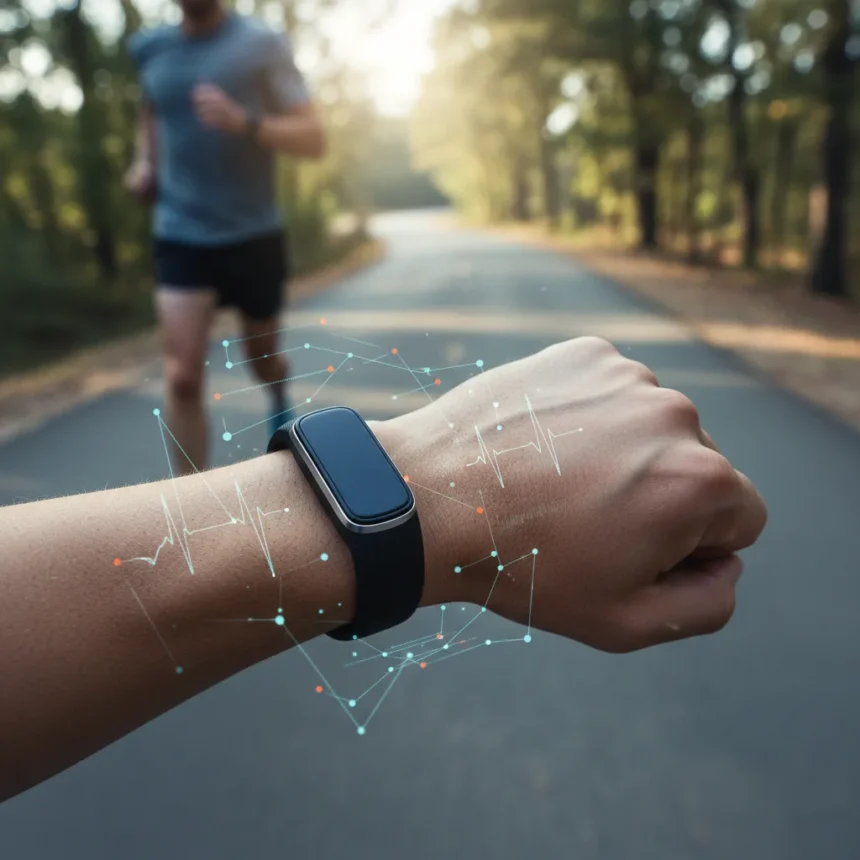
The Fitbit Air fitness tracker is a screenless wearable made by Google, priced at $99, designed to strip away smartwatch complexity and focus on one thing: tracking your workouts and daily movement without distractions. A recent test pitting the Fitbit Air against the $250 Garmin Forerunner 70—a legitimate entry-level running watch—revealed something surprising: the cheaper device kept pace on the metrics that matter most to runners.
Key Takeaways
- The Fitbit Air costs $99 and lacks a screen, buttons, and GPS, relying on a paired smartphone for location data.
- During a 1.5-mile run test, the Fitbit Air tracked heart rate, speed, pace, and distance as reliably as the $250 Garmin Forerunner 70.
- The device offers seven days of battery life and charges fully in about 90 minutes.
- Google Health Premium subscription is optional at $9.99 per month or $99 per year.
- The Fitbit Air weighs just 5.2 grams without the strap, making it the smallest and lightest screen-free fitness tracker available.
How the Fitbit Air Performed Against a Premium Running Watch
The test was straightforward: wear the Fitbit Air and Garmin Forerunner 70 simultaneously during a 3,000-step walk and a 1.5-mile outdoor run, using the Strava app as a reference point. On paper, the comparison seemed lopsided. The Garmin is a dedicated running watch with years of algorithmic refinement. The Fitbit Air is a band with no screen and no onboard GPS. Yet the results showed the Fitbit Air delivered heart rate measurements, speed, pace, and distance tracking that matched what the more expensive watch recorded.
This matters because outdoor workout accuracy is where cheaper trackers typically stumble. Without GPS built in, the Fitbit Air depends entirely on your smartphone’s location data to calculate distance and pace. Many runners dismiss screenless trackers for exactly this reason—the perceived friction of needing a phone nearby. But in practice, most runners already carry their phones. The Fitbit Air simply exploits that reality rather than forcing you to buy a device with redundant GPS hardware.
The absence of an onboard altimeter is another limitation worth noting. If elevation tracking matters to your training, the Fitbit Air will not help you there. For flat-route runners or casual fitness enthusiasts, this is irrelevant. For trail runners or those training in mountainous terrain, it is a meaningful gap.


Design and Comfort: Minimalism as a Feature
The Fitbit Air is described as comfortable after roughly four days of continuous wear. At 5.2 grams without the strap and measuring just 35 x 17 x 8 millimeters, the device is small enough that you genuinely forget you are wearing it—which is precisely the point. There are no buttons to accidentally press, no screen glare in sunlight, and no notifications pulling your attention away from your workout.
This minimalist approach is deliberate. The Fitbit Air has a haptic motor and supports a Smart Alarm, so you still get tactile feedback and wake-up functionality. But there is no NFC for mobile payments, no speaker or microphone for calls, and no mirrored smartphone notifications. For users exhausted by smartwatch feature bloat, this is refreshing. For those who want their wearable to be a communication hub, the Fitbit Air is not your device.



Strap swapping is easy, which matters if you plan to wear the tracker across different contexts—gym, office, sleep. The minimalist form factor also means the Fitbit Air competes directly with the Whoop 5.0 and Whoop MG, which occupy the same screenless, subscription-optional space. Unlike those devices, the Fitbit Air is not subscription-dependent. Google offers Health Premium at $9.99 per month or $99 per year, but it is optional.
Battery Life and Charging Reality
Google claims up to seven days of battery life, and real-world testing confirmed roughly seven days before the device required a charge, with about 15% battery remaining. That is respectable for a tracker this small. The 90-minute charge time from empty to full is fast enough that you can top up overnight without planning around it.
In practice, seven days means you might charge the Fitbit Air every Sunday evening, or whenever your weekly rhythm allows. It is not the 10-14 day endurance you get from some Garmin watches, but it beats the daily charging cycle of most smartwatches. The tradeoff is intentional: the smaller the device, the smaller the battery.
Who Should Buy the Fitbit Air, and Who Should Not
The Fitbit Air fitness tracker makes sense for runners and fitness enthusiasts who already own a smartphone and do not mind carrying it during outdoor workouts. If you are training for a marathon and obsess over elevation, VO2 max estimates, and advanced metrics, you will outgrow this device. If you run casually, walk daily, and want a tracker that stays out of your way, the Fitbit Air delivers.



The device is also a better choice than the Apple Watch 11, Samsung Galaxy Watch 8, or Google Pixel Watch 4 if you actively dislike notifications and smartwatch features. You are paying for simplicity and discretion, not connectivity. That is a valid choice—it just requires being honest about what you want from a wearable.
Compared to the Garmin Forerunner 70, the Fitbit Air costs $150 less and trades dedicated running features and onboard GPS for a lighter, simpler form factor and smartphone dependency. Neither is objectively better. The Garmin wins if you want a standalone device and advanced metrics. The Fitbit Air wins if you value minimalism and price.
Is the Fitbit Air worth buying for outdoor running?
Yes, if you carry your smartphone during runs and do not need elevation tracking or standalone GPS functionality. The Fitbit Air tracked speed, pace, distance, and heart rate as accurately as a device costing 2.5 times more. For $99, that is a strong value proposition.
How long does the Fitbit Air battery last between charges?
Google rates the Fitbit Air for up to seven days of battery life, and testing confirmed roughly seven days of use before requiring a charge. Recharging takes approximately 90 minutes.
Does the Fitbit Air have GPS?
No. The Fitbit Air lacks onboard GPS and depends on a paired smartphone to capture distance, pace, and post-workout map data. If you run without your phone, the tracker will not record location-based metrics.
The Fitbit Air fitness tracker succeeds because it does one job well and refuses to do anything else. In a market crowded with feature-laden smartwatches and subscription-hungry fitness bands, a simple, affordable, screenless tracker that actually works is a rare thing. Whether that simplicity appeals to you depends entirely on what you want from a wearable—but at $99, the Fitbit Air deserves a serious look.
Where to Buy
Fitbit Air: | Garmin Forerunner 70:
Edited by the All Things Geek team.
Source: Tom's Guide