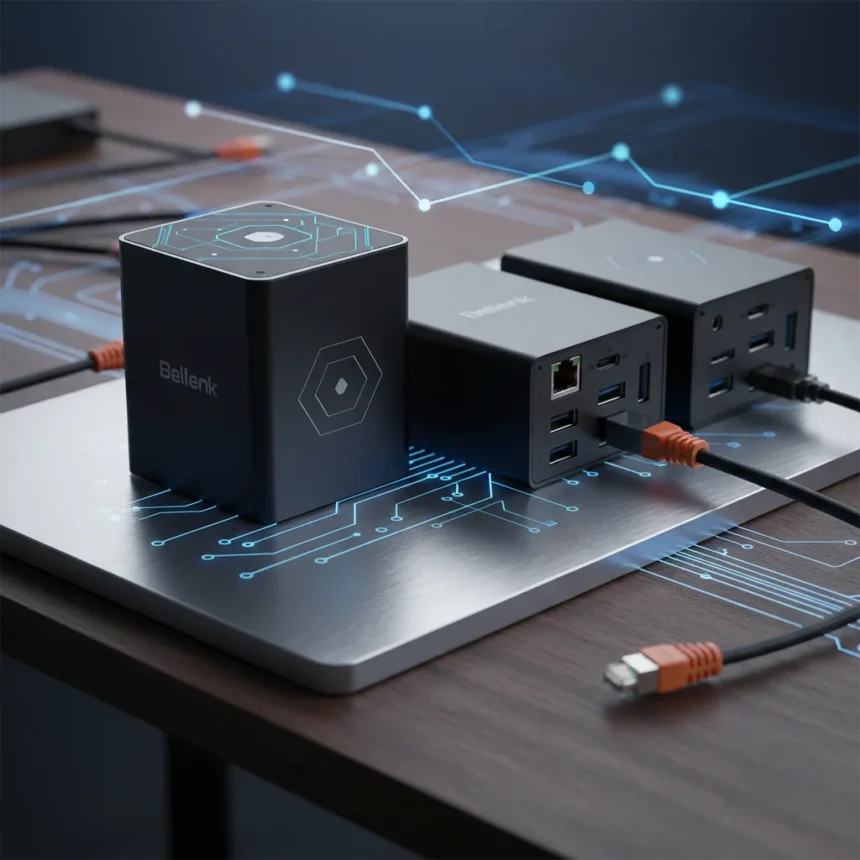
Beelink’s Wildcat Lake mini PCs represent a significant shift in how manufacturers approach networking on compact systems. The company has announced three new models—the EQ, EQi, and ME Pro—all powered by Intel’s Core 3 304 processor and built on the 18A manufacturing process, with a notable distinction: 10GbE LAN ports now come standard across entry-level configurations.
Key Takeaways
- All three Wildcat Lake models feature dual USB4 ports and 10GbE networking as standard
- The Intel Core 3 304 processor includes one performance core, four efficiency cores, an NPU, and Xe3 graphics
- Beelink claims the Core 3 304 delivers 120% higher single-core and 60% better multi-core performance versus the Core i3-N305
- The ME Pro model combines mini PC and NAS functionality with dual 3.5-inch drive bays
- The platform supports up to 24 TOPS of total AI compute power
Wildcat Lake Mini PCs Break the Entry-Level Networking Ceiling
Historically, 10GbE networking has remained locked behind premium pricing. Beelink’s decision to include it across its Wildcat Lake mini PCs—even in the ultra-compact EQ model—challenges that assumption. The EQ serves as the baseline, featuring an integrated 45-watt power supply in a compact chassis. The EQi steps up with dual-network support, adding a 2.5GbE port alongside the 10GbE connection and bumping the power supply to 85 watts. The ME Pro extends the concept further, combining mini PC and NAS capabilities with dual 3.5-inch drive bays and the same dual-network configuration.
This positioning matters. Home users and small businesses increasingly need reliable, high-speed local networking for media workflows, backups, and edge computing tasks. By making 10GbE standard rather than optional, Beelink removes a traditional barrier between consumer-grade and professional-grade systems.
The Intel Core 3 304: Low Power Meets AI Ambition
The Core 3 304 is Intel’s first processor on the 18A process technology, a significant technical achievement that signals where Intel’s efficiency roadmap is heading. The chip pairs one performance core with four efficiency cores, an integrated NPU for AI workloads, and next-generation Xe3 graphics architecture. Beelink’s marketing claims 120% higher single-core performance and 60% better multi-core performance compared to the previous-generation Core i3-N305. The platform delivers up to 24 TOPS of total AI compute power, positioning these systems for users interested in running local AI models without external acceleration.


The efficiency gains matter in compact form factors. A 45-watt power supply in the EQ would be impossible with previous generations at comparable performance levels. This efficiency-first approach appeals to users who want always-on systems for home labs, media servers, or edge computing deployments without significant power consumption or heat generation.
Three Models, Three Use Cases
The EQ targets users who prioritize compact footprint and simplicity—a true ultra-compact desktop system with minimal thermal overhead. The EQi adds network flexibility with its dual-port configuration, making it suitable for creators handling large file transfers or small offices needing redundant connectivity. The ME Pro bridges the gap between storage and compute, combining mini PC functionality with NAS-level drive capacity in a single device. This hybrid approach appeals to users managing local media libraries, running backups, or deploying edge AI inference on stored datasets.



Compared to traditional mini PCs that force users to choose between compact computing and storage capacity, the ME Pro’s integration reduces cable clutter and power requirements. It is a pragmatic answer to the problem of managing both compute and storage in space-constrained environments.
What Wildcat Lake Mini PCs Mean for the Broader Market
Beelink’s move signals that 10GbE is becoming a commodity feature rather than a luxury. Historically, networking specifications have lagged behind processor improvements, with manufacturers using older gigabit ports as a cost-saving measure even in otherwise capable systems. By standardizing 10GbE across an entry-level lineup, Beelink forces competitors to reconsider their own networking strategies.
The 18A process technology carries additional significance. This is the same manufacturing process expected to appear in more powerful Intel processors, suggesting that the efficiency gains demonstrated here will scale upward. For small businesses and creators, that means future-proof architecture without premium pricing.
Should You Consider a Wildcat Lake Mini PC?
The Wildcat Lake lineup makes sense if you need always-on computing with strong networking and local AI capability. The EQ suits minimalists and low-power enthusiasts. The EQi addresses creative professionals managing large media files. The ME Pro appeals to users who want integrated storage and computing in one device. If your workflow depends on gigabit networking, you will immediately notice the difference that 10GbE brings to local transfers and backups.


What processor powers the Wildcat Lake mini PCs?
All three models use the Intel Core 3 304, which includes one performance core, four efficiency cores, an integrated NPU for AI workloads, and Xe3 graphics architecture. The processor is built on Intel’s 18A manufacturing process.
Do all Wildcat Lake models support 10GbE networking?
Yes. All three models—EQ, EQi, and ME Pro—feature 10GbE LAN ports as standard. The EQi and ME Pro add a second 2.5GbE port for dual-network configurations.
What is the difference between the EQ, EQi, and ME Pro models?
The EQ is the ultra-compact baseline with a 45-watt power supply. The EQi adds a second network port and 85-watt power supply. The ME Pro combines mini PC and NAS functionality, including dual 3.5-inch drive bays and the same dual-network setup as the EQi.
Beelink’s Wildcat Lake lineup marks a turning point in how entry-level mini PCs approach networking and storage. By making 10GbE standard and pairing it with efficient AI-capable processors, the company has removed traditional compromises between compact form factors and professional-grade connectivity. For anyone building a home lab, managing media workflows, or deploying edge computing, these systems deserve serious consideration.
Edited by the All Things Geek team.
Source: TechRadar