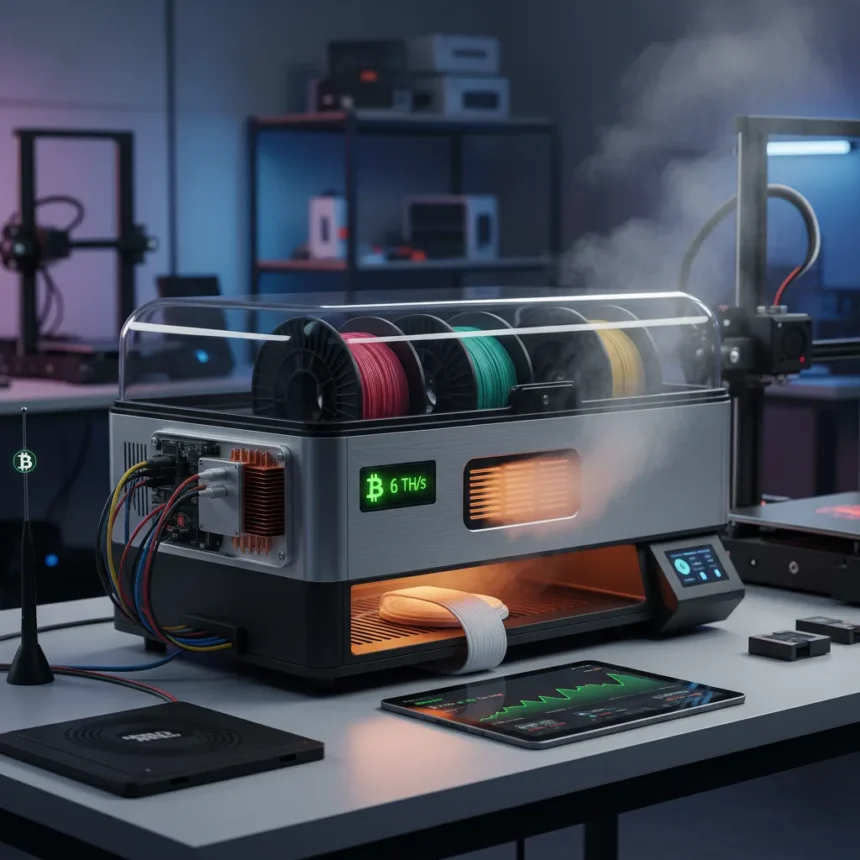
A bitcoin-mining filament dryer that extracts mining heat to dry 3D printer materials while earning cryptocurrency represents a new approach to offsetting idle printer costs in hobbyist operations. The device achieves 6 TH/s (terahashes per second) at just 140W power consumption, joining an earlier bitcoin-mining 3D printer prototype in what inventor PizzAndy calls a “Proof of Print” product line designed for print farms running 24/7.
Key Takeaways
- Bitcoin-mining filament dryer mines at 6 TH/s while drying filament via waste heat from ASIC chips
- Part of Proof of Print hobbyist lineup alongside earlier bitcoin-mining 3D printer prototype
- Prior prototype achieved 500 GH/s using four BM1362 AK chips repurposed from coffee warmer components
- Designed for print farms where idle time becomes mining revenue, not wasted electricity
- Future modular tiles planned to reach 10-30 TH/s using Intel BZM2 ASIC chips
How the Bitcoin-Mining Filament Dryer Works
The bitcoin-mining filament dryer solves a dual problem: filament needs heat to dry properly, and bitcoin mining generates substantial waste heat. Rather than dissipating that heat, the device routes it through the filament chamber while ASIC chips perform mining calculations. The dryer uses CGMiner, an open-source mining software, linked to custom printer and mining controllers via command-line operation. This architecture mirrors the earlier prototype, which modified an open-source Voron 3D printer design with a 110×110 mm bed that doubled as a heatsink for four BM1362 AK chips sourced from GeckoScience hashboards—originally designed for coffee warmers.
The engineering-grade filament targeted, such as PCTG, benefits from the consistent 75°C heat the mining process naturally generates. PCTG offers higher temperature and impact resistance than standard filaments, making it ideal for applications where durability matters. PizzAndy explained the material choice: “It’s an engineering grade filament that has higher temperature resistance and impact resistance than your standard filaments, which makes it perfect for heat punk purposes”. This specificity matters—not all filaments benefit equally from mining heat, so material selection directly impacts both print quality and mining efficiency.
The Economics of Idle Print Farms
The bitcoin-mining filament dryer targets a specific use case: print farms where machines sit idle between jobs. Traditional 3D printers consume electricity without generating revenue during downtime. Mining transforms idle capacity into passive income, though only at scale. PizzAndy framed the opportunity clearly: “This product is mostly intended to exist in a print farm, where printers are printing around the clock, all the time… that’s when the economics of a print farm are not unlike a Bitcoin mine. And if your machines aren’t printing, you’re not making money”. The comparison is direct—print farm economics mirror bitcoin mining economics when you account for electricity costs and idle time.


This approach differs fundamentally from traditional resistive bed heaters using nichrome wire, which generate heat but produce no revenue. The bitcoin-mining filament dryer flips the equation: heat becomes a byproduct of profitable mining rather than a cost center. For hobbyists running multiple printers, even modest mining rates add up over months of operation.
From Prototype to Hobbyist Product Line
The earlier Proof of Print prototype demonstrated proof-of-concept with its bitcoin-mining 3D printer bed. That prototype achieved 500 GH/s (gigahashes per second) hashing rate while maintaining 75°C bed temperature during active printing. The new filament dryer builds on that foundation but targets a different workflow—drying spools rather than heating print beds, though the underlying principle remains identical: waste heat from ASIC chips serves a secondary purpose.



Future plans reveal ambition beyond current hobbyist prototypes. PizzAndy envisions modular tile systems, each containing 16 Intel BZM2 ASIC chips per tile, targeting 10-30 TH/s with zoned heating for different materials. This modularity would allow print farms to scale mining capacity independently of printing capacity, a significant architectural advantage over monolithic designs. However, current thermal management remains constrained—heat is limited to the bed, not the extruder, and ASIC chips are throttled for temperature control rather than maximum hashing performance.
Competitive Context and Heat-Reuse Mining
The bitcoin-mining filament dryer occupies a niche within the broader heat-reuse mining category. Similar projects like Heatbit market bitcoin miners as space heaters, targeting home heating applications. Other initiatives, such as CryptoCloaks, design 3D-printed enclosures for mining hardware, focusing on aesthetics and cooling rather than integrated heat recovery. What distinguishes the Proof of Print approach is its dual functionality—the device must excel at both mining and filament drying simultaneously, not treating one as a secondary benefit. This constraint forces engineering tradeoffs that simpler single-purpose miners avoid.
Frequently Asked Questions
What makes the bitcoin-mining filament dryer different from a regular filament dryer?
A regular filament dryer uses resistive heating elements or heat pumps, consuming electricity with no return beyond dried filament. The bitcoin-mining filament dryer mines cryptocurrency as a byproduct of drying, turning wasted electricity into passive income while materials dry.
Can you use the bitcoin-mining filament dryer with any 3D printer filament?
The dryer works best with engineering-grade materials like PCTG that benefit from consistent 75°C heat. Standard PLA or ABS may not require the same thermal profile, reducing the efficiency advantage of mining-based heating.



How much Bitcoin could a print farm realistically mine with these dryers?
At 6 TH/s per dryer and current Bitcoin difficulty, earnings depend entirely on electricity costs and Bitcoin price at the time of mining. PizzAndy’s model assumes multiple dryers operating continuously in a print farm environment where idle time is minimized.
The bitcoin-mining filament dryer represents a pragmatic approach to offsetting 3D printing costs in commercial and serious hobbyist settings. It does not reinvent mining or printing—it simply refuses to waste the heat that mining generates. For print farms running idle machines, that refusal to waste transforms a cost center into a revenue stream. Whether the economics work depends on electricity rates and mining difficulty, but the engineering elegantly solves a real problem in the print farm workflow.
Edited by the All Things Geek team.
Source: Tom's Hardware