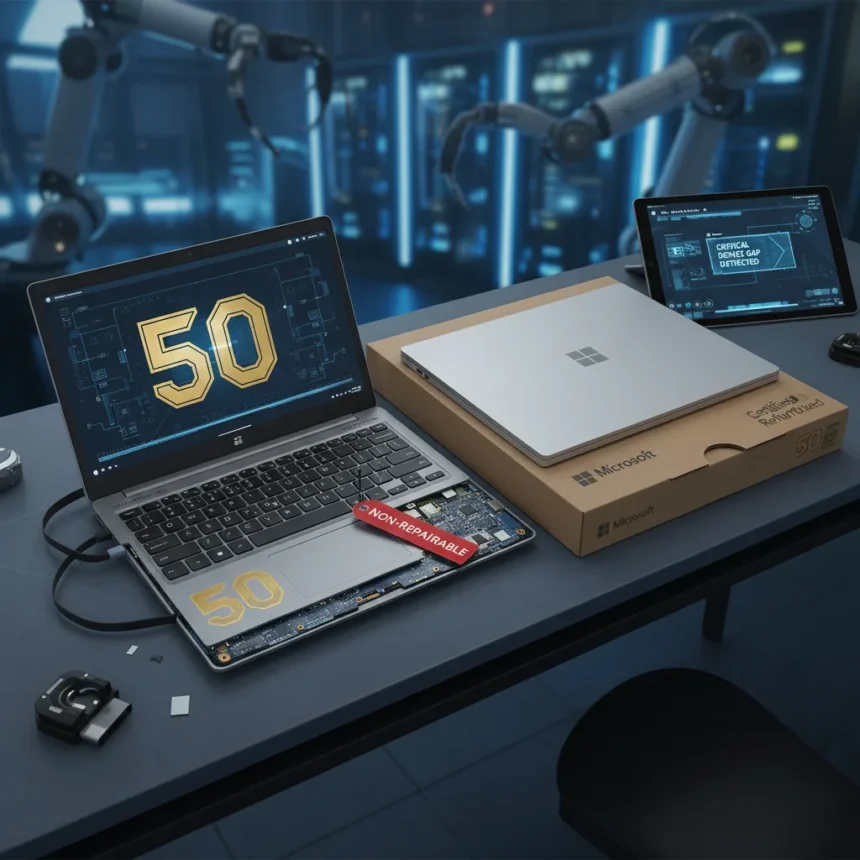
Microsoft’s Surface repair workflow failed spectacularly when handling a limited 50th Anniversary Surface Laptop, exposing a critical gap in how the company processes rare devices. A Surface owner who requested a same-unit repair discovered their exclusive device had been marked non-repairable and swapped for a standard Surface Laptop 7 instead—without consent or notification. The incident reveals that Microsoft’s service procedures, designed for mass-market hardware, struggle when confronted with collector-grade or limited-edition equipment.
Key Takeaways
- A limited 50th Anniversary Surface Laptop was marked non-repairable and replaced with a standard unit during Microsoft’s repair process
- The owner, Furtado, requested the original device be returned, repaired or unrepaired, exposing a workflow failure
- Microsoft’s standard Surface repair turnaround is typically 6–8 business days after shipping, depending on location
- The incident highlighted that standard repair procedures may be inadequate for limited-edition or collector devices
- Microsoft later tracked down the original unit, repaired it, and updated its service process following the issue
How Microsoft’s repair workflow failed on a rare device
When the owner submitted their limited 50th Anniversary Surface Laptop for a same-unit repair, Microsoft’s repair team encountered the device and made a critical decision: they classified it as non-repairable. Rather than returning the original unit or escalating the case, the standard workflow kicked in. The device was swapped for a replacement Surface Laptop 7—a standard model that bears no resemblance to the limited-edition original. This substitution violated the core promise of a same-unit repair and left the owner with a device they never requested.
The problem exposes a fundamental mismatch between Microsoft’s service design and the reality of special-edition hardware. Microsoft’s repair workflow is engineered for volume: start a repair online, ship the device, receive a fixed unit or replacement. For everyday Surface Laptops, this system works. For a limited-edition device tied to Microsoft’s 50th anniversary, it becomes a liability. The repair team had no protocol to flag rare devices, escalate them, or ensure they were treated as irreplaceable rather than interchangeable. A device that should have been handled with extra care was processed through the same pipeline as thousands of standard units.
Why the Microsoft Surface repair workflow left the owner without answers
What makes this failure particularly damaging is the lack of transparency. The owner did not immediately know what happened to their device. They had been promised a same-unit repair and instead received a standard replacement, with no clear explanation of why the original unit was deemed non-repairable or where it had gone. This communication breakdown compounded the service failure—the owner was left uncertain whether their limited-edition Surface would ever be recovered.


Microsoft’s standard repair process does provide post-service warranty coverage: the balance of the original hardware warranty or 90 days, whichever is longer for in-warranty service, and 90 days for out-of-warranty service. However, warranty terms do nothing to address the core issue—a collector’s item was lost in the workflow. The owner’s persistence in demanding the original device be returned, repaired or unrepaired, forced Microsoft to confront the gap in its service procedures. Without that pressure, the limited-edition Surface might have remained lost in Microsoft’s repair system indefinitely.
How Microsoft addressed the limited-edition device failure
After the issue drew public attention, Microsoft took action. The company tracked down the original 50th Anniversary Surface Laptop, repaired it, and returned it to the owner. More significantly, Microsoft updated its repair process to better handle rare and limited-edition devices, ensuring that future cases would not repeat this failure. The recovery demonstrates that Microsoft recognized the severity of the gap and committed resources to fix both the immediate problem and the underlying workflow.



This response is necessary but also revealing. It shows that Microsoft’s repair infrastructure, while functional for standard hardware, was not designed with collector-grade devices in mind. The company had to manually intervene to solve a problem that should have been prevented by protocol. For owners of limited-edition or special-release Surface devices, the incident serves as a cautionary tale: standard repair procedures may not protect rare hardware. The updated process suggests Microsoft is now training repair teams to identify and escalate limited-edition devices, but the burden of proof falls on the customer to clearly communicate that their device is not replaceable.
What this means for Microsoft Surface owners with rare devices
The 50th Anniversary Surface Laptop incident raises a question for anyone with special-edition or limited-release Microsoft hardware: how is your device classified in Microsoft’s repair system? If you own a limited-edition Surface, the safest approach is to explicitly state its rarity when initiating a repair order and request written confirmation that a same-unit repair will be performed. Do not rely on Microsoft’s standard workflow to recognize that your device is not interchangeable with a standard model.
Microsoft’s general repair options—starting a repair online, getting in-person support in some regions, or using self-repair options—remain available to all Surface owners. However, the workflow failure revealed in this case suggests that customers with rare hardware should consider escalating their service request beyond the standard online portal. In-person support or direct contact with Microsoft’s support team may be necessary to ensure that a limited-edition device receives appropriate handling.
Did Microsoft’s repair team intentionally swap the device?
The incident does not suggest intentional malice. Instead, it reflects a workflow designed for efficiency rather than exception handling. When the repair team marked the 50th Anniversary Surface as non-repairable, they may have been responding to a genuine technical issue that prevented standard repair. However, their response—swapping it for a standard unit without consent—was a failure of judgment and communication. A non-repairable device should have been escalated, not replaced.



Will Microsoft’s updated process prevent this from happening again?
Microsoft’s decision to update its repair workflow after this incident is a positive step, but the details of that update remain unclear. The company has indicated that it now flags and escalates limited-edition devices, but without seeing the specific protocol changes, it is difficult to assess whether the fix is comprehensive. Owners of rare Surface hardware should remain cautious and proactive in communicating their device’s status when seeking repairs.
The 50th Anniversary Surface Laptop incident exposes a real vulnerability in Microsoft’s service infrastructure. While the company ultimately recovered and repaired the device, the failure should prompt any Surface owner with a limited-edition or collector-grade device to take extra precautions when seeking repairs. Document your device’s rarity, request written confirmation of same-unit repair, and do not assume that Microsoft’s standard workflow will protect irreplaceable hardware. Microsoft has now learned this lesson the hard way—the question is whether its repair teams have fully internalized it.
Edited by the All Things Geek team.
Source: Windows Central