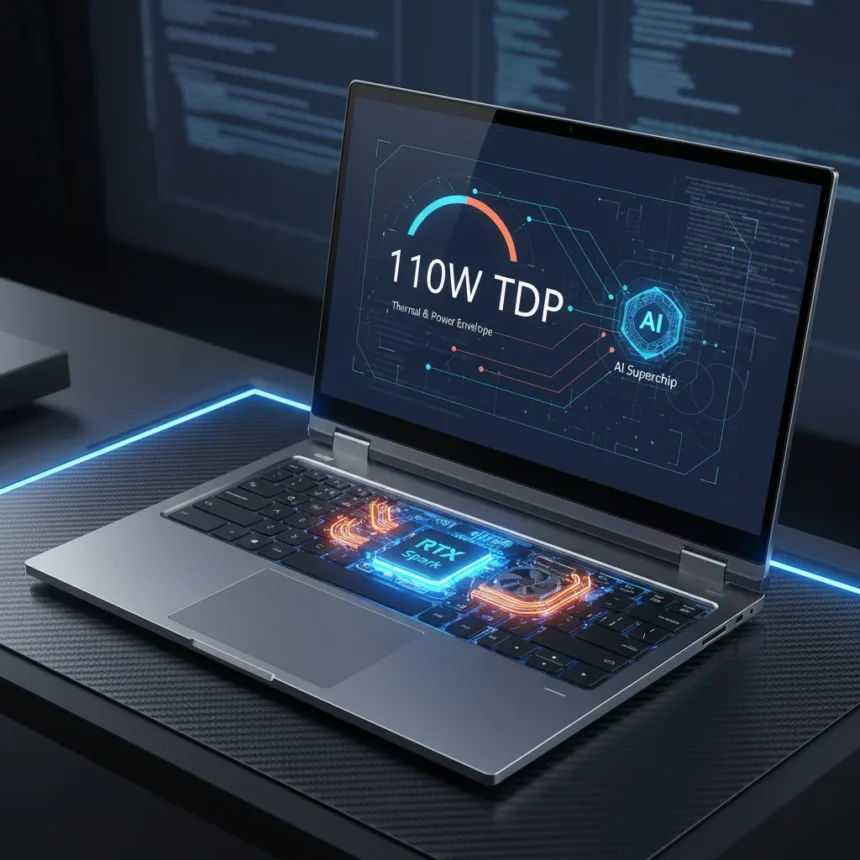
The Surface Laptop Ultra RTX Spark represents Microsoft’s most ambitious play in portable AI computing, and a newly disclosed 110W TDP target gives the clearest picture yet of what thermal and power constraints look like in a shipping system. Microsoft revealed this power budget during a hands-on session with Tom’s Hardware, offering the first concrete data point for how Nvidia’s new Blackwell-based Arm processor will behave in real-world conditions.
Key Takeaways
- Surface Laptop Ultra RTX Spark targets a 110W TDP for sustained thermal design.
- The 15-inch mini-LED display reaches 2,000 nits peak HDR brightness with 2880 x 1920 resolution.
- RTX Spark platform includes 20 Arm CPU cores, 6,144 GPU cores, and 128GB unified memory.
- Microsoft claims up to 1 petaflop of AI compute and support for 120B parameter models locally.
- Device weighs under 4.5 pounds and measures less than 18mm thick.
What the 110W TDP Actually Means
A 110W thermal design power is neither a ceiling nor a guarantee—it is Microsoft’s target power envelope for the Surface Laptop Ultra’s RTX Spark configuration. This matters because Nvidia and Microsoft have otherwise kept RTX Spark specifications tightly controlled. The TDP disclosure serves as a practical benchmark for what thermal designers and battery engineers should expect when building similar systems. Other RTX Spark-powered laptops from ASUS, Dell, Lenovo, HP, and MSI will likely operate within a comparable power window, though specific implementations may vary.
For context, a 110W TDP sits between traditional mobile GPUs and desktop accelerators, reflecting the RTX Spark’s hybrid positioning—far more capable than a standard laptop chip, but designed to fit within a portable form factor without requiring desktop-class cooling. The power target also hints at battery life constraints. Microsoft claims the Surface Laptop Ultra delivers all-day battery life, though actual runtime will depend heavily on workload intensity and real-world usage patterns.
Surface Laptop Ultra RTX Spark Hardware and Display Specs
The Surface Laptop Ultra RTX Spark runs Nvidia’s new Blackwell GPU with 6,144 CUDA cores, paired with 20 Arm CPU cores and 128GB of unified LPDDR5X RAM offering up to 300 GB/s of memory bandwidth. This configuration enables the platform to deliver up to 1 petaflop of AI compute and run models with up to 120 billion parameters locally, eliminating the need to offload inference to cloud services. For developers and AI researchers, this means iterating on large language models without network latency or cloud API costs.


The display is the hardware highlight. Microsoft equipped the Surface Laptop Ultra with a 15-inch mini-LED PixelSense Ultra panel running at 2880 x 1920 resolution and 262 pixels per inch, capable of reaching 2,000 nits of peak HDR brightness. That brightness level puts it in professional display territory, useful for creators working in high-ambient-light environments and for content creators mastering HDR video. The laptop also includes a large haptic touchpad, HDMI, USB-C, USB-A, SD card reader, and a headphone jack—a full port set that respects both legacy and modern workflows.
Design, Weight, and Availability
Microsoft designed the Surface Laptop Ultra to weigh under 4.5 pounds and measure less than 18mm thick, making it genuinely portable for a 15-inch system with this level of compute. The internal layout includes dual fans optimized for sustained performance, suggesting Microsoft prioritized thermal consistency over peak-burst performance—a sensible choice for AI development and content creation workloads that run continuously rather than in short bursts.



The device comes in Platinum (silver) and Nightfall (black) finishes. Microsoft announced the Surface Laptop Ultra at Computex 2026 and confirmed it will arrive later in 2026, with some sources specifying a fall 2026 launch window. Pricing remains unannounced, and Microsoft has not disclosed full configuration options or whether buyers will have choices in RAM, storage, or processor variants.
How Surface Laptop Ultra RTX Spark Compares to Other Platforms
The RTX Spark platform is positioned to compete directly with AMD and Qualcomm in the Windows on Arm space, though the architectural differences are substantial. Nvidia claims RTX Spark delivers graphics performance comparable to an RTX 5070 laptop GPU, a significant claim that suggests the integrated Blackwell GPU outpaces traditional Arm-based iGPUs by a wide margin. However, such comparisons are marketing claims rather than independent benchmarks—real-world performance will depend on driver maturity, game engine optimization, and specific workload characteristics.
What sets Surface Laptop Ultra RTX Spark apart is the unified memory architecture. Unlike traditional laptops where the GPU must copy data from system RAM into dedicated VRAM, the RTX Spark’s 128GB of unified LPDDR5X means the GPU and CPU share the same memory pool with 300 GB/s bandwidth. For AI inference and large model handling, this architecture eliminates memory-transfer bottlenecks that plague discrete GPU setups, making the Surface Laptop Ultra compelling for developers who prioritize iteration speed over absolute peak performance.
Who Should Care About Surface Laptop Ultra RTX Spark
Microsoft explicitly targets AI developers, creators, and developers seeking strong performance in a portable form factor. If you are building machine learning models, running local inference on large language models, or editing 4K video with real-time effects, the RTX Spark platform and Surface Laptop Ultra’s 110W thermal budget offer a credible alternative to cloud-dependent workflows or heavy desktop workstations. The lack of pricing and configuration details makes it premature to recommend it over alternatives, but the disclosed specifications suggest Microsoft is serious about capturing the AI-first laptop market.



Will Surface Laptop Ultra RTX Spark be powerful enough for serious AI work?
Yes, for local inference and model iteration. The 1 petaflop AI compute claim and support for 120B parameter models means you can run state-of-the-art language models without cloud API calls. However, training large models from scratch still requires desktop or data center hardware—the Surface Laptop Ultra is optimized for inference and fine-tuning, not large-scale training.
What does the 110W TDP tell us about battery life?
A 110W power target suggests the Surface Laptop Ultra will consume significant battery under sustained AI workloads, despite Microsoft’s all-day battery claim. Real-world battery life will vary dramatically depending on whether you are running local inference (power-hungry) or light productivity tasks (efficient). Microsoft has not disclosed battery capacity or measured runtime under specific workloads.
How does Surface Laptop Ultra RTX Spark compare to using cloud AI APIs?
The Surface Laptop Ultra eliminates latency, API costs, and data privacy concerns by running 120B parameter models locally. However, cloud services like OpenAI and Anthropic offer more advanced models and frequent updates without hardware investment. The Surface Laptop Ultra suits developers who need offline capability, cost predictability, or cannot send proprietary data to external servers.
The Surface Laptop Ultra RTX Spark is not a finished product yet—pricing, exact availability, and configuration options remain unknown. But the disclosed 110W TDP and RTX Spark specifications outline a system genuinely built for AI-first workflows, not a traditional laptop with AI marketing bolted on. For developers tired of API rate limits and cloud costs, this is worth watching closely when Microsoft finally opens preorders later this year.
Edited by the All Things Geek team.
Source: Tom's Hardware