





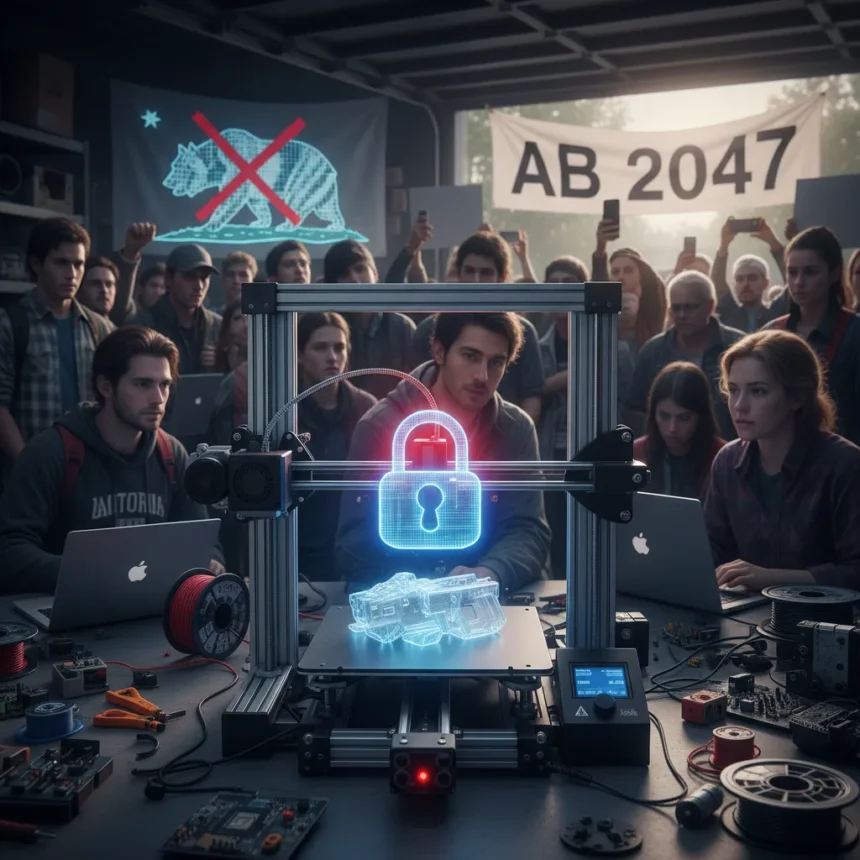
The California 3D printer law is triggering organized resistance from makers, manufacturers, and civil liberties advocates who view it as government overreach disguised as gun safety. Assembly Bill 2047, formally titled the Firearm Printing Prevention Act, would restrict all 3D printer sales in California to state-approved models equipped with proprietary software designed to detect and block firearm designs.
Key Takeaways
- AB 2047 requires all 3D printers sold in California to include firearm-blocking algorithms starting March 1, 2029.
- The bill criminalizes disabling or circumventing detection software as a misdemeanor offense.
- Electronic Frontier Foundation calls it a “digital kill switch” that threatens makerspaces, schools, and open-source innovation.
- California Department of Justice must publish compliance standards by July 1, 2027, with manufacturer attestations due by 2028.
- Civil penalties for non-compliance reach $25,000 per violation plus injunctions and damages.
Assembly Member Bauer-Kahan introduced the California 3D printer law before the legislature’s bill introduction deadline, and it has already advanced past committee with a 9-3 vote. The bill passed committee and moved to the Appropriations Committee as of the April 14, 2026 hearing. If enacted, it would represent the most aggressive algorithmic print-blocking mandate in the nation, setting a precedent that concerns an industry already fractured over innovation versus regulation.
How the California 3D printer law works
The California 3D printer law operates through a three-phase rollout designed to give manufacturers time to comply while ramping up enforcement. By July 1, 2027, the California Department of Justice must investigate firearm blueprint detection algorithms and publish performance standards. By July 1, 2028, any company selling 3D printers in California must submit self-attestations confirming each model includes certified detection and control systems that have been tested and validated. From March 1, 2029 onward, only printers listed on the DOJ’s website can legally be sold or transferred in the state.
The bill’s enforcement teeth are sharp. It criminalizes knowingly disabling, deactivating, uninstalling, or circumventing the firearm-blocking technology, especially to produce firearms or illegal gun parts. Distributing modified printers also triggers criminal liability. Civil penalties for non-compliant sales or false attestations reach $25,000 per violation, with additional damages and court injunctions. Exceptions exist for licensed firearms manufacturers, law enforcement, military, and certain non-consumer industrial settings.


Why the maker community opposes the California 3D printer law
Critics argue the California 3D printer law amounts to mandatory surveillance hardware that connects printers to government databases, creating what the Electronic Frontier Foundation calls a “digital kill switch” capable of remotely bricking devices if flagged or disconnected from the internet. Cliff Braun and Rory Mir of the EFF stated: “AB 2047 goes further than any other legislation on algorithmic print-blocking by making it a misdemeanor for the owners of these devices to disable, deactivate, or otherwise circumvent these mandated algorithms”.
The broader concern is that the California 3D printer law threatens open-source firmware development, makerspaces, and educational institutions. Braun warned that the bill “entrenches the market power of the largest manufacturers who can trivially absorb the cost of compliance. Smaller competitors will not have this capacity, and the result will be stifled competition, increased prices, and fewer competitors while exposing Californians to criminal liability if they break out of a manufacturer’s surveillance of what they’re printing”. This dynamic mirrors debates over digital rights management in other industries—once government mandates proprietary control systems, innovation outside those systems becomes illegal.



Constitutional and competitive concerns
The National Rifle Association’s Institute for Legislative Action argues the California 3D printer law violates First and Second Amendment rights by mandating government oversight on both physical printers and the digital files they process. The NRA-ILA contends that requiring algorithmic censorship of specific content—firearm designs—crosses constitutional lines regardless of intent.
From a market perspective, the California 3D printer law creates a two-tier system. Large manufacturers with resources to develop, test, and certify detection algorithms will dominate the California market. Smaller makers, hobbyists, and open-source communities will face either compliance costs that exceed their budgets or criminal exposure. The bill also raises questions about how a government-approved algorithm database would function. Who decides which designs are blocked? How are updates distributed? What happens if a printer loses internet connectivity?
How does the California 3D printer law compare to other gun-related legislation?
Similar measures are advancing in Washington and New York, but California’s approach is uniquely aggressive. Previous gun-related 3D printing restrictions focused on “ghost guns”—untraceable firearms assembled from unregulated parts—using post-production enforcement. Law enforcement identifies and prosecutes people caught with finished weapons. The California 3D printer law shifts enforcement upstream, targeting the file and the machine before any physical gun is printed. This is harder to bypass despite firearm blueprints remaining available online, because the detection software operates at the device level rather than relying on catching finished products.
The precedent is troubling. If California successfully mandates algorithmic blocking for firearm designs, the framework could expand to other “risk” categories—explosives, drugs, or any content a future legislature deems dangerous. Once the infrastructure exists, scope creep becomes likely.



What happens next with the California 3D printer law?
The bill continues through the legislative process toward a floor vote. The maker community, EFF, and civil liberties organizations are mobilizing opposition, framing the California 3D printer law as a threat to innovation, privacy, and constitutional rights. Manufacturers face a dilemma: comply and accept surveillance infrastructure, or exit the California market. The timeline is tight—compliance attestations are due by July 2028, with the sales ban taking effect March 1, 2029.
The California 3D printer law represents a critical moment for how states regulate emerging manufacturing technology. If it passes, California becomes a test case for algorithmic censorship embedded in hardware. If it fails, it signals that maker communities and digital rights advocates can successfully resist government mandates on device functionality. Either way, the debate reveals a fundamental tension: how do democracies balance public safety concerns with innovation, privacy, and constitutional protections?
Will the California 3D printer law survive a legal challenge?
Constitutional challenges are likely if the bill passes. First Amendment claims focus on blocking digital files (speech), while Second Amendment arguments target the restriction on device functionality. Courts have not yet ruled on algorithmic censorship mandates embedded in consumer hardware, making this untested legal territory. The outcome will depend on how judges weigh public safety against constitutional rights.
What are the compliance costs for 3D printer manufacturers?
The research brief does not specify compliance costs for manufacturers or consumers. The California 3D printer law requires self-attestations and DOJ certification but does not detail testing fees, algorithm licensing, or whether these costs will be passed to buyers. This ambiguity itself concerns smaller manufacturers who fear unpredictable expenses.
The California 3D printer law represents a pivotal clash between gun safety advocates and a tech community that values open innovation. Regardless of the bill’s fate, it signals that 3D printing—once a niche hobbyist pursuit—is now a policy battleground where surveillance, constitutional rights, and market competition collide.
Edited by the All Things Geek team.
Source: Tom's Hardware




