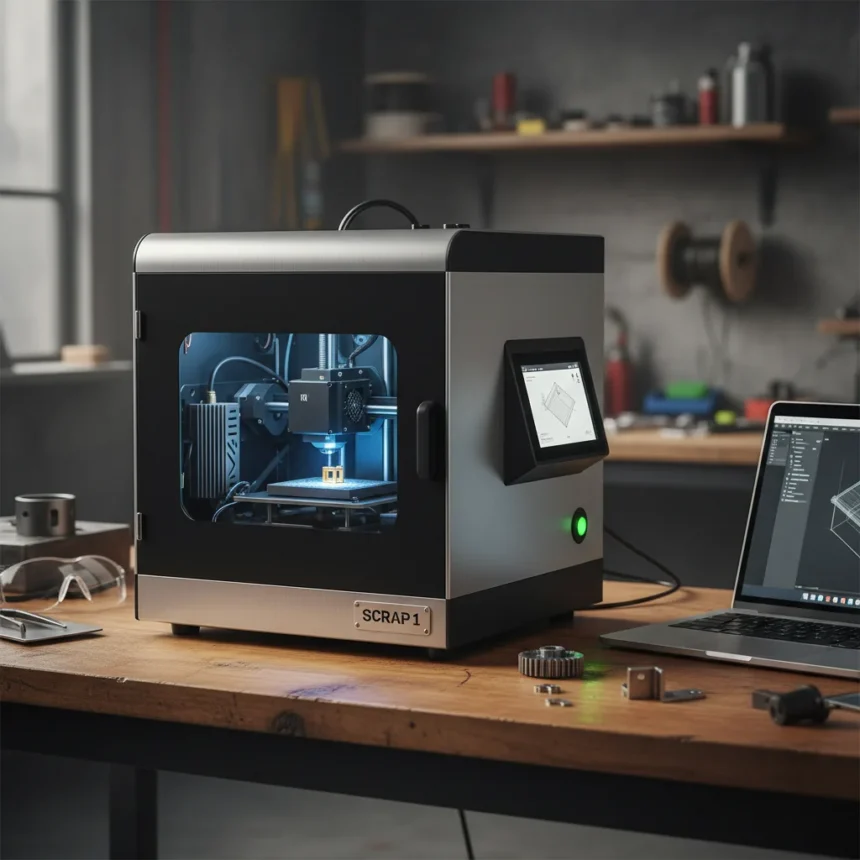
The Scrap 1 is a laser metal 3D printer from Scrap Labs that shrinks industrial-grade laser powder bed fusion (LPBF) technology down to workbench size, starting at $9,600. For the first time, a system capable of printing metal parts with precision comparable to factory-floor equipment fits on a desk instead of consuming an entire room. This compact laser metal 3D printer fundamentally shifts who can afford to experiment with metal additive manufacturing.
Key Takeaways
- Scrap 1 uses laser powder bed fusion, an industrial metal printing technology, in a compact workbench-friendly form factor.
- Starting price of $9,600 is a fraction of traditional industrial LPBF systems, which cost hundreds of thousands of dollars.
- Designed for workshops, labs, and small-scale prototyping rather than high-volume factory production.
- Brings metal additive manufacturing accessibility to users who previously could only access industrial printing services.
- Represents a major shift in democratizing precision metal fabrication technology.
What Makes Laser Powder Bed Fusion Valuable
Laser powder bed fusion is an additive manufacturing process where a laser selectively melts metal powder layer by layer to build solid parts. Industrial LPBF systems have dominated aerospace, medical device, and automotive prototyping for decades because they produce metal parts with strength and precision that traditional manufacturing cannot match at low volumes. The catch? Industrial LPBF machines are massive, require specialized facilities, cost hundreds of thousands of dollars, and demand expert operators. Until now, that barrier locked metal 3D printing behind the doors of well-funded corporations and service bureaus.
The Scrap 1 eliminates that gatekeeping. By miniaturizing the core LPBF technology, Scrap Labs has created a laser metal 3D printer that sits on a standard workbench, runs in a lab environment, and costs less than a used car. This is not a toy or a marketing gimmick—it is a genuine compression of professional-grade capability into an accessible package.
Why Workbench-Size Matters for Metal Additive Manufacturing
Space and cost are the two barriers that have kept metal 3D printing out of smaller shops, educational institutions, and independent makers. A laser metal 3D printer that occupies a cubic meter of floor space demands dedicated real estate, climate control, and power infrastructure. The Scrap 1 changes that equation. By fitting on a workbench, it removes the infrastructure argument. By pricing at $9,600, it removes the budget argument for organizations that already invest in other precision tools.


This compact laser metal 3D printer opens possibilities that were previously unthinkable for small teams. Rapid prototyping of metal parts no longer requires outsourcing to a service bureau and waiting weeks for results. Custom metal components for research projects, art installations, or small-batch production become feasible in-house. Educational institutions can now teach students hands-on metal additive manufacturing without building a dedicated factory wing.
Laser Metal 3D Printer Competition and Market Context
Industrial LPBF systems from established manufacturers typically carry price tags in the hundreds of thousands of dollars and occupy floor space measured in square meters. Those systems are built for high-throughput production environments where their cost is amortized across thousands of parts. The Scrap 1 competes in a completely different market segment—one that did not exist before. It is not cheaper than industrial systems; it is in a different category entirely, the way a home espresso machine is not a cheaper version of a commercial café roaster.



The real competition for the Scrap 1 comes from outsourcing. Previously, anyone needing a few metal parts would contact a service bureau, send CAD files, wait for a quote, and accept lead times measured in weeks. The Scrap 1 eliminates that friction. For workshops and labs that need occasional metal parts or want to iterate designs quickly, in-house printing beats the outsourcing cycle every time.
Who Should Consider a Laser Metal 3D Printer
The Scrap 1 is built for organizations that fall into a specific sweet spot: they need metal parts regularly enough to justify the investment, but not so regularly that they require industrial-scale production. This includes university research labs prototyping new materials or mechanical systems, small manufacturing shops adding custom metal components to products, jewelry designers experimenting with precision casting alternatives, and tool-and-die operations building custom fixtures and inserts.
Educational institutions are an obvious target. A laser metal 3D printer at $9,600 is expensive but defensible as a capital equipment purchase for engineering, materials science, or design programs. Students gain hands-on experience with a technology that is reshaping manufacturing. Independent makers and small studios represent another market. Artists working with metal, designers building bespoke hardware, and entrepreneurs prototyping products can now iterate on metal designs without outsourcing delays or per-part costs that punish experimentation.
Does In-House Metal Printing Make Economic Sense?
The decision to buy a laser metal 3D printer depends on part volume and iteration speed. If your organization prints one or two metal parts per year, outsourcing remains cheaper. If you print dozens, the Scrap 1 pays for itself quickly through reduced lead times, eliminated outsourcing fees, and the ability to redesign on the fly. The real value lies in speed and control. With a laser metal 3D printer on-site, a failed prototype can be redesigned and reprinted the same day. That iterative cycle is impossible when you depend on external service bureaus.



Material costs matter too. Metal powder for LPBF is expensive, and waste is inherent to the process. However, the Scrap 1’s compact size likely means lower powder consumption per print than industrial systems. The total cost of ownership—equipment, materials, maintenance, and operator training—still favors outsourcing for occasional users. For regular users, the math shifts decisively toward in-house printing.
What Comes Next for Affordable Metal Additive Manufacturing
The Scrap 1 signals that the metal 3D printing industry is finally moving beyond the industrial-only paradigm. As more companies develop workbench-scale systems and prices continue to fall, metal additive manufacturing will move from a specialized service to a standard shop capability, similar to how desktop laser cutters and CNC mills have become common in makerspaces. This democratization will unlock new design possibilities and accelerate innovation in fields where metal precision matters—medical devices, aerospace components, custom tooling, and research prototypes.
The barrier to entry is still real. A laser metal 3D printer requires operator training, material handling expertise, and post-processing equipment for finishing parts. It is not a plug-and-play tool for beginners. But for serious makers, engineers, and researchers, the Scrap 1 removes a major obstacle that existed just months ago.
Can a compact laser metal 3D printer match industrial quality?
The Scrap 1 uses the same laser powder bed fusion technology as industrial systems, so part quality should be comparable for small batches. The key difference is speed and scale—industrial machines are optimized for high throughput, while the Scrap 1 prioritizes accessibility and compact footprint. For prototyping and small-batch production, that trade-off is entirely acceptable.
What metals can the Scrap 1 print?
The research brief does not specify which metals or alloys the Scrap 1 supports. Standard LPBF systems typically handle steel, aluminum, titanium, and nickel-based alloys, but you should verify material compatibility directly with Scrap Labs before purchase.
How much does the Scrap 1 cost compared to outsourcing?
At $9,600, the Scrap 1 becomes cost-effective after roughly 10-20 metal parts, depending on part complexity and outsourcing quotes in your region. For regular users, in-house printing typically beats per-part outsourcing fees within the first year of ownership.
The Scrap 1 represents a genuine inflection point in manufacturing technology. For decades, metal 3D printing was a luxury available only to large corporations and service bureaus. Now, a laser metal 3D printer that brings industrial capability to a workbench is finally affordable and accessible. That shift will reshape how small teams, researchers, and makers approach metal design and prototyping. The real question is not whether you need one—it is whether your competitors will get one first.
Edited by the All Things Geek team.
Source: Tom's Hardware