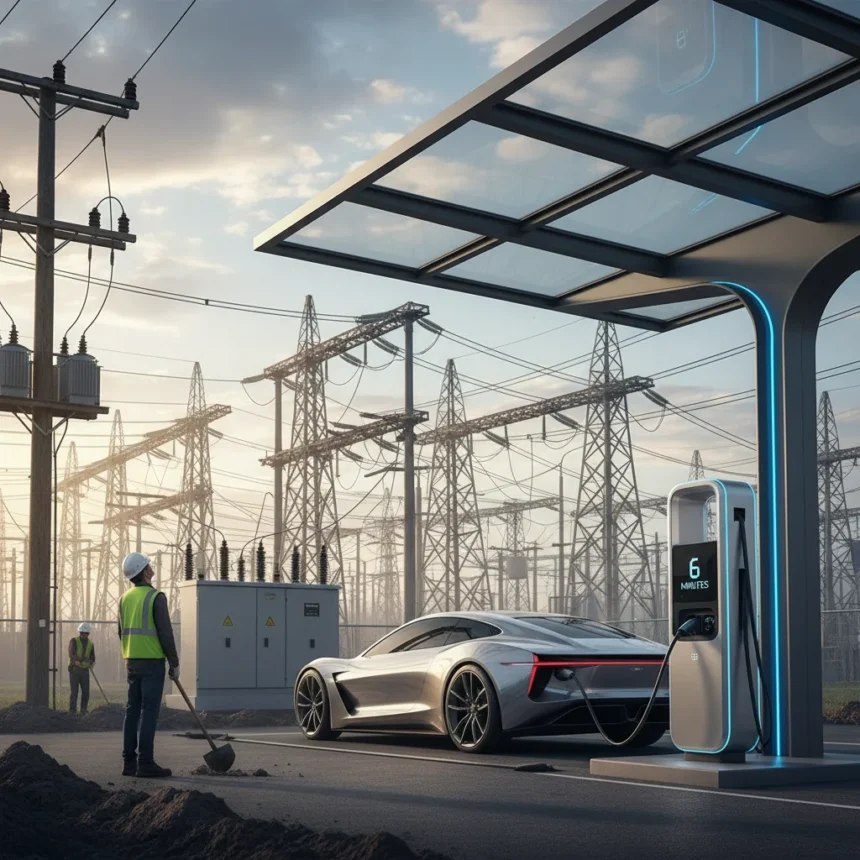
6-minute EV charging has stopped being a distant promise and started becoming a deployed reality. Greater Bay Technology, Nyobolt, BYD, and GAC Aeon have all rolled out vehicles capable of reaching 80% charge in six minutes or less, addressing one of the electric vehicle market’s most persistent pain points. Yet despite these technological breakthroughs, the infrastructure required to make this charging speed practical remains almost entirely absent.
Key Takeaways
- Greater Bay Technology’s Phoenix battery charges 0-80% in 6 minutes across all temperature ranges
- Nyobolt demonstrated a 35kWh battery reaching full charge in under 6 minutes with 250km range, tested for 2,000+ fast charge cycles
- BYD claims 248 miles of charge in 5 minutes using 1-megawatt (1,000kW) charging technology
- GAC Aeon features 480kW charging speed, currently the fastest in the industry
- Ultra-high-power chargers (1MW+) needed for these speeds are not yet widely deployed globally
What 6-Minute EV Charging Actually Means
6-minute EV charging refers to battery systems capable of accepting extremely high power inputs to reach 80% state-of-charge in six minutes or less, eliminating the primary psychological barrier to EV ownership: the wait. Unlike traditional fast chargers that deliver 150-350kW, 6-minute technology requires 480kW to 1,000kW (1 megawatt) power delivery. This is not merely an incremental improvement—it fundamentally changes how people think about electric vehicle refueling, collapsing the gap between a gas stop and an EV charge.
The technological achievement is real. Greater Bay Technology’s Phoenix battery handles this extreme charging rate while maintaining performance in cold temperatures, a historically difficult engineering problem. Nyobolt’s demonstration went further, proving that batteries can endure 2,000+ fast-charge cycles without degradation, suggesting the technology is durable enough for daily use. BYD’s 1-megawatt charger delivers 248 miles of range in just five minutes, a specification that would have seemed impossible three years ago.
The Infrastructure Problem That Kills Adoption
Here is where the story breaks down: these charging speeds require power infrastructure that barely exists. A single 1-megawatt charger demands electrical capacity equivalent to powering 800 homes simultaneously. Most charging networks globally operate at 150-350kW. Even newer ultra-fast networks rarely exceed 500kW. Rolling out 1MW chargers at scale would require substantial grid upgrades, new substations, and distribution infrastructure that utilities have not yet prioritized.

GAC Aeon’s 480kW offering sits in a middle ground—faster than current networks but not requiring the catastrophic infrastructure investment of full 1MW charging. This may explain why it is being positioned as the fastest in the industry rather than racing toward the 1MW ceiling. The real-world deployment landscape suggests that 480-500kW is the practical near-term ceiling, not 1MW.
Consider the geography problem: a highway corridor with ten 1MW chargers spaced 50 kilometers apart would demand more electrical capacity than many regional grids can supply. Battery storage at charging stations could help, but that adds another layer of cost and complexity. The technology works. The infrastructure to use it does not.



Why This Matters Right Now
EV adoption has plateaued in many markets, and charging speed remains cited as a barrier by potential buyers. The announcement of 6-minute charging technologies from established manufacturers (BYD, GAC Aeon) and emerging specialists (Greater Bay Technology, Nyobolt) signals that the industry believes this is the next frontier. But announcing the capability and deploying the infrastructure are entirely different challenges.
The vehicles with 6-minute charging capability are rolling out now, primarily in China, where state investment in charging infrastructure is more aggressive than in Europe or North America. This creates a timing mismatch: early adopters will buy vehicles capable of 6-minute charging and then discover that their local network maxes out at 350kW. That is not a technology failure—it is a deployment failure, and it will frustrate users and slow adoption.
What Comes Next
The next 18-24 months will reveal whether charging infrastructure can catch up to battery capability. If utilities and charging networks prioritize 480-500kW deployments, 6-minute charging becomes practical for highway travel in developed markets. If they stall on infrastructure investment, these batteries become marketing features rather than functional advantages. The technology is proven. The infrastructure race is just beginning, and it is far less certain.
Does 6-minute EV charging work in cold weather?
Greater Bay Technology’s Phoenix battery specifically addresses cold-weather charging, maintaining its 0-80% six-minute charge time across temperature ranges where traditional batteries degrade significantly. This solves a critical real-world problem for drivers in northern climates.



How much does a 1-megawatt charger cost to install?
The research brief does not specify installation costs for 1MW chargers. BYD’s technology uses 1,000kW charging, but pricing and deployment costs for the infrastructure are not disclosed. Utilities and charging networks have not published standardized costs for this tier of equipment.
Which cars have 6-minute charging available now?
Vehicles from BYD, GAC Aeon, Greater Bay Technology, and Nyobolt feature 6-minute charging capability, primarily deployed in China. Specific model names and global availability timelines are not detailed in current announcements, but these manufacturers are leading real-world deployment rather than concept demonstrations.
6-minute EV charging is no longer theoretical—it is here. What remains theoretical is whether the grid can support it at scale. The technology race is won. The infrastructure race is just starting, and that is where the real battle for EV adoption will be decided.
Where to Buy
Edited by the All Things Geek team.
Source: T3