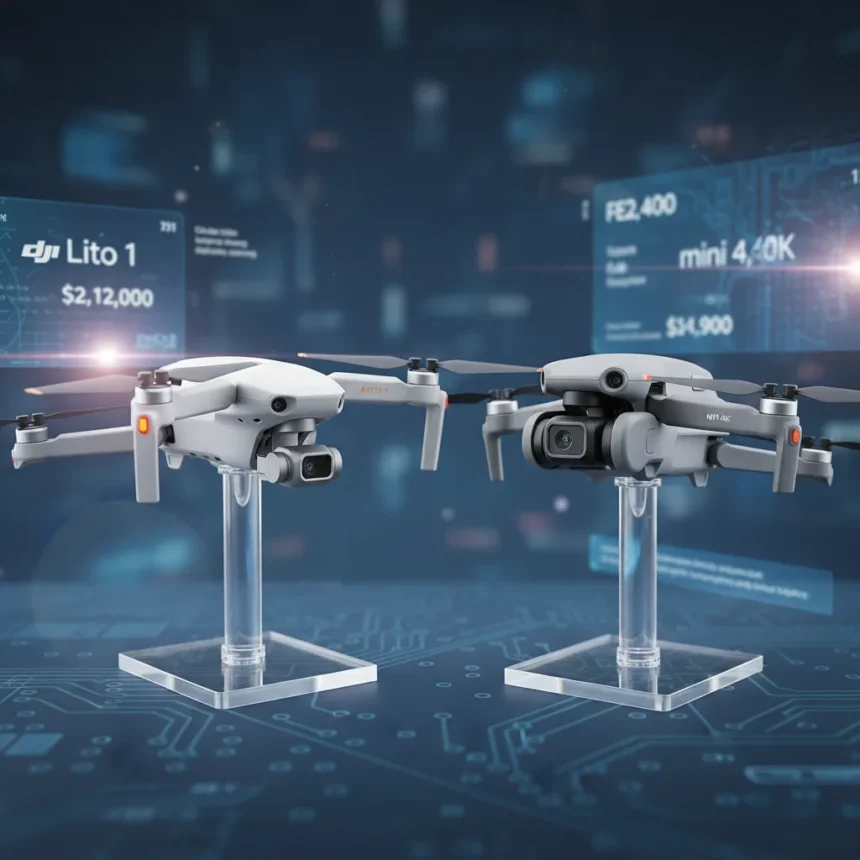
The DJI Lito 1 vs Mini 4K debate matters because DJI just split its beginner drone line, and the newcomer significantly outpaces the older model on nearly every camera spec. But specs don’t always equal real-world value, especially when availability and price shift the equation.
Key Takeaways
- Lito 1 shoots 4K at 60fps; Mini 4K maxes out at 30fps
- Lito 1 has a 48MP sensor vs Mini 4K’s 12MP, with better low-light performance
- Lito 1 includes full-directional safety sensors; Mini 4K has downward-facing vision only
- Lito 1 unavailable in the US; discounted Mini 3 becomes the practical alternative
- Lito X1 (premium tier) offers 10-bit color and superior dynamic range for creators
DJI Lito 1 vs Mini 4K: The Camera Specs Tell the Story
The DJI Lito 1 vs Mini 4K comparison reveals a generational leap in imaging hardware. The Lito 1 packs a 48MP 1/2-inch CMOS sensor that shoots 4K video at up to 60fps with 8-bit color depth, while the Mini 4K relies on a 12MP 1/2.3-inch sensor capped at 4K/30fps. That’s four times the megapixel count and double the frame rate—a massive advantage for anyone wanting smooth slow-motion footage or higher-quality stills.
The Lito 1 also extends its ISO range to 12800 (versus Mini 4K’s 3200), meaning it handles dim indoor spaces and dusk shots with far less noise. Its f/1.7 lens gathers more light than the Mini 4K’s f/2.8 optic. For beginners shooting social media content, these aren’t academic differences—they’re the gap between sharp, usable footage and grainy compromises.
The Mini 4K does retain one advantage: it’s been on the market longer and costs less where available. But on pure imaging capability, it’s outmatched.

Safety Features and Flight Performance: Where Lito 1 Pulls Ahead
DJI’s Lito 1 includes full-directional safety sensors—forward, backward, and sideways obstacle avoidance—while the Mini 4K relies only on downward-facing vision sensors. For beginners learning to navigate tight spaces, that extra awareness is genuinely useful. The Lito 1 also promises 30 minutes of standard flight time, extending to 52 minutes with the optional Intelligent Flight Battery Plus, compared to the Mini 4K’s more modest endurance.
Both drones stay under the 250-gram regulatory threshold in most markets, but the Lito 1 achieves this while packing a larger sensor and more powerful battery. That’s efficient engineering. Neither drone will thrill experienced pilots, but for someone picking up a camera drone for the first time, the Lito 1’s safety suite feels more thoughtful.



Where DJI Lito 1 vs Mini 4K Falls Apart: Availability
Here’s the catch: the Lito 1 doesn’t ship to the US market. If you’re buying in America, the comparison becomes moot. Instead, DJI has discounted the Mini 3 (RC variant) to $379, a 31 percent cut that suddenly makes it the sensible buy for US-based beginners. The Mini 3 isn’t as capable as the Lito 1, but it’s affordable and readily available.
Outside the US, the Lito 1 becomes the stronger value proposition. It offers significantly better specs than the aging Mini 4K at comparable or lower pricing. The real question for non-US buyers is whether to stretch for the Lito X1 instead—DJI’s premium tier in the Lito series, which adds 10-bit D-Log M color and 14 stops of dynamic range for serious content creators.
DJI Lito 1 vs Mini 4K: Should You Upgrade?
If you own a Mini 4K and live outside the US, the Lito 1 offers enough improvements—faster frame rates, better sensors, superior safety features—to justify the switch if you shoot video regularly. The 4K/100fps slow-motion mode alone opens creative possibilities the Mini 4K simply can’t match. Content creators focused on vertical video and social media will notice the difference immediately.
But if you’re starting from scratch, the choice depends on where you live. US buyers should grab the discounted Mini 3. International buyers should compare the Lito 1’s price against the Mini 4K in their region—the Lito will likely win on specs and value. Only consider the Lito X1 if you’re serious about color grading and dynamic range; the extra cost jumps significantly.



How does the Lito 1 compare to the Mini 5 Pro?
The Mini 5 Pro costs roughly three times the Lito 1’s price and features a full 1-inch sensor with 50MP capability, 4K/120fps slow-motion, and superior noise performance at high ISO. It’s the choice for professionals or wealthy enthusiasts. The Lito 1 is the beginner’s smarter path.
Is the DJI Lito 1 worth buying over the Mini 4K?
Yes, if it’s available in your region. The Lito 1 delivers better video frame rates, a larger sensor, more intelligent safety features, and longer flight time for the same or less money. The Mini 4K is aging hardware. Pick the Lito 1 unless you’re in the US, where the discounted Mini 3 becomes your practical alternative.
Can you use the Lito 1 without a remote controller?
The research brief does not specify controller options or smartphone-only operation for the Lito 1. Verify with DJI’s official specs before purchase.
The DJI Lito 1 vs Mini 4K showdown has a clear winner on paper: the Lito 1 dominates in sensors, frame rates, and safety. But geography and pricing shift the real-world verdict. For most buyers outside the US, the Lito 1 is the smarter buy today. US customers stuck with the Mini 3 discount won’t regret it—it’s still solid hardware at a genuine bargain.
Where to Buy
of just $209 (was $299) | DJI Mini 4K drone: | check out all of today's drone deals at Amazon
Edited by the All Things Geek team.
Source: TechRadar