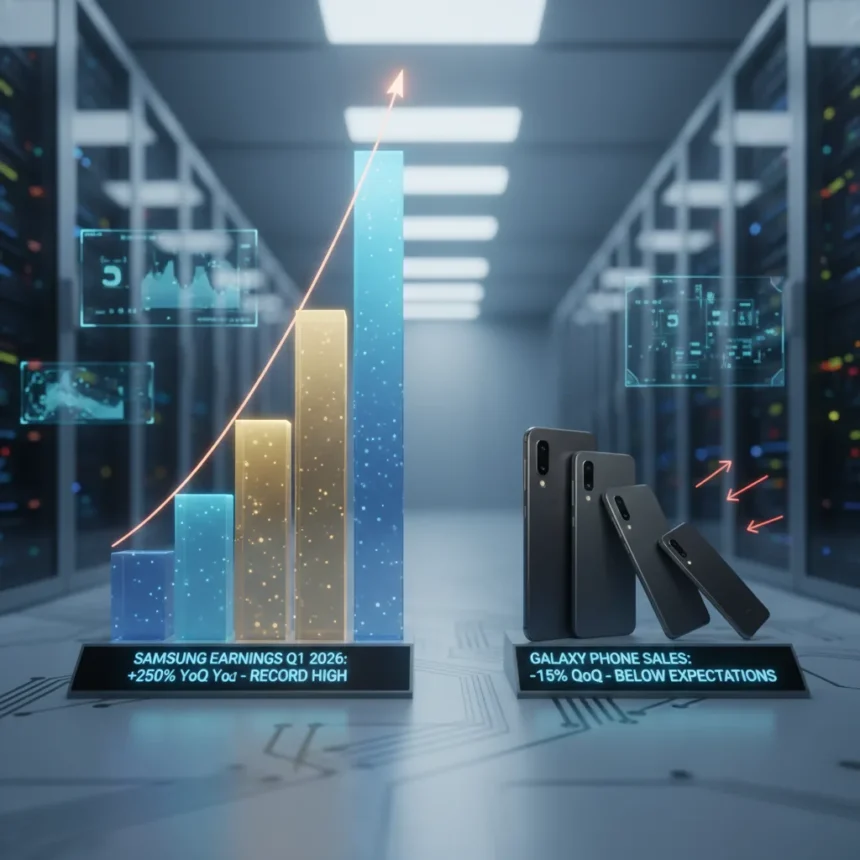
Samsung Q1 2026 earnings delivered a surprise that contradicts the company’s smartphone ambitions: record-breaking profits driven almost entirely by non-phone divisions, while Galaxy devices contributed disappointingly little to the bottom line.
Key Takeaways
- Samsung Q1 2026 earnings reached record levels, defying smartphone market slowdown expectations.
- Galaxy phone sales underperformed relative to overall company profit growth.
- Non-smartphone divisions carried Samsung’s earnings surge in the first quarter.
- The earnings disconnect reveals a widening gap between Samsung’s phone strategy and its actual profit drivers.
- Investors are questioning whether Galaxy phones remain strategically important to Samsung’s future.
Samsung Q1 2026 Earnings: The Smartphone Reality Check
Samsung Q1 2026 earnings reached unprecedented levels, yet the company’s flagship Galaxy phone line barely moved the needle on profitability. This disconnect between overall earnings growth and Galaxy phone contribution exposes a fundamental shift in where Samsung actually makes its money. While the company celebrated record quarterly results, the smartphone division’s modest performance raises uncomfortable questions about the viability of competing in a saturated handset market where margins continue to compress.
The earnings report reveals that Samsung’s profit explosion came from divisions largely invisible to consumers who associate the brand with phones. Memory chips, display panels, and semiconductor manufacturing drove the quarterly surge. These components generate far higher margins than finished consumer devices, and they serve customers across the entire tech industry—not just Samsung’s own ecosystem. This structural advantage has become increasingly obvious to Samsung’s leadership, and the Q1 2026 results make it impossible to ignore.
Why Galaxy Phones Underperformed in Samsung Q1 2026 Earnings
Galaxy phone sales failed to match the growth trajectory of Samsung’s other divisions during Q1 2026, according to the earnings breakdown. Smartphone competition intensified across all price tiers, squeezing unit volumes and forcing manufacturers to discount aggressively. Samsung faced pressure from both premium competitors and budget-focused rivals, leaving little room for margin expansion in the handset category. The company shipped phones, certainly, but the contribution to Samsung Q1 2026 earnings remained surprisingly modest relative to total company profit.


Market saturation in developed regions meant that Galaxy phone growth relied heavily on replacement cycles rather than new customer acquisition. In emerging markets, local manufacturers offered compelling alternatives at lower price points, fragmenting Samsung’s traditional customer base. The smartphone market’s maturity meant that even successful Galaxy launches generated predictable, incremental revenue rather than the explosive growth Samsung’s investors hoped for. This reality stands in sharp contrast to the explosive profitability of Samsung’s component and materials divisions.
Samsung Q1 2026 Earnings: Where the Real Money Comes From
The true story of Samsung Q1 2026 earnings lies in semiconductor manufacturing and display technology. Samsung’s foundry business, which produces chips for other companies, expanded margins significantly. Display division profits surged as demand for OLED panels recovered across multiple industries. Memory chip sales—both DRAM and NAND flash—commanded premium pricing in a market recovering from previous oversupply. These divisions operate at scale, serve multiple customers, and generate returns that dwarf what smartphone manufacturing can achieve.



This earnings composition fundamentally challenges the assumption that Samsung must prioritize Galaxy phones to remain competitive. The company generates more profit from selling OLED screens to competitors than from selling complete Galaxy devices. Samsung’s semiconductor fabs produce chips for Apple, Qualcomm, and dozens of other firms—a customer base far broader and more lucrative than any single smartphone manufacturer could be. The Q1 2026 earnings data makes clear that Samsung’s future prosperity depends far more on manufacturing excellence than on winning the smartphone popularity contest.
The Strategic Implication for Samsung’s Phone Division
Samsung Q1 2026 earnings raise an existential question: how long will Samsung justify massive R&D and marketing investment in Galaxy phones if the division contributes marginally to overall profitability? The earnings report does not suggest Samsung will abandon smartphones entirely, but it does suggest the company may be rethinking how aggressively to compete. A smaller, more focused Galaxy lineup targeting specific profit-rich segments could deliver better returns than trying to maintain market share across every price tier.
Competitors like Apple maintain premium positioning and extract higher margins per device, making smartphone investment worthwhile. Samsung, historically a volume player, faces a harder calculation. The company could optimize for profitability rather than market share, reducing Galaxy phone variants and focusing engineering resources on components and materials where Samsung’s manufacturing advantages are genuinely defensible. Samsung Q1 2026 earnings suggest this shift may already be underway, even if the company has not explicitly acknowledged it.
What Samsung Q1 2026 Earnings Mean for Consumers
For Galaxy phone buyers, the earnings reality could translate into less aggressive innovation cycles and potentially fewer flagship options. Samsung may redirect engineering talent from phone design toward semiconductor and display development, where profit margins justify the investment. This does not mean Galaxy phones will disappear, but it could mean slower iterative improvements and a narrower range of models. Consumers seeking latest smartphone technology might find Samsung’s focus shifting elsewhere.



The earnings disconnect also suggests Samsung may pursue different pricing strategies. If the smartphone division must operate with lower margins, Samsung could either reduce prices to drive volume or exit segments where profitability is unattainable. Neither path excites existing Galaxy customers hoping for innovation. The company’s Q1 2026 earnings demonstrate that Samsung has the financial resources to invest in phones if it chooses to, but the earnings data shows the company is choosing to invest profits elsewhere.
Does Samsung still care about Galaxy phones?
Samsung Q1 2026 earnings suggest the company cares about Galaxy phones as a brand and ecosystem anchor, but not as a primary profit driver. Samsung will continue making phones, but the strategic priority has clearly shifted toward higher-margin components and manufacturing services. The earnings report is essentially Samsung’s way of telling investors that smartphone volume matters less than semiconductor margin.
Why did Galaxy phones contribute so little to Samsung Q1 2026 earnings?
The smartphone market has matured and become highly competitive, compressing margins across the industry. Samsung faces competition from both premium brands like Apple and budget manufacturers in developing regions. Unit volumes may be healthy, but the profit per phone remains thin compared to Samsung’s component divisions, which serve the entire tech industry at premium pricing.
What should Galaxy phone buyers expect going forward?
Samsung Q1 2026 earnings suggest a future where Galaxy phones receive adequate investment to remain competitive but not exceptional resources for breakthrough innovation. Expect evolutionary improvements, selective flagship offerings, and potentially higher prices as Samsung optimizes for profitability rather than market share. The company’s earnings demonstrate it has the financial strength to support phones, but the Q1 results show where Samsung’s true strategic focus lies.
Samsung Q1 2026 earnings tell a story that challenges everything the smartphone industry assumed about the company’s priorities. Record profits driven by components and manufacturing, not phones, represent a fundamental shift in how Samsung generates value. For Galaxy phone enthusiasts, this earnings reality means Samsung’s smartphone division is no longer the company’s growth engine—it is simply one division among many, and increasingly not the most important one. Investors and consumers should adjust expectations accordingly.
Edited by the All Things Geek team.
Source: Android Central