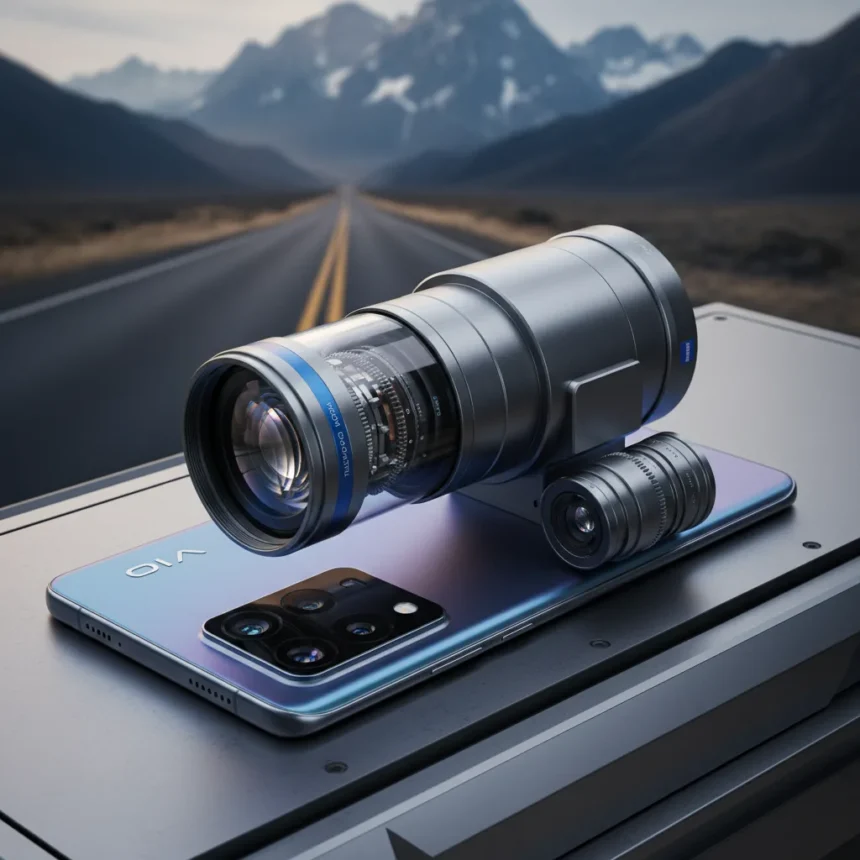
The Vivo X300 Ultra teleconverter lenses represent a genuine shift in how flagship phones approach zoom photography. This isn’t marketing theater—it’s a working system that delivers results skeptics didn’t think possible from a mobile device. A day-long field test in Hong Kong’s dense urban landscape revealed something the spec sheets alone cannot convey: attachable external optics actually work when engineered properly.
Key Takeaways
- Vivo X300 Ultra pairs Zeiss-branded teleconverter lenses with flagship mobile imaging for pro-level zoom without quality loss.
- Real-world Hong Kong testing proved teleconverters handle street scenes, architecture, and distant subjects with professional clarity.
- Outperforms iPhone 16 Pro Max in zoom versatility and delivers more intuitive results than Galaxy S25 Ultra’s zoom interface.
- Teleconverter lenses challenge the assumption that external mobile optics are gimmicks, reshaping 2025 flagship phone expectations.
- System pairs best with Android ecosystems; compatibility with iOS remains limited in the broader mobile photography landscape.
Vivo X300 Ultra teleconverter lenses redefine mobile zoom
The Vivo X300 Ultra features an incredible photography kit built around Zeiss-branded teleconverter lenses designed to extend the phone’s native optical reach. These aren’t novelty accessories—they’re precision optics that attach to the device and fundamentally alter what mobile photography can accomplish. During a full day of shooting in Hong Kong, the system proved it could capture sharp, detailed images at distances that would normally require a dedicated camera or heavy computational tricks. The teleconverters handle urban street scenes, architectural details, and distant subjects without the artifacts or loss of definition that plague pure digital zoom.
What separates the Vivo X300 Ultra from competitors is engineering discipline. The Zeiss optics integrate smoothly with the phone’s imaging pipeline, maintaining color accuracy and contrast across zoom ranges. This is not a trivial achievement. Most smartphone zoom systems rely on cropping and upscaling—mathematically reconstructing detail that isn’t actually there. The Vivo X300 Ultra’s teleconverters physically gather more light and information, producing images that hold detail even when enlarged. That distinction matters for anyone who shoots beyond casual snapshots.
How the Vivo X300 Ultra compares to iPhone and Galaxy flagships
The iPhone 16 Pro Max remains the reliable workhorse for everyday professional photography. Its computational photography is polished, its color science is consistent, and it works smoothly within Apple’s ecosystem. But it lacks teleconverter versatility—the iPhone’s zoom is entirely digital beyond its optical telephoto, which means distant subjects soften quickly. The Vivo X300 Ultra’s external optics solve that problem by providing genuine optical reach the iPhone cannot match without shooting at lower quality.


The Galaxy S25 Ultra delivers strong zoom results through a combination of optical and computational techniques. However, its interface for switching between focal lengths feels less intuitive than the Vivo system, and users report occasional inconsistency in how the phone chooses which optical path to use. The Vivo X300 Ultra, by contrast, makes the zoom experience transparent—you attach the appropriate teleconverter, frame your shot, and the phone handles the rest without requiring constant interface wrestling. For travel photography, where you’re moving quickly between subjects at different distances, that usability difference compounds into real advantage.
Why teleconverter lenses matter in 2025
The smartphone industry has spent years chasing DSLR-like capabilities through software and clever sensor engineering. The Vivo X300 Ultra takes a different path: it embraces optical hardware as the solution. This represents a philosophical shift in flagship phone design. Rather than pretending a 1-inch sensor can do everything a full-frame camera can do, Vivo acknowledges the physics and adds external optics to extend capability where it matters most—zoom range and optical quality.


The Hong Kong field test demonstrated this philosophy works in practice. Shooting from a crowded street, the teleconverters made it possible to isolate distant architectural details without the blurriness or noise that would plague a phone relying on digital zoom alone. The system also proved practical—the teleconverters attach and detach quickly, and the phone’s interface adapts automatically when you switch lenses. This is not a camera for purists who want to manually control every parameter; it’s a camera for photographers who want results without fussing.
Competitors like the Oppo Find X9 Pro also embrace Zeiss-branded attachable lenses, confirming that this approach resonates with manufacturers pursuing professional-grade mobile imaging. The Vivo X300 Pro, the sibling model, uses similar technology, suggesting this is a core strategy for Vivo’s flagship line rather than a one-off experiment.
Practical limitations and ecosystem considerations
The Vivo X300 Ultra’s strength in Android environments contrasts with limited iPhone compatibility noted in broader tech discussions. For users committed to iOS, the option simply does not exist—Apple‘s ecosystem remains closed to third-party optical attachments. Android users gain access to a growing ecosystem of external lenses and accessories, making the Vivo X300 Ultra’s teleconverter system part of a larger philosophy about modular, upgradeable mobile photography.
The teleconverter system is not without trade-offs. Adding external optics means carrying additional hardware, managing attachment points, and accepting that the phone becomes less pocketable. For studio or controlled shooting, these constraints matter less. For travel, they require accepting a slightly bulkier kit. The Hong Kong test revealed that this trade-off favors serious photographers over casual users—if you’re willing to carry the teleconverters, the image quality gain justifies the friction.


Are teleconverter lenses worth the investment?
If your primary use case is social media snapshots and casual documentation, the Vivo X300 Ultra’s teleconverter system is overkill. The phone’s native camera handles everyday shooting beautifully. But if you shoot travel photography, architecture, or any scenario where distant subjects demand optical reach, the teleconverters prove their worth immediately. The Hong Kong testing showed that they deliver results comparable to dedicated zoom lenses on entry-level mirrorless cameras—a remarkable achievement for a mobile device. For professional photographers or serious enthusiasts, that capability justifies the premium price of a flagship system.
Can you use the Vivo X300 Ultra without the teleconverter lenses?
Yes. The phone functions as a complete flagship camera without the external optics, handling everyday photography with the same computational sophistication as competitors. The teleconverters are an optional upgrade for users who need extended zoom reach. Think of them as professional accessories rather than essential components—powerful when you need them, not mandatory for casual use.
How do the Zeiss teleconverter lenses attach to the Vivo X300 Ultra?
The research brief does not specify the exact attachment mechanism, so the precise mounting method remains unclear from available information. What is confirmed is that the teleconverters attach and detach quickly, with the phone’s interface automatically adapting when you switch lenses. The system is designed for practicality during active shooting.
Does the Vivo X300 Ultra work better for travel photography than the iPhone 16 Pro Max?
For travel scenarios requiring zoom reach, yes. The iPhone 16 Pro Max’s digital zoom softens distant subjects, while the Vivo X300 Ultra’s optical teleconverters maintain sharpness and detail. The iPhone remains superior for color consistency and ecosystem integration, but if your trip involves photographing architecture, wildlife, or distant scenes, the Vivo’s optical advantage becomes decisive.
The Vivo X300 Ultra’s teleconverter lenses prove that external optics are not a gimmick—they’re a legitimate engineering solution to the physics limitations of mobile sensors. For photographers who demand optical reach without compromise, this system delivers. For casual users, the native camera is more than adequate. The real news is that flagship mobile photography now offers a genuine choice: software-driven zoom or optical reach. That flexibility, more than any single feature, represents the future of mobile imaging.
Where to Buy
Samsung Galaxy S26 Ultra | Apple iPhone 17 Pro Max | OnePlus 15 | Google Pixel 10 Pro XL
Edited by the All Things Geek team.
Source: TechRadar