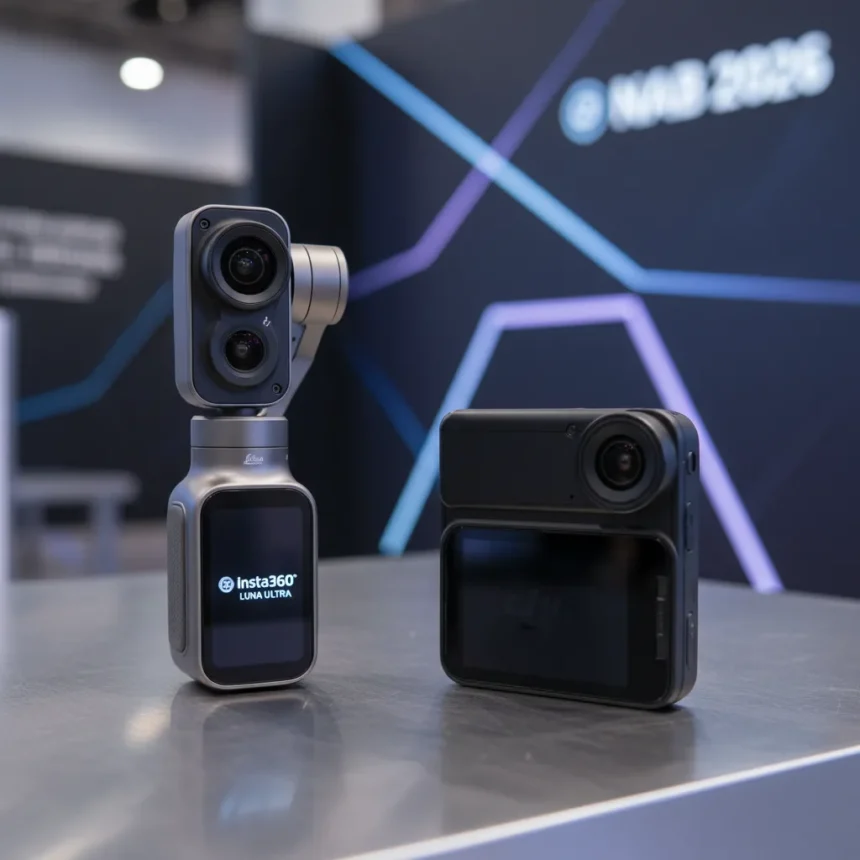
Insta360 Luna Ultra is a dual-lens pocket gimbal co-engineered with Leica, officially teased at NAB Show 2026 in Las Vegas (April 18-22) as a direct competitor to DJI’s Osmo Pocket series. The Luna Ultra represents Insta360’s most aggressive entry into the gimbal market, adding telephoto capability and a larger battery than DJI’s flagship offering.
Key Takeaways
- Insta360 Luna Ultra features dual lenses with 1-inch sensor and F1.8 aperture, co-engineered with Leica
- Luna series includes two models: Luna Pro (single-lens) and Luna Ultra (dual-lens with telephoto)
- Both cameras offer 10-bit color and variable focal length on a 3-axis gimbal
- Luna Ultra battery (1550mAh) exceeds DJI Osmo Pocket 3’s 1300mAh capacity
- Official specs remain under wraps; first 14-second footage showed impressive stabilization
Insta360 Luna Ultra Specs and Design
The Insta360 Luna Ultra pairs a wide-angle lens with a telephoto lens mounted on a 3-axis gimbal, delivering optical zoom capability absent from DJI’s current Osmo Pocket lineup. Both Luna Pro and Luna Ultra share a 1-inch sensor with an F1.8 aperture, 10-bit color recording, and variable focal length—matching DJI’s sensor class but expanding the optical toolset. The Ultra model’s dual-lens architecture lets creators frame shots without moving the gimbal itself, a significant workflow advantage for vlogging and travel content.
Insta360 displayed the Luna Ultra behind frosted glass at its NAB booth, deliberately obscuring full details while confirming the dual-lens design. A brief teaser video released at NAB showed 14 seconds of footage from the Luna Ultra, demonstrating stabilization quality that suggests the gimbal handles motion as smoothly as established competitors. The camera is available in two color options, though Insta360 has not yet revealed which finishes will ship at launch.
How Insta360 Luna Ultra Stacks Against DJI Osmo Pocket
The Luna Ultra directly targets DJI’s Osmo Pocket 3 and rumored Pocket 4, but with architectural advantages that reshape the pocket gimbal category. Where DJI’s Osmo Pocket 3 relies on a single fixed lens and digital zoom, the Luna Ultra’s dual-lens design adds true optical zoom, letting creators switch perspectives without crop loss. The battery capacity difference is meaningful too: Luna Ultra’s 1550mAh battery outpaces the Osmo Pocket 3’s 1300mAh, potentially extending runtime for longer shoots.

DJI has dominated the pocket gimbal space for years by combining compact form factor with reliable stabilization. The Luna Ultra challenges that dominance by offering telephoto reach and Leica’s optical engineering—two elements DJI’s current Osmo Pocket lineup does not emphasize. However, DJI’s ecosystem advantage (app maturity, accessory availability, established creator base) remains significant. Insta360 will need to prove the Luna Ultra’s real-world performance and software reliability match the marketing promise.
Leica Partnership and Optical Engineering
The Luna series is co-engineered with Leica, bringing the German optics house’s reputation for precision glass to a consumer gimbal. Leica’s involvement signals Insta360’s commitment to optical quality rather than relying on software enhancement alone. The F1.8 aperture is bright enough for low-light vlogging without excessive noise, and the 10-bit color pipeline preserves dynamic range for color grading.



This partnership echoes Leica’s collaborations with smartphone makers, where the brand lends optical credibility to mobile cameras. For Insta360, the Leica co-engineering claim serves as a differentiator against DJI, which sources its Osmo Pocket optics from unnamed suppliers. Whether Leica’s involvement translates to measurably superior image quality remains to be seen—the teaser footage is too brief to judge rendering, color science, or autofocus performance.
What About the Luna Pro?
Alongside the Luna Ultra, Insta360 is launching a Luna Pro with a single-lens design. The Pro model shares the 1-inch sensor, F1.8 aperture, 10-bit color, and 3-axis gimbal stabilization, but drops the telephoto lens. This two-tier strategy mirrors DJI’s approach: offer a base option for cost-conscious buyers while reserving the premium features (dual lenses, zoom) for the Ultra. The Luna Pro likely targets creators who prioritize simplicity and lower cost over telephoto flexibility, though Insta360 has not yet announced pricing or a specific release date.
NAB 2026 Reveals and Broader Insta360 Updates
Beyond the Luna series, Insta360 used NAB 2026 to preview other hardware and software updates. The company announced a new Mic Pro wireless microphone system, positioning it as a competitor to DJI’s Mic 3 Ultra. Insta360 also revealed the GO Ultra Tadej Pogačar Edition—a branded variant of its tiny action camera—and major Flow app updates including multi-lens support for Samsung Galaxy S26 Ultra, faster 360-degree panorama capture, Dual View Mode, and Apple Watch control. These announcements position Insta360 as a diversified creator-hardware company, not just a gimbal maker.
When Will Insta360 Luna Ultra Launch?
Insta360 has not announced a release date or pricing for the Luna Ultra or Luna Pro. The NAB teaser suggests a launch is imminent, likely within weeks or months of the show, but the company is clearly building anticipation rather than rushing to availability. Early social media teasers on Instagram invite exclusive sneak peeks, a common strategy to grow a waitlist before official preorders. Creators and tech enthusiasts should expect a formal announcement with full specs, pricing, and availability details in the coming weeks.



Is the Insta360 Luna Ultra worth waiting for?
If you shoot vlogging or travel content and need optical zoom without changing lenses, the Luna Ultra’s dual-lens design offers genuine workflow advantages over DJI’s Osmo Pocket. However, DJI’s ecosystem maturity and proven reliability remain compelling reasons to wait for reviews and real-world testing before switching. Leica’s optical partnership is a meaningful credibility signal, but it does not guarantee the Luna Ultra will outperform DJI in autofocus speed, color accuracy, or software stability.
How does the Luna Ultra’s battery compare to other pocket gimbals?
The Luna Ultra’s 1550mAh battery exceeds DJI Osmo Pocket 3’s 1300mAh capacity, suggesting longer runtime between charges. Larger batteries typically extend recording time by 15-30 minutes depending on gimbal load and stabilization intensity, a practical advantage for full-day shoots. Insta360 has not yet disclosed exact runtime figures, so direct comparison will require hands-on testing after launch.
Insta360 Luna Ultra arrives at a pivotal moment for pocket gimbals. DJI has owned this category for years, but the Luna Ultra’s dual-lens architecture and Leica partnership represent a credible challenge. The real test comes after launch—when creators can compare image quality, autofocus performance, and software reliability head-to-head. Until then, the frosted-glass tease at NAB 2026 tells us Insta360 is serious about competing, but not yet whether it can dethrone DJI’s market dominance.
Where to Buy
Insta360 X5 | Insta360 X4 | Insta360 Go 3S | Insta360 X4 Air | Insta360 Ace Pro 2
Edited by the All Things Geek team.
Source: T3