The Dyson PencilWash is a cordless wet floor cleaner made by Dyson, launched as the company’s most affordable wet cleaning option at $349 USD, available via Dyson and Amazon. It weighs just 4.6 pounds total—with only 0.84 pounds in hand—and features an ultra-slim 38mm handle designed to slide under low furniture and clean tight spaces. The appeal is immediate: a lightweight, hygienic mop that looks like it belongs in a modern home, not a utility closet. But after weeks of real-world testing, reviewers have uncovered a fundamental problem that no amount of design polish can fix.
Key Takeaways
- Weighs 4.6 pounds total, 0.84 pounds in hand; handle is 38mm ultra-slim for under-furniture cleaning
- Cordless runtime up to 30 minutes per charge; clean water tank covers 1,076 sq ft per fill
- Microfiber roller with 64,000 filaments per cm² refreshed via 8 hydration points; automatic dirt extraction per rotation
- Two cleaning modes—Standard for everyday, MAX for spot-cleaning stains
- Lacks suction and self-cleaning; poor on grout gaps, sticky messes, uneven floors without suction power
Why the Dyson PencilWash Impresses at First Glance
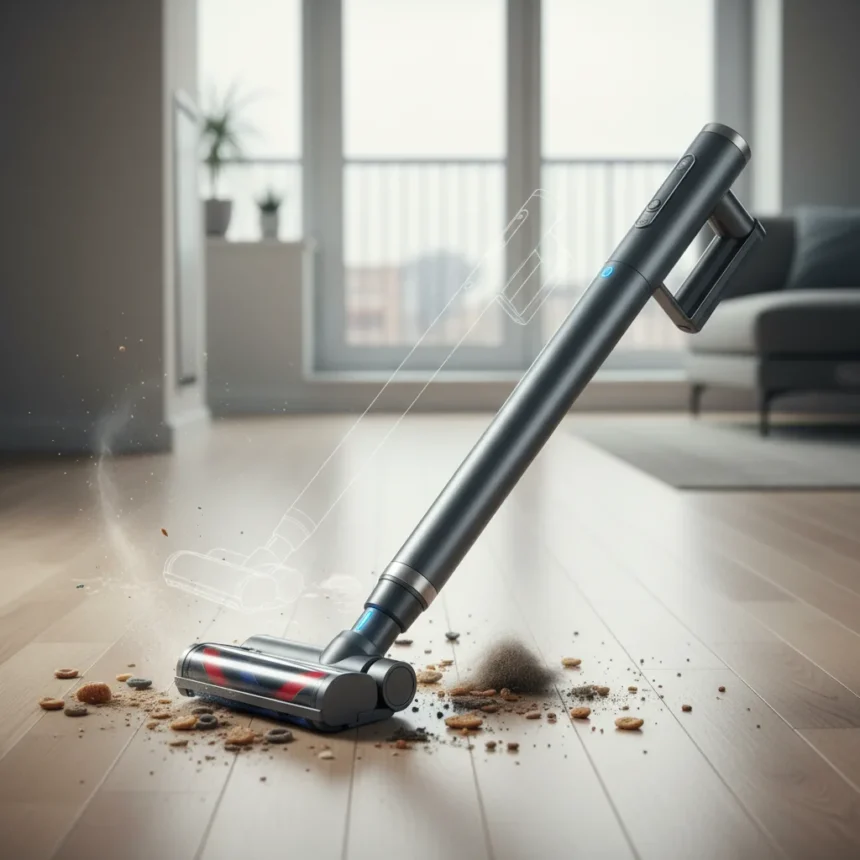
The Dyson PencilWash delivers on ergonomics and ease of use. The machine offers smooth, effortless forward propulsion, which makes cleaning feel easy and actually fun, according to reviewers. The lie-flat design—tilting to 170 degrees with just 15cm ground clearance—lets you reach under sofas and beds without contorting yourself. At 4.6 pounds, it is genuinely light enough that you can clean your entire home without arm fatigue. The design is sleek and the copper colorway looks premium sitting in a corner.
The cleaning mechanism itself is clever. The microfiber roller applies fresh water via eight hydration points for even coverage while simultaneously extracting dirty water and debris with each rotation. Users report that floors dry quickly and the machine actually removes grime instead of spreading it around like a regular mop. For everyday dust, light spills, and surface-level dirt on hard floors—tiles, marble, vinyl, laminate, sealed wood—the PencilWash performs adequately. The two modes, Standard for routine cleaning and MAX for stains, give you some flexibility.
The Critical Flaw: No Suction, No Self-Cleaning
Here is where the PencilWash stumbles. The machine lacks suction and self-cleaning capabilities—features that competitors like the Tineco S9 and Roborock F25 include as standard. This omission becomes painfully obvious when you encounter anything sticky, dried-on, or ground into grout gaps. Dried oatmeal, spilled syrup, or debris wedged between tiles? The PencilWash cannot extract it without suction. You end up pushing water around without actually lifting the mess, which defeats the purpose of an electric mop. On uneven floors or grout lines, the roller simply cannot make contact evenly, leaving streaks and residue behind.

The self-cleaning gap is equally frustrating. The roller is not cleaned automatically in the dock—you must manually wash it under running water after every use, air-dry it before reattaching, and replace it every six months. Reviewers describe this maintenance routine as tedious, especially when the roller does not fully dry in the dock. For a $349 investment, this manual upkeep feels archaic compared to competitors that handle roller cleaning automatically.
Maintenance and Real-World Usability
The PencilWash charges for 3.5 hours and runs for up to 30 minutes per charge. The clean water tank holds 0.3L (300ml), which covers up to 1,076 square feet per tank—adequate for apartment-sized spaces but limiting for larger homes. You will refill frequently if you have more than 1,000 square feet to cover. The dirty water tank is 0.36L.



Post-cleaning maintenance requires four steps: empty and rinse both tanks, wash the roller under running water, wipe down the machine, and air-dry the roller before reattaching. It sounds simple on paper, but in practice, this routine adds friction to daily use. The dock is charge-only with a drip tray—it does not auto-clean the roller, which means you are doing manual maintenance every single time. Dyson recommends using their proprietary Dyson 02 Probiotic hard floor cleaning solution for a deeper clean with probiotic action, which adds another consumable cost to the ownership experience.
Dyson PencilWash vs. Traditional Mops and Competitors
The PencilWash occupies an awkward middle ground. It is more expensive than a traditional mop but offers less capability than suction-equipped wet cleaners. A regular mop costs $20 and requires no charging or maintenance beyond rinsing. A Tineco or Roborock wet cleaner costs more but includes suction and self-cleaning, making them genuine upgrades for sticky messes and grout. The PencilWash is lighter and more elegant than either, but that design advantage evaporates when you cannot clean effectively. You are paying a premium for form over function.
Who Should Buy the Dyson PencilWash?
The PencilWash makes sense only for a narrow use case: someone with hard, flat floors (no grout, no sticky spills), who values design and ease of everyday cleaning over deep-clean capability, and who does not mind manual roller maintenance. If your home has primarily smooth tiles, vinyl, or sealed wood and you clean up spills immediately, the PencilWash will keep your floors looking spotless. If you have pets, kids, grout lines, or a tendency to let spills dry, skip it. The lack of suction is not a minor trade-off—it is a fundamental limitation that undermines the entire value proposition at this price point.
Is the Dyson PencilWash worth $349?
The PencilWash is Dyson’s most affordable wet floor cleaner, but affordability does not equal value. At $349, you are paying for design and lightweight convenience, not for cleaning power. If you have simple cleaning needs and love the aesthetic, it is defensible. If you expect it to handle real-world messes like a traditional wet cleaner, you will be disappointed.



How does the Dyson PencilWash compare to the Tineco S9?
The Tineco S9 includes suction and self-cleaning—capabilities the PencilWash lacks entirely. The S9 will extract sticky debris and dried-on messes that the PencilWash cannot touch. The trade-off is weight and complexity. The PencilWash is lighter and simpler, but simpler does not mean better when the core job is incomplete.
Do you need the Dyson 02 Probiotic solution for the PencilWash?
Dyson recommends their proprietary Dyson 02 Probiotic hard floor cleaning solution for deeper cleaning with probiotic action. You can technically use water alone for basic cleaning, but the solution is designed to maximize the machine’s limited cleaning capability. It is an additional recurring cost worth factoring into the total ownership expense.
The Dyson PencilWash is a design success and a cleaning compromise. It looks beautiful, feels light in your hand, and handles everyday dust without breaking a sweat. But the moment you face a sticky spill, dried-on debris, or grout gaps, its lack of suction becomes a deal-breaker. For a $349 investment, you deserve a wet cleaner that cleans, not one that looks good while failing at its primary job. Unless your floors are pristine and your messes are minimal, the PencilWash is a stylish disappointment.
Where to Buy
Shark HydroVac Cordless | £5.99
Edited by the All Things Geek team.
Source: T3