





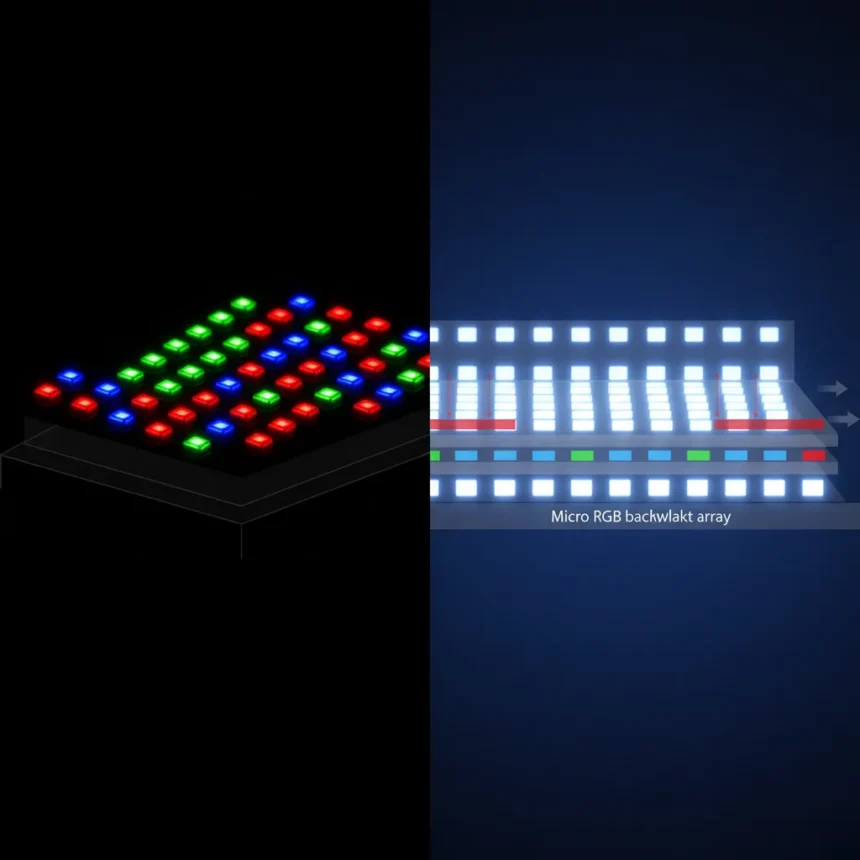
Micro-LED vs Micro RGB TVs represent two competing approaches to next-generation television displays, each with fundamentally different architectures and performance characteristics. Understanding these differences matters because they determine picture quality, manufacturing complexity, and ultimately the price you pay.
Key Takeaways
- Micro-LED uses self-emissive pixels where each pixel contains its own RGB LEDs
- Micro RGB places individually controlled RGB LEDs in a backlight array behind an LCD panel
- Self-emissive Micro-LED delivers true blacks and infinite contrast ratios
- Micro RGB offers brighter peak brightness and lower manufacturing costs than Micro-LED
- Both technologies aim to improve upon traditional LED and Mini-LED backlighting
How Micro-LED and Micro RGB Architectures Differ
The core distinction between Micro-LED vs Micro RGB TVs lies in pixel architecture. True Micro-LED displays use self-emissive pixels, meaning each individual pixel contains its own red, green, and blue LED elements. These pixels emit light independently, without requiring a separate backlight layer. This design eliminates the need for a backlight entirely, giving Micro-LED displays complete control over every pixel’s brightness and color.
Micro RGB TVs work differently. They place individually controlled RGB LEDs in a backlight array positioned behind a standard LCD panel. The LCD layer acts as a shutter, controlling how much light from the backlight passes through to reach the viewer. While the RGB elements are individually addressable, they still function as a backlight system rather than as self-emissive pixels. This fundamental difference cascades through performance, brightness, and cost implications.
Picture Quality: Where Micro-LED vs Micro RGB TVs Diverge
Micro-LED vs Micro RGB TVs deliver distinctly different picture quality characteristics because of their opposing light-emission strategies. Micro-LED’s self-emissive architecture enables true blacks—when a pixel is off, it emits zero light, creating genuinely dark areas on screen. This results in infinite contrast ratios, since the darkest blacks sit next to the brightest whites with no backlight bleed or halo effects. For content with dark scenes, night sequences, or moody cinematography, Micro-LED provides uncompromising shadow detail.



Micro RGB TVs cannot match this black level performance because light from the backlight array inevitably bleeds through the LCD layer, even when pixels are supposed to be dark. However, Micro RGB achieves higher peak brightness levels than Micro-LED because the backlight array can concentrate more light output in specific zones. This makes Micro RGB better suited for bright rooms and HDR content that demands intense highlights. The trade-off is contrast—you gain brightness but sacrifice the true black levels that Micro-LED delivers.
Manufacturing Complexity and Cost Implications
The architectural difference between Micro-LED vs Micro RGB TVs directly affects production difficulty and price. Micro-LED requires manufacturing millions of microscopic LED elements and assembling them into a single panel with pixel-level precision. This complexity makes Micro-LED expensive to produce and currently limits availability to premium models and specialized applications. Yield rates remain challenging, and scaling production to mainstream price points has proven difficult.



Micro RGB simplifies manufacturing by reusing proven LCD panel technology paired with a more manageable backlight array. Producers can leverage existing LCD supply chains and expertise, reducing production costs significantly. This cost advantage allows Micro RGB to reach broader market segments at more accessible price points. For manufacturers, Micro RGB represents an incremental improvement over Mini-LED rather than a revolutionary redesign, making it a more pragmatic near-term solution.
Which Technology Should You Care About?
Choosing between Micro-LED vs Micro RGB TVs depends on your priorities and budget. If you prioritize perfect blacks, infinite contrast, and the absolute best picture quality regardless of cost, Micro-LED is the superior choice. It’s the technology that will define flagship displays for the next decade. However, Micro-LED TVs remain rare and expensive, limiting real-world availability.
If you want improved brightness, better HDR performance, and better value, Micro RGB delivers meaningful upgrades over traditional Mini-LED at a more reasonable cost. It’s the pragmatic choice for most buyers in the near term, offering genuine performance gains without the manufacturing barriers that constrain Micro-LED supply.
Will Micro-LED eventually replace Micro RGB?
Micro-LED has superior technical capabilities, but manufacturing economics favor Micro RGB in the short term. As Micro-LED production matures and costs decline, it will likely become the dominant technology for premium displays. Micro RGB may occupy the mid-range segment for years before Micro-LED scales down to mainstream prices.



Can you upgrade from Micro RGB to Micro-LED?
No. These are fundamentally different display technologies that cannot be retrofitted. Upgrading requires replacing the entire panel, which means buying a new TV. This is why understanding the difference before purchase matters—you’re committing to one architecture for the lifespan of the display.
Is Micro RGB better than traditional Mini-LED?
Yes. Micro RGB offers finer control over individual LED elements in the backlight array, delivering better contrast and brightness uniformity than traditional Mini-LED. However, it still cannot match Micro-LED’s true black levels because it retains the LCD layer and backlight structure inherent to the Mini-LED design.
Micro-LED vs Micro RGB TVs represent a clear technological fork in display evolution. Micro-LED offers the superior image quality for those who can access and afford it, while Micro RGB provides a practical stepping stone that improves on current technology without the production complexity. As manufacturing scales, Micro-LED will eventually dominate, but Micro RGB will likely remain the mainstream choice for the next several years.
Edited by the All Things Geek team.
Source: Tom's Guide




