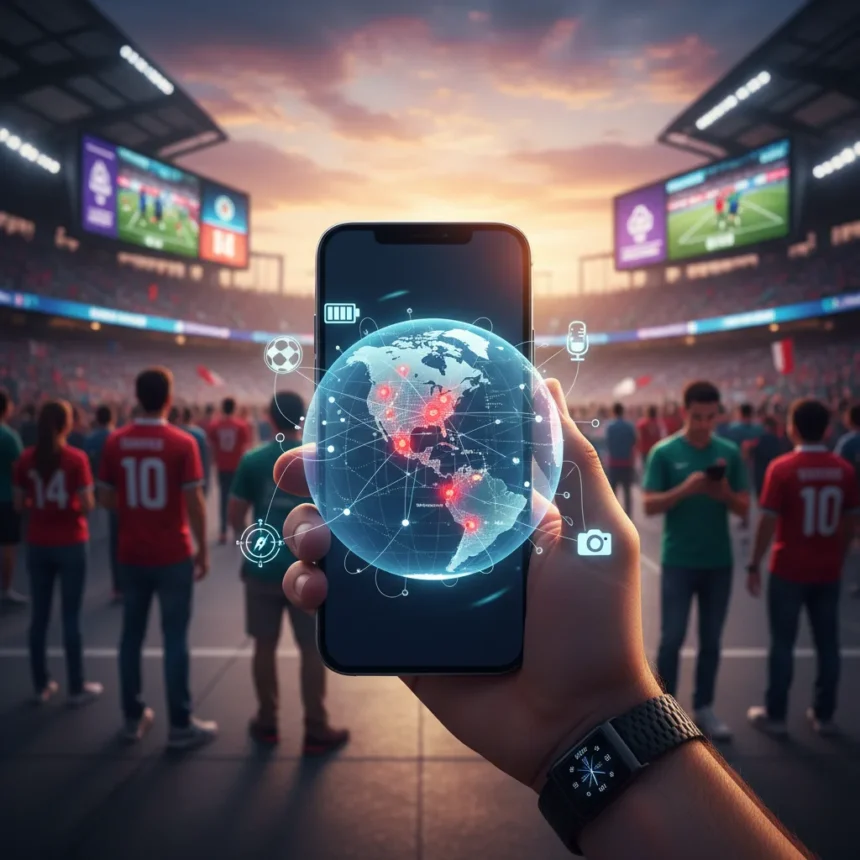
The 2026 FIFA World Cup smartphone demands will separate the prepared fans from the frustrated ones. This tournament is unprecedented: 48 teams, 104 matches, and matches spread across 16 cities in the United States, Mexico, and Canada from June 11 to July 19, 2026. That geographic sprawl means constant travel, relentless stadium crowds, and network strain that will expose any weakness in your phone’s battery, connectivity, or performance.
Key Takeaways
- 2026 FIFA World Cup spans three countries with 48 teams and 104 matches—the largest World Cup ever.
- Battery capacity of 5,000mAh+ with 65W+ fast charging essential for multi-day travel without outlets.
- 5G/6G support with verified band compatibility across US, Mexico, and Canada required for crowded stadiums.
- eSIM or multi-SIM capability mandatory for seamless international roaming across three nations.
- Flagship phones from 2024 or later recommended; mid-range devices struggle with heat and crowd-induced network congestion.
Battery Life: The Non-Negotiable Spec
Battery capacity separates survival from frustration at a tournament of this scale. Fans traveling across multiple countries and attending consecutive matches cannot rely on finding a charger between games. Devices with 5,000mAh or larger batteries paired with adaptive battery technology will stretch usage through full match days, navigation between stadiums, and constant streaming or photo capture. The combination of heat, crowd density, and high-brightness outdoor viewing drains batteries faster than typical use. Fast charging rated at 65W or higher becomes essential—a 20-minute charge break between matches beats a dead phone in the 89th minute.
Portable chargers rated 10,000mAh or higher are not optional accessories; they are survival gear. Fans should enable power-saving modes during travel days when they are not actively watching matches or navigating. Phones like the Samsung Galaxy S25 Ultra deliver extended battery endurance specifically designed for travel scenarios where charging infrastructure is unpredictable.
Connectivity Across Three Nations: The 5G Band Puzzle
The 2026 FIFA World Cup smartphone connectivity challenge extends beyond simply having 5G—it demands verified band compatibility across three separate countries with different network infrastructures. The United States operates 5G on bands n71 and n260; Mexico relies on n28 and n78; Canada uses n66 and n78. A phone that supports US 5G may fail in Mexico unless it covers band n28. Before traveling, verify your device’s exact 5G bands against your carrier’s coverage maps for each destination.


eSIM support eliminates the friction of swapping physical SIM cards at airports or hunting for local carriers. Major carriers across all three countries now offer eSIM plans priced between $10–20 per day for international roaming bundles, with expanded options launching in Q2 2026 as the tournament approaches. Test eSIM activation before departure—a failed activation in a Mexican stadium is worse than no backup plan. Wi-Fi 6E connectivity will handle stadium hotspots and hotel networks, but public Wi-Fi cannot be your primary connectivity strategy during matches when millions of fans flood networks simultaneously.
Display and Streaming Performance in Crowded Stadiums
High-refresh-rate displays become practical necessities, not luxury specs, when streaming live matches or watching replays in direct sunlight. A 120Hz or 144Hz display reduces motion blur when panning across stadium action or scrolling through FIFA+ and YouTube highlights. Apps like FIFA+ and YouTube should be downloaded pre-tournament; adjusting stream resolution to 720p in crowded network conditions prevents buffering that ruins live viewing. Picture-in-picture mode lets fans follow multiple matches or keep navigation visible while watching—a feature that separates flagship phones from mid-range devices.



Storage capacity of 256GB minimum prevents the constant deletion cycle that plagues fans trying to capture match footage, player photos, and stadium moments across a month-long tournament. RAW photo capture enables post-match editing with better detail recovery than compressed formats, while night mode becomes essential for evening matches where stadium lighting varies dramatically. Telephoto lenses rated 5x zoom or higher let fans photograph distant action from upper-deck seats without digital interpolation that degrades image quality.
Navigation and Offline Capability Across 16 Cities
Pre-loading offline maps using Google Maps or Apple Maps prevents the dead-phone navigation scenario that derails travel schedules. Fans moving between 16 different cities cannot assume cellular coverage in transit zones, parking areas, or rural routes between stadiums. Syncing maps with smartwatches enables hands-free turn-by-turn directions while carrying bags or tickets, freeing attention for stadium navigation and security lines. A phone without reliable offline navigation in unfamiliar cities becomes a liability, not a tool.
AI Features for Translation and Photo Enhancement
AI-powered translation tools become practical assets when moving between English-dominant US venues, Spanish-speaking Mexican stadiums, and French-English Canadian cities. Real-time translation for stadium signage, ticket information, and local directions reduces friction across language barriers. AI photo enhancement automatically optimizes match photos for lighting conditions that vary wildly between indoor and outdoor venues, producing shareable content without manual editing expertise.
Which Phones Actually Handle It
Flagship phones from 2024 or later provide the baseline capability to manage the demands of the 2026 FIFA World Cup smartphone requirements. Samsung Galaxy S25 Ultra leads for battery endurance and travel-optimized features. iPhone 17 Pro Max integrates smoothly with Apple’s ecosystem of maps, translation, and photo tools. Google Pixel 10 Pro excels at AI-powered photography and real-time translation. OnePlus 14 delivers competitive 5G performance at lower price points. These devices all offer IP68 dust and water resistance—essential when navigating crowded stadiums, unexpected weather, or accidental beverage spills during celebrations.


Mid-range phones like the Pixel 9a or budget 5G devices without verified band compatibility for all three countries will struggle. Heat management deteriorates in crowds, batteries drain faster under network congestion stress, and slower processors create lag when switching between navigation, streaming, and photography apps during high-intensity moments.
Foldables and Rugged Alternatives
Foldable phones like the Galaxy Z Fold7 offer multitasking advantages—watching a match on one screen while checking stadium directions on another—but their larger form factors and higher price points may not justify the benefit for tournament attendance. Rugged phones like the Motorola Razr 60 Ultra prioritize durability over performance, which may appeal to fans attending outdoor matches in unpredictable weather, though they sacrifice some processing power for travel convenience.
FAQ
What is the best phone for the 2026 FIFA World Cup?
Flagship phones from 2024 or later with 5,000mAh+ batteries, verified 5G band support for US/Mexico/Canada, eSIM capability, and IP68 durability ratings handle tournament demands. Samsung Galaxy S25 Ultra, iPhone 17 Pro Max, and Google Pixel 10 Pro are specifically optimized for this use case.
Do I need 5G for the 2026 FIFA World Cup?
5G support is essential for streaming live matches and navigating crowded stadiums where 4G networks become congested. However, verify your phone supports the specific 5G bands used in each country—US (n71/n260), Mexico (n28/n78), Canada (n66/n78)—before traveling. Phones lacking band compatibility will default to slower 4G.
How much battery capacity do I need for World Cup travel?
Minimum 5,000mAh with 65W+ fast charging, paired with a 10,000mAh portable charger. Full-day tournament attendance involving navigation, streaming, photography, and social sharing will drain even flagship batteries by evening without supplemental charging.
The 2026 FIFA World Cup smartphone demands are real, but they are not mysterious. Pick a recent flagship with verified band compatibility, pack a portable charger, and test eSIM activation before you board your flight. The fans who arrive prepared will spend a month capturing memories; the ones who ignore these specs will spend a month frustrated by dead batteries and dropped connections in the moments that matter most.
Edited by the All Things Geek team.
Source: T3