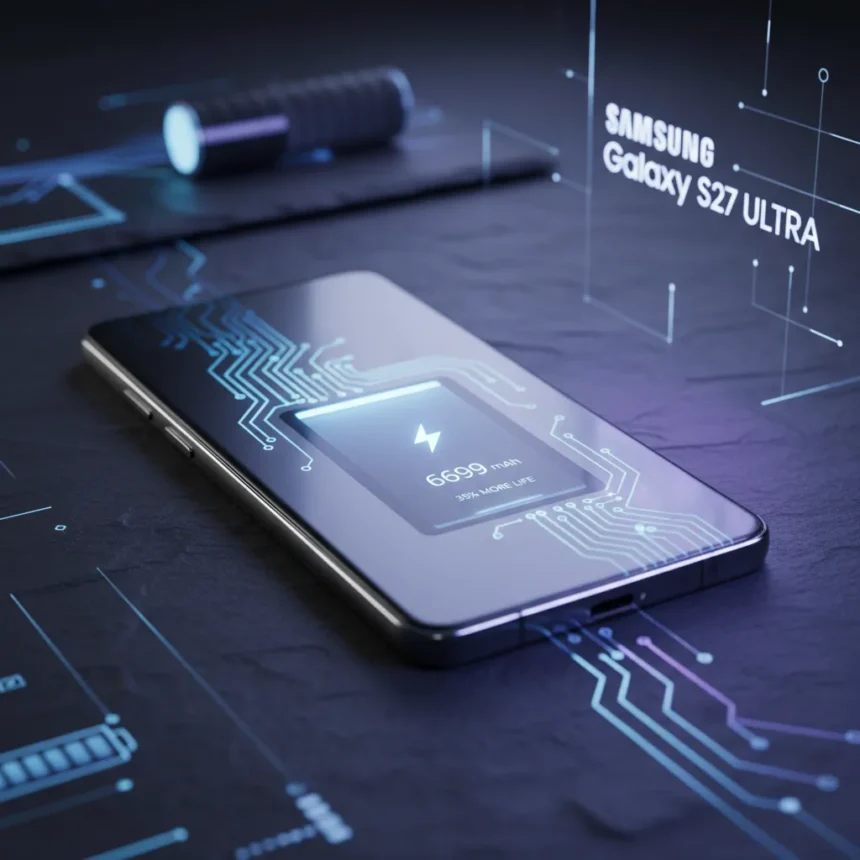
The Galaxy S27 Ultra battery upgrade could finally end Samsung’s embarrassing stagnation on its flagship line. For seven years, Samsung has stuck with a 5,000 mAh battery in its Ultra models—a constraint that has frustrated users and handed competitive advantage to rivals pushing 6,000-7,000 mAh capacities. Now, leaked testing data suggests the S27 Ultra could jump to 6,699 mAh using silicon-carbon (Si-C) technology, potentially delivering nearly 35% more battery life than the Galaxy S26 Ultra.
Key Takeaways
- Galaxy S27 Ultra leaks indicate 6,699 mAh silicon-carbon battery, up from S26’s 5,000 mAh
- Si-C batteries retain 80% capacity after 1,500 charge cycles versus 500-1,000 for lithium-ion
- Samsung has tested capacities up to 20,000 mAh in Si-C form factor, though durability concerns emerged
- Galaxy S26 represents a transitional year before S27’s battery breakthrough
- Thinner packaging with higher capacity addresses Samsung’s competitive battery weakness
Why Samsung’s Battery Stagnation Matters Now
Samsung’s refusal to move beyond 5,000 mAh has become a liability. The Galaxy S26 Ultra perpetuates a design choice that began with the Galaxy S20 Ultra in 2020, a decision that made sense then but looks defensive today. Meanwhile, competitors have been climbing steadily, with several flagship alternatives now exceeding 6,000-7,000 mAh. Samsung’s own Galaxy Z TriFold manages 5,600 mAh despite stricter US regulations, proving the company knows how to pack larger cells into premium devices. The S26 Ultra’s battery was always going to feel like a holding pattern, and that’s precisely what it is—Samsung is waiting for the S27 to deliver real innovation.
The timing of these leaks matters. Samsung has publicly acknowledged falling behind in battery innovation, and the S27 Ultra is positioned as the flagship that finally corrects course. Leaks reveal Samsung is testing silicon-carbon batteries in multiple capacities: 12,000 mAh, 18,000 mAh (using three cells of 6,699 mAh, 6,000 mAh, and 5,257 mAh), and 20,000 mAh configurations. This breadth of testing suggests Samsung is serious about finding the right balance between capacity, durability, and form factor.
Silicon-Carbon Technology: The Real significant shift
Silicon-carbon batteries represent a genuine leap forward compared to traditional lithium-ion. The key advantage is energy density—Si-C cells can achieve higher capacity in the same physical footprint, or maintain capacity while slimming the cell thickness. For the S27 Ultra, leaks indicate Samsung is targeting a single 6,699 mAh cell just 4.2 mm thick, a density that would have been impossible with older chemistry. This matters because it means Samsung could increase battery capacity without making the phone noticeably thicker or heavier, a constraint that has haunted the company’s flagship design for years.


Durability is where Si-C shows its muscle. Samsung’s testing data indicates these batteries are expected to retain 80% capacity after at least 1,500 charge cycles, compared to 500-1,000 cycles for modern lithium-ion cells. That translates to roughly four to five extra years of usable lifespan before the battery degrades to the point where users notice performance drops. One caveat: Samsung’s testing of a 20,000 mAh configuration failed after just 960 cycles, suggesting that pushing too far into extreme capacities introduces reliability risks. This is likely why the leaked S27 Ultra targets 6,699 mAh rather than the theoretical maximum—it’s the sweet spot where capacity gains meet proven durability.
What This Means for Galaxy S27 Ultra Buyers
If these leaks hold, the Galaxy S27 Ultra battery upgrade would be the most significant improvement Samsung has made to its flagship line in years. A jump from 5,000 mAh to 6,699 mAh is not just a percentage bump—it’s a statement that Samsung is no longer content to compete on processor speed and camera megapixels while accepting defeat on the one metric users care about most: how long the phone lasts between charges. The Galaxy S27 lineup is predicted to increase capacities by several hundred mAh across all models, not just the Ultra.



The S26 Ultra, by contrast, will feel like yesterday’s phone the moment the S27 launches. At 5,000 mAh, it continues a seven-year design tradition that was already stale. Samsung is essentially asking buyers to wait one more generation for the battery breakthrough everyone has been demanding. For those considering an upgrade from an older flagship, the S26 Ultra is now a poor choice—the S27 Ultra will offer dramatically better longevity without any apparent trade-offs in thickness or weight.
The S Pen Sacrifice and Other Design Decisions
One intriguing detail from the leaks: Samsung originally planned to redesign the S Pen for the S27 Ultra by removing the digitizer and switching to a hybrid EMR/active electrostatic system, which would have allowed a thinner phone. That plan appears to have been shelved in favor of prioritizing the battery upgrade. This decision reveals Samsung’s priorities—the company decided that users would rather have all-day battery life than a marginally thinner phone with a redesigned stylus. It’s a pragmatic choice that aligns with what users have been asking for.
When Will the Galaxy S27 Ultra Actually Arrive?
Samsung has not announced an official launch date, but the S27 lineup is expected in 2027 based on the company’s typical two-year refresh cycle. That means the Galaxy S26 Ultra, launching in 2025, is explicitly designed as a transitional product—a way to keep the flagship line relevant while Samsung completes testing on the Si-C battery technology. It’s an unusual approach, but it explains why the S26 feels like a holding pattern rather than a major leap forward.
Should You Wait for the Galaxy S27 Ultra or Buy the S26 Now?
If battery life is your primary concern, waiting for the S27 Ultra is the smarter move. The Galaxy S26 Ultra’s 5,000 mAh capacity will feel dated the moment the S27 launches with its 6,699 mAh silicon-carbon battery. If you need a phone today and your current device is struggling, the S26 Ultra is still a capable flagship with a premium processor and excellent camera system. But know that you are buying a transitional device, not Samsung’s best effort at battery technology. The real innovation is coming in 2027.



Are silicon-carbon batteries better than lithium-ion?
Yes, for capacity and longevity. Silicon-carbon cells pack more energy into the same size, retain charge better over thousands of cycles, and degrade more slowly than traditional lithium-ion. The trade-off is manufacturing complexity—Si-C batteries are harder to produce at scale, which is why Samsung is still in testing phase rather than mass production.
Will the Galaxy S26 Ultra get a silicon-carbon battery?
No. Earlier rumors suggested Samsung might bring Si-C tech to the S26 Ultra, but those did not materialize. The S26 will stick with its 5,000 mAh lithium-ion cell, cementing its role as a stepping stone to the S27.
How much longer will the Galaxy S27 Ultra battery last than the S26?
Leaks indicate the S27 Ultra’s 6,699 mAh silicon-carbon battery could deliver nearly 35% more capacity than the S26 Ultra’s 5,000 mAh. In real-world use, this translates to significantly longer time between charges, though exact duration depends on your usage patterns and the efficiency of the S27’s processor and display.
The Galaxy S27 Ultra battery upgrade is not just a spec bump—it represents Samsung finally admitting that its seven-year stagnation at 5,000 mAh was a mistake. Silicon-carbon technology gives the company a credible path forward, one that delivers capacity without compromise. The S26 Ultra will be remembered as the phone Samsung released while waiting for the real breakthrough. If you can hold off until 2027, the S27 Ultra will be worth the wait.
Edited by the All Things Geek team.
Source: Tom's Guide