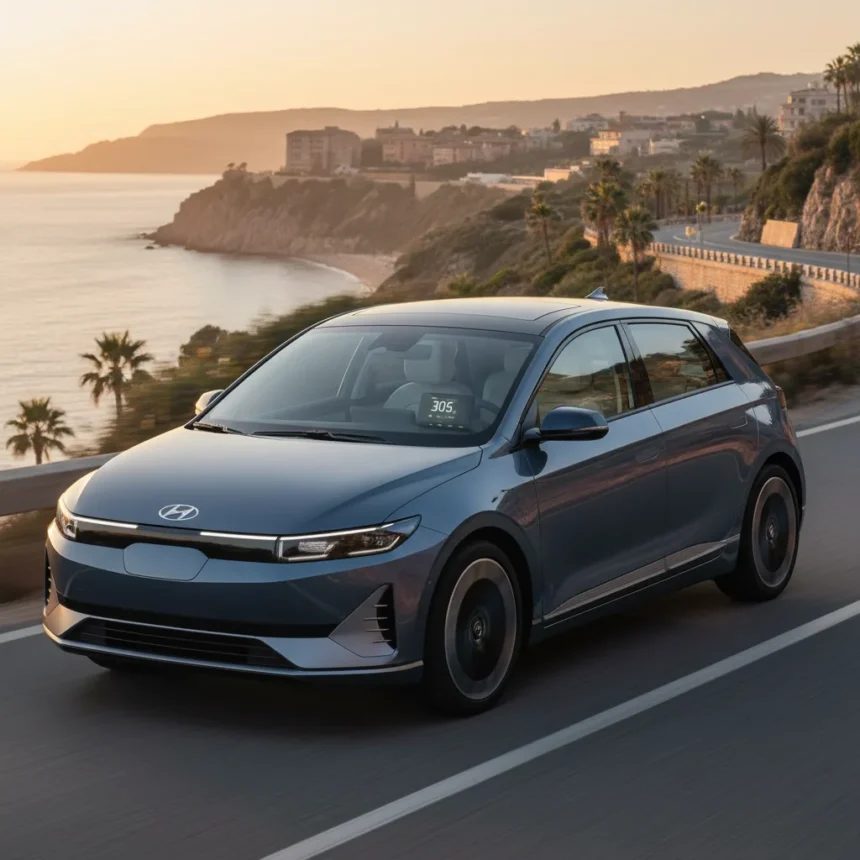
The Hyundai Ioniq 3 is a compact, all-electric five-door hatchback built on the E-GMP architecture, designed to prove that small cars don’t mean cramped interiors. With an estimated range up to 376 miles, Android Automotive infotainment, and a design philosophy called Furnished Space that treats the cabin like a living room rather than a traditional car dashboard, the Ioniq 3 challenges the assumption that compact hatchbacks must sacrifice comfort for size.
Key Takeaways
- Hyundai Ioniq 3 offers up to 376 miles of range with the larger 81.4 kWh battery, matching the Kia EV3 platform.
- Front-wheel-drive single motor produces 150 hp or optional 201 hp variant; dual-motor AWD possible in future versions.
- Android Automotive powers the infotainment system with optional 12.9-inch or 14.6-inch displays and AI voice recognition.
- Sales launch mid-2026 in Europe; production based in Turkey with no confirmed U.S. availability.
- Vehicle-to-Load (V2L) technology supports up to 3.6 kW power output for external devices.
Interior Design Reimagines the Compact Hatchback
Hyundai’s Furnished Space design language treats dashboard components, storage, and controls as individual furniture pieces rather than integrated wraparound surfaces. This approach creates a warm, intuitive living environment in what could otherwise feel like a cramped compact car. The flat floor and stretched wheelbase deliver generous legroom and headroom despite the hatchback’s modest external footprint, making the Ioniq 3 feel larger than competitors like the Volkswagen Golf or Ford Focus.
The 441-liter luggage compartment provides practical storage for a compact car, while the bridge-type center console houses cupholders and open storage within arm’s reach. A compact steering wheel with a flattened bottom and a chunky center pad featuring Hyundai’s logo in Morse code (four dots) adds personality without sacrificing functionality. This design detail signals that the Ioniq 3 doesn’t take itself too seriously—a refreshing contrast to the sterile minimalism dominating modern EV interiors.
Hyundai Ioniq 3 Battery and Performance Specs
The Hyundai Ioniq 3 shares its battery options with the Kia EV3, its sister model on the same E-GMP platform. Two battery capacities are available: a 58.3 kWh option delivering an estimated 271 miles of range, and an 81.4 kWh battery pushing the range to 376 miles. The aerodynamic design, inherited from the Concept THREE that debuted at IAA 2025, may allow the Ioniq 3 to exceed these estimates through improved efficiency.


The base front-wheel-drive motor generates 150 horsepower, accelerating from zero to 62 mph in approximately 7.5 seconds with a top speed of 105 mph. A more powerful 201 hp variant is available for those seeking quicker acceleration, while a dual-motor all-wheel-drive setup is expected in later model years. DC fast charging supports up to 128 kW, allowing a preconditioned battery to charge from 10 to 80 percent in about 30 minutes.
Android Automotive and Connected Features
The Hyundai Ioniq 3 debuts Pleo Connect infotainment running Android Automotive, marking a significant shift in Hyundai’s software strategy. The system offers 12.9-inch or 14.6-inch touchscreen displays with AI-powered voice recognition and optional Apple CarPlay Ultra for full-screen integration without traditional mirroring. Physical controls remain below the touchscreen, preserving tactile access to essential functions—a design choice that avoids the all-screen trap that frustrates drivers in other modern EVs.



Connected technologies include Hyundai Digital Key 2 for smartphone-based vehicle access, Plug & Charge for seamless DC fast charging, and wireless charging pads for compatible devices. The Vehicle-to-Load (V2L) feature supplies up to 3.6 kW of power through an on-board 230V socket and exterior port, enabling the car to power external appliances or tools. Motion-sensing smart keys, heated seats and steering wheel, ambient lighting, and an optional panoramic roof round out the feature set.
How Does the Ioniq 3 Compare to the Kia EV3?
The Hyundai Ioniq 3 and Kia EV3 share identical powertrains, batteries, and charging speeds because both ride the E-GMP architecture. The critical difference lies in aerodynamics and design philosophy. The Ioniq 3’s sleeker, more aerodynamic profile—derived from the Concept THREE’s flowing roofline, pushed-forward cowl, and ducktail spoiler—may deliver superior efficiency and range despite identical battery packs. Where the EV3 emphasizes rugged, boxy styling, the Ioniq 3 pursues a streamlined hatchback aesthetic that appeals to drivers seeking classic proportions with modern EV credentials.
Hyundai positions the Ioniq 3 between the smaller Inster and the larger Kona Electric, filling a gap in the compact segment that the EV3 also occupies in Kia’s lineup. For European buyers, the choice between them will hinge on brand preference and styling rather than technical capability—they’re fundamentally the same car in different clothes.
When Will the Ioniq 3 Launch and Where?
The Hyundai Ioniq 3 launches for sales in mid-2026, following its world premiere on April 20, 2025. Production is based in Turkey, supporting European distribution as Hyundai’s primary target market. The United States will not receive the Ioniq 3, as Hyundai focuses this model on European consumers. Regional availability will roll out progressively across Europe starting mid-2026, though specific pricing remains unconfirmed.



Does the Ioniq 3 offer all-wheel drive?
Hyundai has not yet confirmed a dual-motor all-wheel-drive variant for the Ioniq 3, though it is expected to arrive in later model years. The launch version will feature front-wheel drive with either 150 hp or 201 hp motor options. AWD capability is possible on the E-GMP platform, as proven by other Ioniq and Kia models, so it’s a reasonable expectation for future updates.
What safety features does the Ioniq 3 include?
The Ioniq 3 equips seven airbags and active safety systems including Forward Collision-Avoidance Assist, Lane Keeping Assist, Blind-Spot View Monitor, and Rear Cross-Traffic Collision-Avoidance Assist. These systems address common accident scenarios in urban and highway driving, though Hyundai has not released comprehensive crash test ratings or autonomous driving capabilities for this model.
The Hyundai Ioniq 3 proves that reinventing the compact hatchback doesn’t require radical styling or unproven technology—it requires thoughtful interior design, efficient engineering, and software that respects the driver. By launching with Android Automotive and the Furnished Space philosophy, Hyundai signals that it’s serious about competing with traditional hatchback makers and newer EV startups alike. European buyers who want a spacious, practical electric hatchback with 300+ miles of range will have a compelling option when the Ioniq 3 arrives mid-2026, though U.S. customers will need to look elsewhere.
Edited by the All Things Geek team.
Source: TechRadar