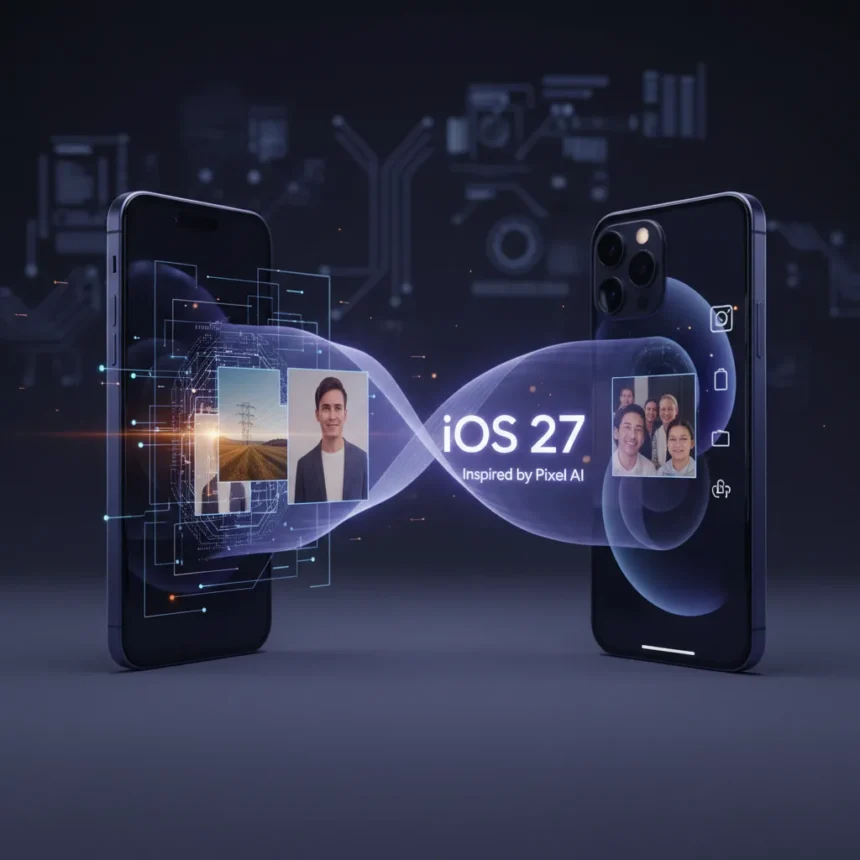
Google Pixel AI photo tools have become the gold standard for mobile image editing, and Apple is finally taking notice. According to reports, Apple is developing its own suite of AI-powered photo-editing capabilities for iOS 27, including features to extend, enhance, and reframe images using on-device processing. The timing matters: WWDC 2026 is approaching, and iOS 27 represents Apple’s chance to close a gap that has widened over the past two years.
Key Takeaways
- Google Pixel AI photo tools include Magic Eraser, Photo Unblur, and generative image expansion.
- Apple’s iOS 27 is rumored to add extend, enhance, and reframe capabilities to compete.
- Apple’s current Clean Up tool removes objects but lacks the sophistication of Google’s alternatives.
- Google’s Ask Photos feature demonstrates natural-language photo search Apple should replicate.
- Theft Detection Lock is another Android feature Apple may adapt for iPhone security.
What Google Pixel AI photo tools do better right now
Google Pixel’s AI photo editing suite operates on a philosophy of intelligent simplification. Magic Eraser removes unwanted objects smoothly. Photo Unblur sharpens blurry shots. Generative image expansion fills in missing areas of a photo by intelligently guessing what should be there. These are not minor tweaks—they represent core computational photography features that fundamentally change how users interact with their phone cameras.
Apple’s current photo-editing arsenal feels dated by comparison. Clean Up removes objects from photos, but the results often fall short of Google’s standard. The gap is particularly visible when handling complex backgrounds or detailed subjects. A user trying to remove a photobomber from a landscape shot will find Clean Up produces visible artifacts where Google’s Magic Eraser blends smoothly. This is not a matter of opinion—it is a matter of algorithmic sophistication and on-device processing power.
The real news is that Apple recognizes this gap. Rumors suggest iOS 27 will introduce an Enhance feature for color and lighting adjustments, an Extend capability for generative image expansion, and a Reframe tool for spatial photos. These are not coincidental similarities. Apple is explicitly building features to match Google’s playbook.


iOS 27 photo editing tools: Apple’s catch-up strategy
Apple’s rumored iOS 27 photo tools may appear under a new Apple Intelligence Tools section in the Photos app, signaling a broader push toward on-device AI. This is significant because it suggests Apple is moving beyond incremental improvements and toward a complete reimagining of how iOS handles image manipulation.
The extend and reframe features are particularly interesting. Extend would work similarly to Google’s generative expansion, allowing users to add content beyond the original frame. Reframe targets spatial photos, letting users shift perspective after the shot is taken. Both features require substantial computational resources and neural processing—exactly the kind of work that separates flagship phones from mid-range devices.



What remains unclear is whether Apple will match Google’s execution speed. Google has been shipping these features for over a year. Apple’s versions will arrive later in 2026 at the earliest. In mobile tech, a year is a generation. By the time iOS 27 launches, Google will have already iterated on its AI photo tools, refined them based on user feedback, and possibly introduced new capabilities that Apple will then need to chase.
Beyond photo editing: the broader iOS 27 AI picture
Photo tools are only part of Apple’s rumored iOS 27 overhaul. The update is also expected to include a dedicated Siri app, overhauled search functionality, system-wide grammar checking, and prompt-based photo search modeled after Google’s Ask Photos feature. Ask Photos demonstrates how natural language can unlock photo libraries—users can search for specific moments using conversational queries rather than tags or dates.
Apple may also be building its own version of Theft Detection Lock, one of Android’s most underrated security features. This tool detects when a phone is being used by someone other than the owner and locks it down accordingly. For a company that emphasizes privacy and security, this is a logical addition.
The pattern is clear: Apple is not just copying individual features. It is rebuilding iOS around AI as a foundational layer rather than a bolt-on enhancement. This is a significant shift in strategy and reflects how thoroughly Google’s approach has influenced the industry.



Why Apple is playing catch-up instead of leading
The question worth asking is why Apple fell behind in the first place. The company has the computational resources, the neural engine hardware in every iPhone, and the engineering talent to have built these features years ago. The answer likely lies in Apple’s cautious approach to on-device AI and its focus on privacy-first processing.
Google took a different path. It shipped features faster, iterated publicly, and accepted that some early versions would be imperfect. This aggressive timeline allowed Google to establish itself as the AI phone leader before Apple had even committed to the category. By the time Apple decided to move, the narrative was already set.
This does not mean Apple’s eventual implementation will be inferior. Apple’s on-device processing and privacy guarantees may ultimately deliver a better user experience than Google’s approach. But arriving second means playing defense, not offense. iOS 27 will be judged against whatever Google has shipped by mid-2026, not against what Google shipped in 2024.
Will iOS 27 photo tools actually match Google’s?
Feature parity on paper does not guarantee parity in practice. Apple’s Enhance, Extend, and Reframe tools may work differently than Google’s equivalents. The neural models may be trained on different datasets. The UI may guide users toward different use cases. These subtle differences matter enormously in real-world usage.
One advantage Apple has is integration. iOS 27 photo tools will be baked directly into the Photos app and likely available system-wide through APIs. Google’s best features remain concentrated in the Google Photos app and Pixel-specific interfaces. If Apple can make AI photo editing as accessible as the native camera app, adoption could be swift.
What about other Android AI features Apple should copy?
Photo editing is only one category where Android leads. Theft Detection Lock is another. This feature detects unauthorized access attempts and locks the device, protecting against physical theft in ways iPhone currently does not. It is a small feature with enormous practical value for anyone who has ever worried about losing their phone in public.
Beyond security and photos, Google’s natural-language search capabilities through Ask Photos represent a broader shift in how users interact with their device libraries. Apple’s rumored prompt-based photo search for iOS 27 suggests the company recognizes this trend.
When will iOS 27 actually ship?
iOS 27 is expected to arrive later in 2026, likely announced at WWDC 2026 in June. This means the photo tools discussed here are still months away from reaching users. For anyone currently frustrated with Clean Up’s limitations, the wait will feel long.
Should iPhone users switch to Pixel for AI photo editing now?
If AI photo editing is your primary use case, Google Pixel offers a more mature, feature-complete solution today. Magic Eraser and Photo Unblur are not theoretical capabilities—they work, they are fast, and they produce results that exceed what iOS currently offers. However, switching phones is a major decision driven by dozens of factors beyond a single feature category. For most users, waiting for iOS 27 and evaluating Apple’s execution makes more sense than abandoning the iPhone ecosystem.
Will Apple’s AI photo tools be free?
The research brief provided does not specify pricing or whether these features will require a subscription. Apple Intelligence features are expected to work on-device, but specific cost details have not been confirmed in available reports.
What makes Google Pixel’s AI photo tools special?
Google Pixel’s advantage stems from years of computational photography research, massive datasets for training neural models, and aggressive shipping timelines. Magic Eraser and Photo Unblur do not just remove or sharpen—they reconstruct missing information intelligently. This requires sophisticated machine learning models trained on millions of images. Google’s scale and AI expertise give it a structural advantage that takes years to replicate.
Apple is not behind because it lacks the capability. It is behind because it chose a different path: slower, more private, more cautious. iOS 27 represents a recalibration of that strategy. Whether it succeeds depends not on feature parity but on execution quality. If Apple’s Extend, Enhance, and Reframe tools work as well as Google’s equivalents, the company can reclaim leadership. If they arrive buggy or half-baked, Apple’s reputation for polish suffers. The stakes are higher for followers than for leaders.
Edited by the All Things Geek team.
Source: Tom's Guide