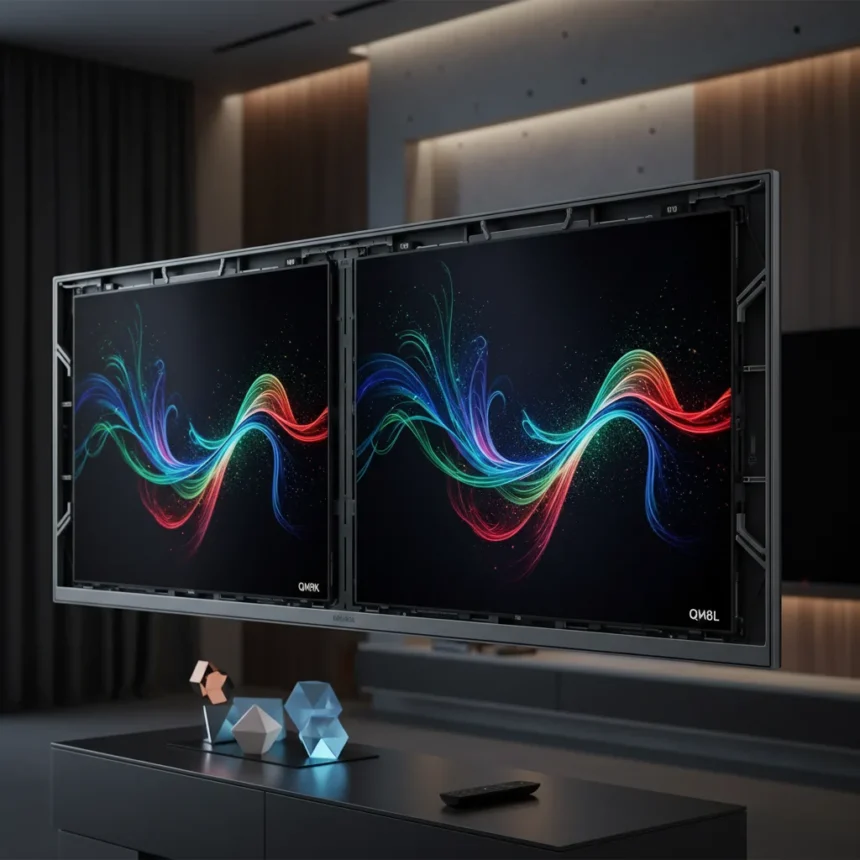
The TCL QM8L vs QM9K comparison matters right now because TCL is betting that its new Super Quantum Dot (SQD) technology justifies buying the QM8L over a proven Mini-LED champion. Both TVs launch in 2025-2026, both use Google TV, and both promise premium performance at mainstream prices. But Tom’s Guide testing reveals the real story: the QM8L wins, but only by a little.
Key Takeaways
- TCL QM8L uses Super Quantum Dot (SQD) technology; QM9K uses Mini-LED backlighting
- QM8L measured at 3,719 nits HDR brightness; QM9K reached 5,413 nits in HDR Standard mode
- QM8L 65-inch launched at 2,499 USD, dropped to 1,799 USD at Best Buy
- QM8L offers superior color range and lower input latency than QM9K
- Performance gap is marginal; both are nearly identical in design and features
What Makes the TCL QM8L Different
The TCL QM8L vs QM9K showdown hinges on one fundamental difference: display technology. The QM8L is TCL’s first mainstream Super Quantum Dot TV, a new backlighting approach designed to deliver QD-OLED-level color without the burn-in risk. The QM9K, by contrast, is a traditional Mini-LED set — and Tom’s Guide called it the pinnacle of Mini-LED performance when it launched. On paper, SQD sounds revolutionary. In practice, the differences are real but subtle.
The QM8L covers 90 percent of the BT.2020 color space and delivers what Tom’s Guide describes as incredible color with black levels, brightness, and shadow detail near the top of the field. The TV produces no blooming halos on dark screens, a common Mini-LED weakness. Its slightly higher brightness, added color, and lower input latency make for superior performance — if only by a little. For gamers, the QM8L offers four HDMI 2.1-compatible inputs supporting 4K gaming at 120Hz and PC gaming up to 144Hz.
The QM9K Still Performs Exceptionally
Here’s where the comparison gets complicated. The TCL QM9K is not some outdated also-ran. Tom’s Guide measured it at 5,413 nits in HDR Standard mode — actually brighter than the QM8L’s 3,719 nits in the 10 percent window test. The QM9K is extremely bright in both SDR and HDR, making it genuinely excellent for bright rooms. It also costs less: the 75-inch QM9K sells for 1,699.99 USD, while the 75-inch QM8L launched at 2,999 USD.


Tom’s Guide’s verdict is blunt: the QM8L and QM9K are nearly carbon copies in design, layout, and overall feature set. Both run Google TV, both have the same refresh rate support, and both deliver exceptional performance. The QM8L’s advantages — superior color saturation, lower gaming latency, and the prestige of SQD technology — matter, but only if you care about those specifics. If you want a bright, fast, color-accurate TV and you’re watching your budget, the QM9K remains a genuinely compelling choice.
Pricing and Where to Buy
The TCL QM8L launched at 2,499 USD for the 65-inch model, 2,999 USD for 75-inch, and 3,999 USD for 85-inch. However, Best Buy discounted the 65-inch to 1,799 USD and the 75-inch to 1,999 USD at the time of Tom’s Guide’s reporting. Those sale prices matter because they narrow the gap between the QM8L and QM9K — suddenly, the SQD upgrade feels less like a luxury and more like an achievable step up.



If you’re shopping for an entry-level SQD TV, TCL also offers the QM7L, a 55-inch SQD set priced at 999 USD at Best Buy. That positions the QM8L as TCL’s sweet spot: mainstream SQD pricing without flagship-level cost. The QM8L is available in 65-inch, 75-inch, and 85-inch sizes.
Should You Upgrade to the TCL QM8L?
The answer depends on what you already own and what you value. If you’re coming from an older TV or a budget set, the QM8L is an excellent choice — it delivers incredible color, strong brightness, and gaming-friendly features in a size that fits most living rooms. If you already own a QM9K or another high-end Mini-LED TV, the upgrade is harder to justify. Tom’s Guide’s testing shows the improvements are real but incremental, not transformative.
The real question is whether you believe in SQD as a technology worth supporting. TCL is currently the only manufacturer selling SQD TVs, so you’re betting on TCL’s execution and long-term commitment. The QM8L proves the company can deliver SQD at reasonable prices, but it doesn’t prove SQD is superior to all alternatives. For color fanatics and gamers with demanding specs, the QM8L’s advantages add up. For everyone else, the QM9K remains a formidable alternative that costs less and offers comparable brightness.
How does the TCL QM8L compare to OLED TVs?
The QM8L is brighter than most OLED TVs and avoids burn-in risk, making it safer for static content like news channels or gaming HUDs. However, OLED TVs like the LG C6 deliver deeper blacks and superior contrast because each pixel produces its own light. The QM8L’s SQD backlighting is a middle ground: brighter and more practical than OLED, but not quite as pure in black levels.



Is the TCL QM8L worth buying over the QM9K?
If you can get the 65-inch QM8L at 1,799 USD or the 75-inch at 1,999 USD, yes — the SQD color advantage and lower input latency justify the modest price premium. If both are at launch prices, the QM9K offers better brightness for the money and remains an exceptional TV.
What sizes does the TCL QM8L come in?
The QM8L is available in 65-inch, 75-inch, and 85-inch models. The 55-inch SQD option is the QM7L, TCL’s entry-level Super Quantum Dot TV.
The TCL QM8L vs QM9K choice ultimately comes down to whether marginal improvements in color and latency matter enough to justify the cost. Tom’s Guide’s testing confirms the QM8L is better — just not dramatically so. For most buyers, that’s reason enough to go with the newer SQD technology if the price is right. For budget-conscious shoppers or those who prioritize sheer brightness, the QM9K remains a genuinely excellent alternative that should not be dismissed as yesterday’s news.
Where to Buy
$1,998 at Amazon | $2,267.98 at Amazon
Edited by the All Things Geek team.
Source: Tom's Guide