





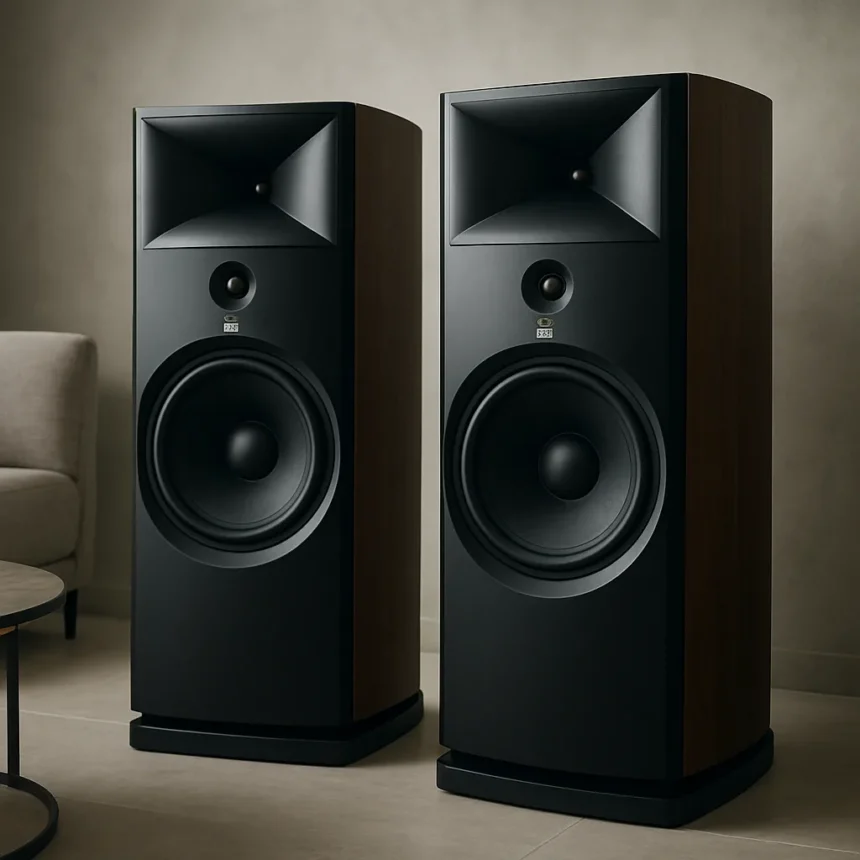
JBL Summit Everest speakers represent the company’s most ambitious entry into the ultra-high-end loudspeaker market, priced at $160,000 per pair and unveiled at High End Munich 2025. After an exclusive first listen, the question isn’t whether these flagship loudspeakers justify their cost — it’s whether they deliver anything less than transformative sound quality.
Key Takeaways
- JBL Summit Everest speakers cost $160,000 per pair and use a 3.5-way configuration with dual 38 cm woofers.
- The new Summit range spans five models, from the $19,995 Ama to the $160,000 Everest, launched at High End Munich 2025.
- JBL’s compression drivers extend to 34 kHz on the Everest, delivering exceptional high-frequency clarity.
- The Summit series uses HC4 hybrid carbon cellulose composite cone material across all woofers and mid-bass drivers.
- IsoAcoustic isolation feet decouple speakers from floor vibrations, fundamentally improving bass performance.
What Makes JBL Summit Everest Speakers Different
The JBL Summit Everest speakers represent a departure from the company’s mainstream consumer audio reputation. These are not the JBL soundbars or portable speakers most people know. Instead, they are positioned as the culmination of JBL’s technical expertise for domestic listening rooms. The Everest is a 3.5-way loudspeaker that succeeds four prior iterations of JBL’s Project Everest reference monitors, suggesting decades of refinement concentrated into this single design.
What distinguishes the JBL Summit Everest speakers from other ultra-premium loudspeakers is their architectural approach. The system employs three 5 cm dual-diaphragm compression drivers — the heart of high-frequency production — paired with a large Sonoglass horn, twin 25 cm mid-bass drivers, and dual 38 cm differential drive woofers. This configuration allows the speakers to deliver both the delicate detail of acoustic instruments and the visceral impact of orchestral crescendos without compromise.
The compression drivers in the JBL Summit Everest speakers extend frequency response to 34 kHz, well beyond the limit of human hearing but crucial for capturing harmonic overtones that define tonal character. This technical specification translates into what listeners describe as glorious, silken highs — not bright or fatiguing, but rich with information.



Listening Impressions: Does Performance Match the Price?
At the launch event, demonstration tracks featuring the Oscar Peterson Trio and Leonard Cohen revealed what the JBL Summit Everest speakers are engineered to do: reproduce music with exceptional dynamics and detail. The bass response was described as so low and tight it practically registered on the Richter scale — a poetic way of saying these speakers dig deep without bloat or resonance.
This level of control comes from multiple design choices working in concert. The HC4 hybrid carbon cellulose composite cone material used in every woofer and mid-bass driver across the Summit range reduces distortion and extends dynamic range. The IsoAcoustic adjustable isolation feet decouple the speakers from floor vibrations, allowing the cabinet to vibrate freely without transmitting energy into the listening room, which fundamentally changes how bass integrates with the rest of the frequency spectrum.



The JBL Summit Everest speakers achieve 88 dB sensitivity with recommended amplifier power of 25 to 300 W RMS and a maximum SPL of 113 dB. These specifications indicate speakers designed for high-resolution listening rather than party-volume playback — a crucial distinction that explains the price positioning. You are not paying for loudness. You are paying for the ability to resolve the finest details in a recording at moderate listening levels.
How JBL Summit Everest Speakers Compare to Alternatives
JBL’s own product hierarchy offers context. The Summit K2, priced at $100,000 per pair, uses three 4 cm dual-diaphragm drivers, a 25 cm differential drive mid-bass driver, and a 38 cm woofer — a smaller configuration that sacrifices some of the Everest’s scale and bass extension. The JBL Summit Ama, at $19,995 per pair with stands, is the only non-floorstanding model in the range, making it accessible to listeners with space constraints but without the full-range capability of the flagship.
Where the JBL Summit Everest speakers position themselves is in the luxury audiophile segment, competing against other range-topping loudspeakers from manufacturers focused exclusively on high-end audio. JBL’s brand heritage in mainstream consumer products might seem at odds with this positioning, yet the company’s technical foundation in compression drivers, horn loading, and cabinet design — refined over decades — translates directly into these ultra-premium speakers. The Everest is not a fashion statement. It is an engineering statement.
Technical Architecture and Build Quality
The cabinet construction of the JBL Summit Everest speakers uses heavily braced and softly contoured design to eliminate resonance. This approach prevents the cabinet itself from becoming a secondary instrument that colors the sound. The MultiCap crossover network ensures that each driver receives the correct frequency range without phase anomalies or timing issues.


Available finishes include gloss black and platinum or ebony wood and gold, reflecting the luxury positioning. These are speakers intended to anchor a high-end listening room aesthetically as well as sonically. The $160,000 price tag includes not just engineering but also the craftsmanship and material quality expected at this level of the market.
Are JBL Summit Everest Speakers Worth $160,000?
The answer depends on what you value. If you measure audio equipment by price-to-decibel output or feature count, the JBL Summit Everest speakers will never justify their cost. You can buy loudspeakers that play louder for a fraction of the price. But if you prioritize the ability to hear into a recording — to distinguish the resonance of a piano’s wooden case from the attack of the hammers, to hear where a vocalist is positioned in the stereo image, to feel bass as pressure and detail simultaneously — then the JBL Summit Everest speakers deliver that capability in a way that fewer speakers at any price can match.
The real question is not whether these speakers are worth $160,000 in absolute terms, but whether they represent the best value in their market segment. For listeners who have already committed to a dedicated listening room with acoustic treatment, quality amplification, and vinyl or high-resolution digital sources, the JBL Summit Everest speakers offer a logical endpoint — a speaker system that will not become a bottleneck in the playback chain.
What is the difference between JBL Summit Everest and K2 speakers?
The Summit Everest uses larger drivers across the board: three 5 cm compression drivers versus three 4 cm drivers in the K2, twin 25 cm mid-bass drivers versus a single 25 cm driver, and dual 38 cm woofers in both models. This larger configuration in the Everest allows deeper bass extension and greater dynamic range, justifying the $60,000 price premium between the two flagships.
Can the JBL Summit Everest speakers work in smaller rooms?
The JBL Summit Everest speakers are full-range floorstanding loudspeakers designed for dedicated listening rooms where they can be positioned away from walls and given proper acoustic space. Smaller rooms will struggle to accommodate their physical footprint and acoustic needs. For compact spaces, the JBL Summit Ama or Pumori offer smaller alternatives within the Summit family.
What amplifier power do JBL Summit Everest speakers require?
JBL recommends 25 to 300 W RMS for the Summit Everest, a wide range reflecting the speakers’ ability to work with both high-efficiency tube amplifiers and powerful solid-state designs. The key is matching the amplifier’s tonal character to your listening preferences, not simply choosing the highest wattage available.
The JBL Summit Everest speakers are not a casual purchase. They demand a committed listening space, quality source material, and an amplifier worthy of their capabilities. But for listeners who can provide those conditions, they deliver a level of sonic transparency and control that makes the $160,000 investment feel justified rather than excessive. This is JBL’s statement that it belongs at the very top of the high-end loudspeaker market.
Edited by the All Things Geek team.
Source: What Hi-Fi?






