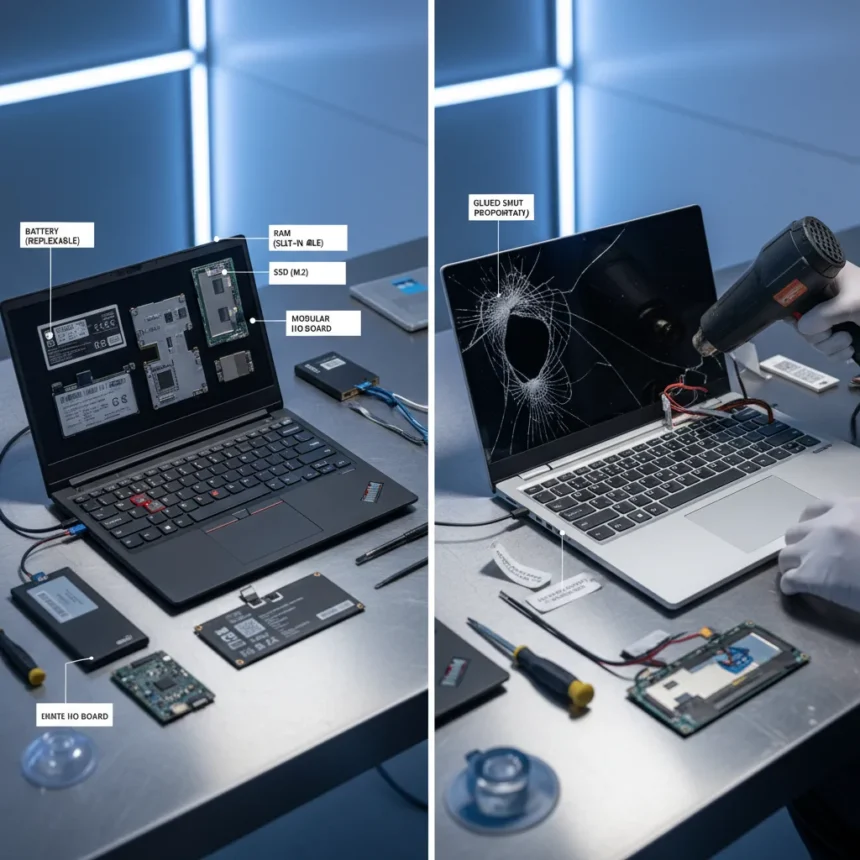
The ThinkPad T14 Gen 7 repairability score of 10/10 from iFixit stands as a stark reminder of what Microsoft’s Surface line still cannot deliver: a laptop that users can actually fix without destroying it. While Lenovo achieves perfect modularity, Microsoft’s premium Surface Laptop 7 trails at 8/10, exposing a hardware design philosophy gap that no amount of direct parts sales can fully bridge.
Key Takeaways
- ThinkPad T14 Gen 7 earns perfect 10/10 iFixit repairability score with fully modular design
- Surface Laptop 7 improves to 8/10 but still lags behind ThinkPad’s modularity standard
- Framework 12 also achieves 10/10, matching ThinkPad with tool-free battery and upgradeable RAM
- Microsoft’s Surface Laptop SE offers budget repairability at $250 but uses aging Celeron processor
- MacBook Neo scores 6/10, more repairable than MacBook Air M4’s 5/10 due to soldered components
ThinkPad T14 Gen 7 Repairability Sets New Standard
Lenovo’s ThinkPad T14 Gen 7 is a fully modular business laptop that enables straightforward replacement of battery, RAM, storage, and other critical components, according to iFixit’s teardown analysis. This perfect 10/10 score means users face no adhesive traps, no proprietary screws, and no design obstacles to routine maintenance. For IT departments and individual users alike, this represents the gold standard in hardware accessibility.
The significance extends beyond convenience. EU right-to-repair regulations are reshaping how manufacturers design consumer electronics, and ThinkPad’s approach demonstrates that modularity and premium performance are not mutually exclusive. Lenovo has built a business-class machine that respects user ownership without sacrificing build quality or processing power.
Surface Laptop 7 Improves But Remains Second-Tier
Microsoft’s Surface Laptop 7 marks a genuine departure from the sealed, nearly unrepairable designs that plagued earlier Surface models. At 8/10 repairability, most components are replaceable, and Microsoft now sells parts directly to users rather than forcing repair through authorized channels. This is real progress, not marketing spin.


Yet the gap between 8/10 and 10/10 matters. A two-point iFixit difference often signals the presence of adhesive-bonded panels, proprietary connectors, or design choices that complicate what should be routine repairs. Surface Laptop 7 remains a premium machine designed for users who want a thin, light form factor—but that design imperative still compromises the repairability that ThinkPad achieves without sacrifice. Microsoft’s direct parts sales program helps, but it does not eliminate the underlying architectural limitations.
Framework 12 Matches ThinkPad’s Perfect Score
Lenovo is not alone at the top. Framework 12 also scores 10/10 from iFixit, with tool-free battery removal, upgradeable LPCAMM2 RAM, and replaceable M.2 storage. Framework’s entire business model centers on modularity and user repairability, so the score aligns with its brand promise. The fact that two completely different manufacturers—a traditional OEM and a startup—both achieve perfect modularity while Microsoft does not suggests that Surface’s 8/10 reflects deliberate design choices, not technical constraints.



Budget Alternative: Surface Laptop SE
Microsoft’s Surface Laptop SE, priced at $250, offers easy repairability as a stated advantage. This education-focused device uses an Intel Celeron N4120 processor from 2019, optimized for Windows 11 SE but delivering slow resume times and sluggish app loading. The repairability is genuine, but the performance trade-off is steep. Surface Laptop SE serves a specific market—schools and budget-conscious institutions—but it cannot compete with ThinkPad T14 Gen 7 on either repairability or performance grounds.
MacBook Neo and Air: Apple’s Repair Struggle
Apple’s MacBook lineup shows how soldered components limit repairability even in premium machines. MacBook Neo scores 6/10, the most repairable MacBook in 14 years, yet soldered RAM and NAND storage still prevent user upgrades. Battery replacement out of warranty costs $149. The newer MacBook Air M4 scores only 5/10, confirming that Apple’s design direction prioritizes thinness over serviceability. EU regulations are nudging Apple toward better repairability, but the company still lags behind Lenovo and Framework.
What ThinkPad T14 Gen 7 Repairability Means for Buyers
A 10/10 iFixit score translates to real ownership benefits. Users can replace a failing battery without sending the machine to a service center. IT departments can stock spare RAM modules and SSDs, reducing downtime and support costs. The device’s longevity potential increases because critical components remain accessible for the machine’s entire lifespan. For business users and anyone planning to keep a laptop for five years or longer, this matters more than raw processor speed or display refresh rate.
ThinkPad T14 Gen 7 repairability also signals Lenovo’s confidence in its engineering. A manufacturer that seals components often does so to hide cost-cutting or design flaws. Lenovo’s modularity suggests the opposite: components are durable enough to be replaced individually without compromising the whole system.



The Broader Market Shift
Right-to-repair momentum is accelerating. iFixit scores now influence purchase decisions for IT managers, environmental advocates, and anyone skeptical of planned obsolescence. Microsoft’s move to an 8/10 on Surface Laptop 7 and direct parts sales shows the company is listening, but it is still playing catch-up. Lenovo set the benchmark with ThinkPad T14 Gen 7. Microsoft and Apple are responding, not leading.
FAQ
How does ThinkPad T14 Gen 7 repairability compare to Surface Laptop 7?
ThinkPad T14 Gen 7 scores 10/10 from iFixit with fully modular components, while Surface Laptop 7 scores 8/10 with replaceable but sometimes adhesive-bonded parts. The two-point gap reflects design choices that favor thinness and premium aesthetics in Surface over the modularity prioritized in ThinkPad.
Can you upgrade RAM in ThinkPad T14 Gen 7?
Yes. ThinkPad T14 Gen 7 features user-replaceable RAM as part of its fully modular design. This contrasts sharply with soldered RAM found in many MacBooks and some premium ultrabooks.
Is Surface Laptop SE worth buying for repairability?
Surface Laptop SE offers easy repairability and starts at $250, making it an accessible option for education and budget markets. However, the Intel Celeron N4120 processor delivers noticeably slower performance than ThinkPad T14 Gen 7 or Surface Laptop 7, so the repairability advantage comes with significant performance trade-offs.
ThinkPad T14 Gen 7 repairability has reset expectations for what a premium business laptop should deliver. Microsoft’s Surface Laptop 7 represents progress, but it remains a second-place finish in a race Lenovo is winning decisively. For users who value long-term ownership, component upgrades, and repair independence, the choice is clear.
Edited by the All Things Geek team.
Source: Windows Central