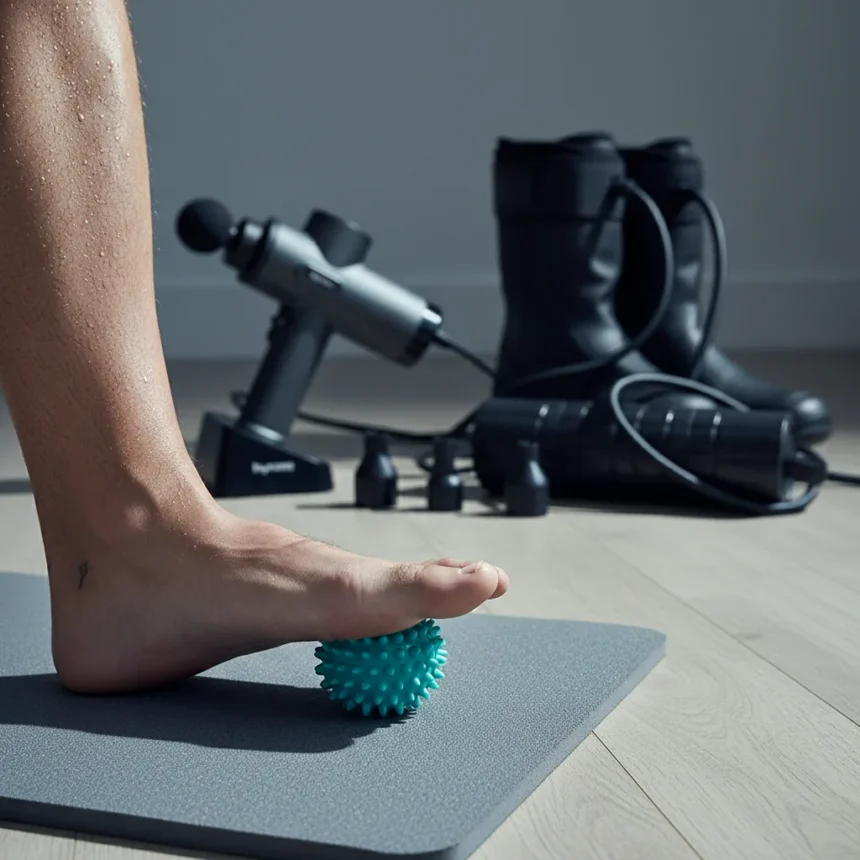
A massage ball recovery tool costing just $7 has become a marathoner’s most-used recovery accessory, despite owning dozens of pricier alternatives that sit unused. The simplicity and portability of this single item outperform expensive massage guns, foam rollers, and other recovery gadgets that clutter most runners’ homes.
Key Takeaways
- A $7 massage ball is a marathoner’s primary daily recovery tool for foot care.
- Massage ball recovery prevents foot cramps after long runs more effectively than neglecting post-run care.
- Massage guns and foam rollers, despite higher prices, gather dust compared to the affordable massage ball.
- Portability and storage ease make massage ball recovery superior for on-the-go athletes.
- Most runners neglect recovery work, but consistent foot massage requires minimal effort and cost.
Why Massage Ball Recovery Wins Over Expensive Alternatives
Most runners own a graveyard of recovery gadgets. A marathoner who uses a massage ball recovery routine almost daily admits to having massage guns, foam rollers, and other tools scattered throughout the home—all gathering dust. The gap between purchase intention and actual use reveals something uncomfortable: expensive does not equal practical. A massage ball recovery approach costs a fraction of what runners spend on equipment they abandon within weeks, yet delivers consistent results where pricier alternatives fail through sheer neglect.
The author’s experience reflects a broader truth about runner behavior: recovery work gets deprioritized. When faced with a choice between a $7 tool and a $300 massage gun, the cheaper option wins not because it is superior in isolation, but because it actually gets used. Massage ball recovery requires no setup, no charging, no learning curve. Roll your feet. Done. Compare this to massage guns, which demand ritual and space, or foam rollers, which require floor room and motivation. The massage ball recovery method eliminates friction from the equation entirely.
Massage Ball Recovery vs. Massage Guns and Foam Rollers
Massage guns like the Therabody Elite or Ekran Athletics B37 are recommended by experts for loosening tight muscles and are significantly more expensive than a massage ball recovery solution. Yet the marathoner with direct access to these devices chooses the massage ball recovery tool almost daily instead. Foam rollers occupy similar territory—more expensive, more cumbersome, and less portable than massage ball recovery. Neither alternative has earned consistent use despite their premium pricing and marketing as essential runner tools.

The portability advantage cannot be overstated. A massage ball recovery tool fits in a gym bag, a suitcase, or a jacket pocket. Massage guns are bulky. Foam rollers demand dedicated storage. For a marathoner juggling training schedules, travel, and life, the massage ball recovery approach removes barriers to consistency. You do not skip foot recovery because your recovery tool is inconvenient—you skip it because inconvenience is built into the tool itself.
Massage Ball Recovery for Foot Cramps: The Real Payoff
Foot cramps after runs are a legitimate problem that most runners address poorly or not at all. A consistent massage ball recovery routine targeting the feet directly addresses this pain point. Rolling your feet with a massage ball recovery tool after a long run helps prevent the cramping that can plague runners for hours afterward. This is not marketing hype—it is basic biomechanics. The plantar fascia and foot muscles bear the entire load of running. Direct pressure and rolling via massage ball recovery releases tension in these tissues before cramps develop.



The author’s daily massage ball recovery habit stems from this simple cause-and-effect: feet get worked hard during running, massage ball recovery provides immediate relief, cramps diminish. There is no mystery here, no pseudoscience, no need for expensive accessories. A marathoner who neglects most recovery work but commits to massage ball recovery for the feet has identified the highest-return recovery action available at any price point.
Affordability and Practicality: The Hidden Advantage
At $7, a massage ball recovery investment is low-risk and high-reward. If you do not like it, you have lost seven dollars. If you do like it, you have found your most-used recovery tool. Compare this mental calculus to dropping $300 on a massage gun that might gather dust. The affordability of massage ball recovery removes the psychological barrier that keeps runners from trying recovery tools in the first place. You are more likely to experiment with a $7 purchase than a $300 one, and experimentation is how habits form.
Most runners neglect recovery not because they lack willpower but because recovery tools often fail the convenience test. A massage ball recovery approach passes every test: cost, storage, portability, setup time, learning curve. It is the recovery tool that does not feel like a tool at all—just something you roll under your foot while watching television. Consistency builds habits. Habits build results. Massage ball recovery delivers all three at a price point that makes failure inconsequential.
Is massage ball recovery effective for all types of soreness?
Massage ball recovery works best for foot-specific tension and plantar fascia tightness, where direct pressure and rolling are most effective. While massage guns excel at addressing broader muscle groups and soreness throughout the legs, a massage ball recovery approach is specifically designed for feet. For comprehensive post-run recovery, massage ball recovery is best paired with other methods like stretching or rest days rather than relied upon as a total solution.



How often should you use massage ball recovery?
A marathoner using massage ball recovery almost every day has found this frequency works for preventing foot cramps and maintaining foot health. Most runners can benefit from daily or near-daily massage ball recovery sessions, especially on heavy training days or after long runs. Consistency matters more than duration—five minutes of daily massage ball recovery beats sporadic 30-minute sessions with tools you do not actually use.
Can massage ball recovery replace massage guns entirely?
For foot-focused recovery, a massage ball recovery tool can absolutely replace a massage gun, as evidenced by the marathoner’s choice to use it almost daily while massage guns gather dust. However, massage guns target larger muscle groups across the legs and back more effectively than massage ball recovery. A runner seeking comprehensive recovery might benefit from both, but if forced to choose one, massage ball recovery offers better daily usability and consistency for most runners.
The lesson here is not that expensive recovery tools are worthless. It is that the best recovery tool is the one you actually use. A marathoner who rolls feet with a massage ball recovery method almost every day has solved the recovery equation better than someone with a closet full of gadgets and zero consistency. At $7 and infinite practicality, massage ball recovery represents the rare case where the cheapest option is also the smartest one.
Where to Buy
Gaiam Restore Ultimate Foot Massage Roller:
Edited by the All Things Geek team.
Source: Tom's Guide