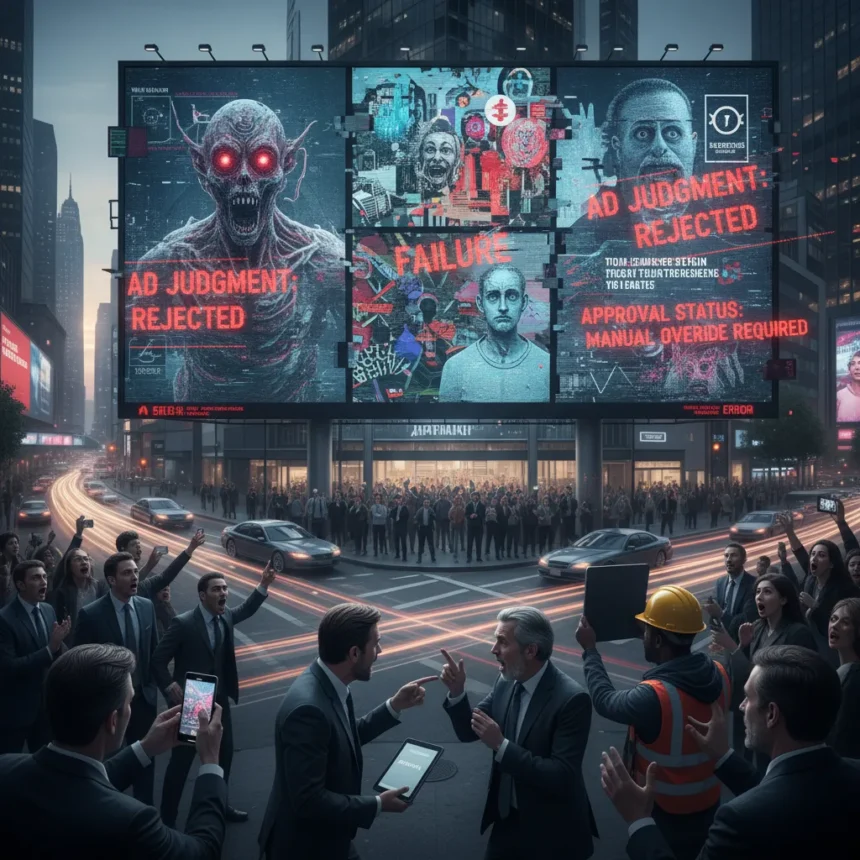
An AI billboard ad approval failure in San Francisco exposed a critical gap in how tech companies vet automated advertising before it reaches millions of eyes. The campaign, which featured provocative messaging about replacing human workers, sparked immediate backlash from bystanders and raised uncomfortable questions about who is actually reviewing these ads before they go live.
Key Takeaways
- A controversial AI-generated billboard campaign appeared in San Francisco without apparent content review.
- The ad’s messaging about worker replacement alarmed passersby and triggered public criticism.
- Similar campaigns have appeared in other major markets, suggesting systemic approval gaps.
- No clear industry standard exists for vetting AI-generated advertising content before public deployment.
- The incident highlights the tension between automation speed and responsible content oversight.
What happened with the AI billboard ad approval process
An AI billboard ad approval failure allowed a campaign to launch in San Francisco that featured messaging designed to provoke. The ad content centered on themes of worker replacement, presented in a way that alarmed bystanders who encountered it in public spaces. Bystanders were reportedly horrified by the messaging, according to coverage of the incident. The campaign raised immediate questions about what approval mechanisms, if any, existed before the ad went live.
The core issue is straightforward: somewhere in the chain between AI generation, campaign approval, and public deployment, no human reviewer flagged the content as inappropriate or controversial enough to warrant revision or rejection. Whether the approval process was automated, understaffed, or simply absent remains unclear. What is clear is that a campaign designed to provoke reached a major metropolitan audience without apparent editorial friction.
Why AI billboard ad approval matters now
This incident is not isolated. Similar campaigns have appeared in other major markets, including Times Square, suggesting that inadequate AI billboard ad approval is becoming a pattern rather than a one-off mistake. Each instance reinforces a troubling reality: the advertising industry has moved faster to automate content generation than to build safeguards around it.



Traditional advertising has always required human approval before launch. A creative director, a client, a legal reviewer, and sometimes a brand safety team would examine copy and visuals for tone, accuracy, and potential backlash. AI-generated campaigns often skip or abbreviate these steps, betting that speed and cost savings outweigh the risk of public relations damage. This incident proves that bet is wrong.
The stakes are higher than embarrassment. Provocative messaging about worker displacement, whether intentional or accidental, can inflame public anxiety, damage brand reputation, and invite regulatory scrutiny. A single poorly vetted campaign can become a news story, a social media firestorm, and ammunition for critics arguing that AI companies lack responsible governance.



The approval gap and what comes next
No industry standard currently exists for AI billboard ad approval. Advertising networks, tech platforms, and AI companies operate with different thresholds for what content is acceptable. Some may rely on automated flagging systems trained on generic harmful content. Others may have minimal human review. The result is inconsistency and gaps.
Fixing this requires two things: transparency and standards. Companies deploying AI-generated advertising should disclose what approval process exists, who reviews content, and what criteria trigger revision or rejection. Industry bodies should establish baseline guardrails for AI advertising—not to kill creativity, but to ensure campaigns don’t blindside audiences or damage public trust.
The irony is sharp: AI companies building tools to automate decision-making often fail to automate the one decision that matters most—whether to actually release something to the public. Until AI billboard ad approval processes match the sophistication of the generation tools themselves, expect more incidents like this one.
Could this have been prevented?
Yes. A simple human review step would have caught the problematic messaging. A brand safety specialist would have flagged worker replacement themes as potentially inflammatory. A legal reviewer might have raised concerns about reputational risk. The failure was not technological—it was organizational. Someone decided that approval could be skipped or minimized, and that decision backfired spectacularly.


What should advertisers do differently?
Any advertiser using AI to generate campaign content should treat the output as a draft, not a final product. Build in mandatory human review before any public deployment. If the cost of review feels too high, the campaign probably isn’t worth running. The cost of a public relations disaster is always higher than the cost of hiring a reviewer.
FAQ
Why does AI billboard ad approval matter if it’s just one campaign?
Because it is not just one campaign. Similar incidents have appeared in multiple cities, indicating a systemic problem with how AI advertising is vetted before launch. One incident is embarrassing; a pattern suggests the industry has a governance problem that will invite regulation.
Can automated systems catch problematic AI advertising?
Automated content moderation can catch some obvious issues, but it struggles with context and intent. Messaging about worker replacement might be flagged as potentially sensitive, but only a human reviewer can assess whether it crosses the line from provocative to irresponsible in a given context. Automation is a helpful filter, not a replacement for judgment.
Who is responsible for vetting AI-generated ads?
That depends on the business model. If an ad network deploys AI tools, the network bears responsibility. If a brand generates content in-house, the brand owns the decision to publish. If a third-party AI company builds the tool, it should document what safeguards exist. Responsibility is muddied when automation removes human decision-makers from the chain—which is precisely the problem this incident exposes.
The AI billboard ad approval failure in San Francisco was not a technical failure. It was a governance failure—a choice to prioritize speed and cost over the basic due diligence that advertising has always required. Until companies rebuild approval processes to match the sophistication of their AI tools, expect more provocative campaigns to slip through and more damage to public trust in both advertising and AI.
Edited by the All Things Geek team.
Source: Creativebloq