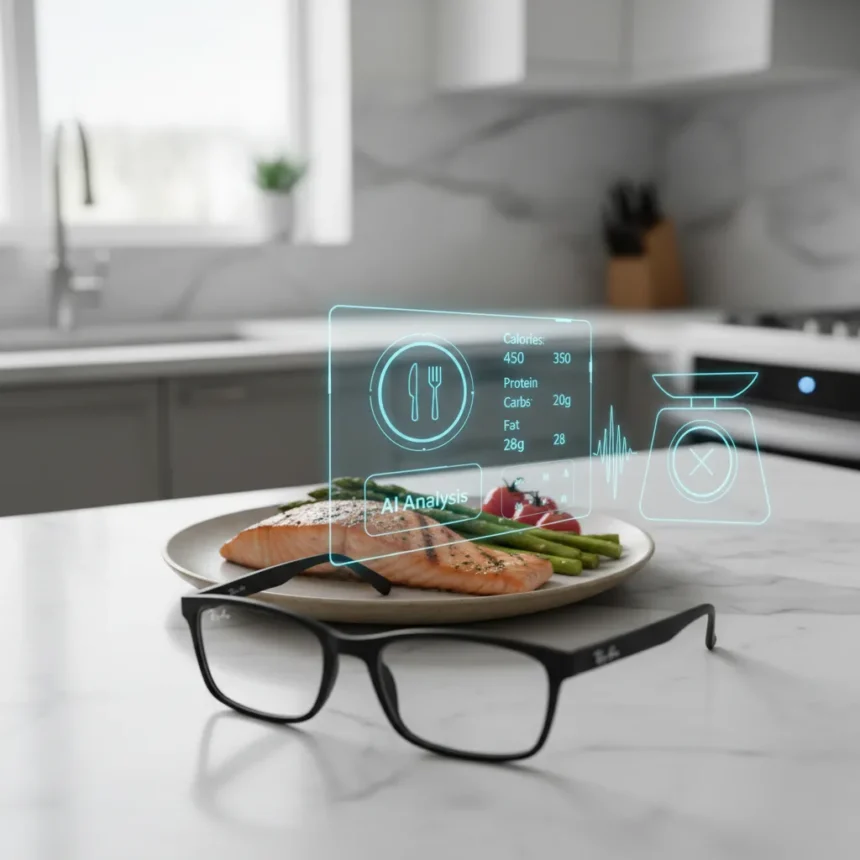
Ray-Ban Meta glasses calorie tracking just ditched the food scale entirely. Meta’s new AI feature lets you log meals hands-free using your smart glasses camera, eliminating the tedious weighing and manual app entry that has plagued diet tracking for years. For users tired of pulling out a scale before every meal, this is genuinely different.
Key Takeaways
- Ray-Ban Meta glasses now log meals via voice prompt or quick photo without manual entry or scales.
- Meta AI extracts calories, macros, and nutrition details automatically from images.
- Feature builds a personalized food log that powers nutrition recommendations over time.
- Currently requires user prompts; full automation is planned but not yet live.
- Rolling out to U.S. users 18+ soon; Ray-Ban Meta Display glasses arrive later this summer 2026.
How Ray-Ban Meta Glasses Calorie Tracking Actually Works
The workflow is stripped down to its simplest form. You wear your Ray-Ban Meta or Oakley Meta glasses, issue a voice prompt like “Log my meal,” or snap a quick photo of your food. Meta AI analyzes the image via the glasses’ built-in camera, identifies what you’re eating, and extracts key nutrition details—calories, macros, micronutrients. The log automatically populates in the Meta AI app without you typing a single number.
Unlike traditional food scales that require you to measure portions manually, or apps that demand you search for foods and enter quantities, this approach treats your glasses as both camera and nutritionist. The friction drops dramatically. According to Meta, “With a simple voice prompt or quick photo, you can log what you eat hands-free, and Meta AI will extract key nutrition details and add them to your food log in the Meta AI app”. It’s one less decision, one less step between eating and tracking.
Building Personalized Nutrition Insights Over Time
The real power emerges once your food log accumulates data. Ray-Ban Meta glasses calorie tracking learns your eating patterns and can deliver increasingly personalized recommendations. Ask Meta AI “What should I eat to increase my energy?” and it considers your logged meals, your stated nutrition goals, and your habits to suggest answers tailored to you. This moves beyond generic advice into something closer to a personal nutritionist.



The system does not just count calories—it tracks what you actually eat over time, patterns emerge, and Meta AI uses that context to guide future choices. Someone logging high sugar intake and low energy might receive different suggestions than someone with balanced macros. This contextual understanding is what separates passive logging from active nutrition coaching.
Ray-Ban Meta Glasses Calorie Tracking vs. Traditional Methods
Food scales and manual logging apps have dominated diet tracking for a decade, but both demand effort. A scale requires you to own the device, place food on it, read the weight, and then enter that number into an app—often multiple entries per meal. Apps like MyFitnessPal force you to search a database, confirm the food match, and adjust portions. Ray-Ban Meta glasses eliminate these friction points by using computer vision instead.



Smartwatches like the Apple Watch track heart rate, steps, sleep, and calories burned through activity—but they do not log what you eat. They measure output, not input. Ray-Ban Meta glasses focus exclusively on intake: what goes into your body, not what your body burns. That is a fundamentally different role. The glasses do not track heart rate, sleep, steps, calories burned, activity, or O2 levels. They are a food logging tool, not a full health tracker.
What Ray-Ban Meta Glasses Calorie Tracking Cannot Do Yet
The feature is not fully automated. You still need to prompt it—saying “Log my meal” or taking a photo. Meta plans to move toward automatic detection where the glasses identify and log food without your input, but that is not live yet. Until then, you are trading scale weight for voice prompts, which is faster but still requires conscious action.
The glasses also do not integrate deeply with Apple Health or Samsung Health. If you use a fitness ecosystem built around another platform, Ray-Ban Meta glasses operate somewhat in isolation. Meta is working toward broader ecosystem integration, including potential future hardware like a Neural Band wrist device for muscle signal tracking, but those are not available now.
Availability and Timeline
The feature rolls out to Ray-Ban Meta and Oakley Meta glasses for U.S. users 18 and older “soon”. Ray-Ban Meta Display glasses, the newer model with a built-in display, will receive the feature “later this summer” in 2026. If you already own a pair of Ray-Ban Meta glasses, the update will arrive as a software feature. If you are considering buying them specifically for food logging, the hardware already exists—you are waiting for the software rollout.


Is Ray-Ban Meta Glasses Calorie Tracking Worth It?
For anyone who finds food scales annoying or forgets to log meals, this is a meaningful upgrade. The convenience factor is real: raising your glasses to your face and saying “Log my meal” is faster than pulling out a scale, weighing portions, and typing numbers. Geekspin called it “one of the easiest ways to track your meals yet”. The personalized recommendations add value beyond simple logging—Meta AI learns your habits and offers guidance that improves over time.
The main limitation is that it still requires you to initiate the log. If you eat without thinking to prompt your glasses, the meal does not get tracked. Full automation would solve this, but that is a future feature. For now, Ray-Ban Meta glasses calorie tracking is best suited to people who want to track meals but resent the friction of scales and manual apps—not people who need passive, always-on monitoring.
Will Ray-Ban Meta glasses replace my food scale?
For most users, yes. Ray-Ban Meta glasses calorie tracking eliminates the need to own and use a scale by leveraging computer vision and AI instead. You get faster logging with less friction, though you still need to prompt the glasses to log each meal. If you require absolute precision for clinical or athletic purposes, a scale may still be preferable.
Does Ray-Ban Meta glasses calorie tracking work with Apple Health?
Not currently. The feature logs meals into the Meta AI app but does not integrate deeply with Apple Health or Samsung Health. If you rely on a fitness ecosystem from another platform, the data remains siloed in Meta’s app rather than syncing across your health dashboard.
How accurate is Ray-Ban Meta glasses calorie tracking?
Meta AI analyzes photos to identify foods and extract nutrition details, but the research brief contains no accuracy data or benchmarks. The system requires you to confirm that Meta AI correctly identified your food before logging it, which adds a verification step. Accuracy likely varies based on food type, lighting, and how clearly you photograph the meal.
Ray-Ban Meta glasses calorie tracking represents a genuine shift in how casual users can approach diet monitoring. By replacing scales with smart glasses and AI, Meta has removed a major friction point from nutrition tracking. The feature is not perfect—it still requires prompts, lacks deep health app integration, and has not yet reached full automation. But for people tired of scales and manual logging, it is the closest thing to effortless food tracking that exists today.
Edited by the All Things Geek team.
Source: Tom's Guide