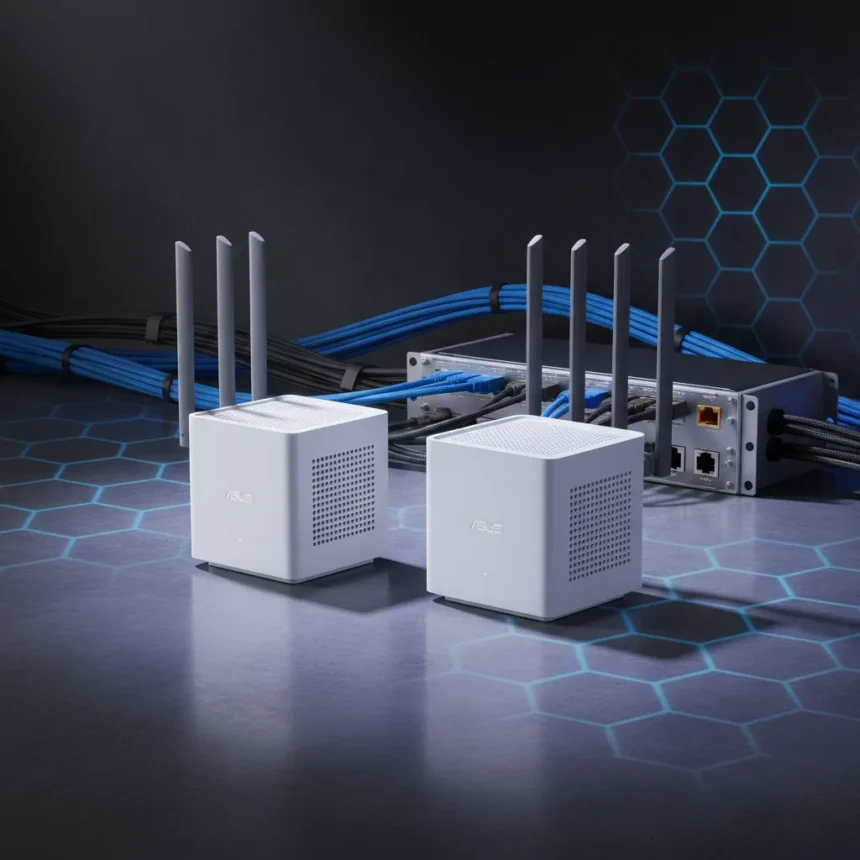
The Asus ZenWiFi BQ16 is a quad-band Wi-Fi 7 mesh system engineered for users who refuse to compromise on connectivity. This isn’t the router for casual browsing and streaming—it’s built for the kind of demands that make standard mesh systems sweat. With dual 10G ports, VPN support, and multi-SSID capabilities, the ZenWiFi BQ16 represents a shift toward next-generation networking infrastructure in home and small office environments.
Key Takeaways
- Quad-band Wi-Fi 7 architecture delivers maximum throughput and reduced interference across multiple devices.
- Dual 10G ports enable direct gigabit connections for servers, NAS units, or desktop workstations.
- Coverage reaches 4,000 sq.ft per unit, scalable via mesh expansion for larger properties.
- VPN support and multi-SSID configuration offer advanced network segmentation and privacy.
- Available as single unit or full mesh system, adapting to different deployment scenarios.
Asus ZenWiFi BQ16 Architecture and Core Performance
The Asus ZenWiFi BQ16 operates on quad-band Wi-Fi 7, a technical leap that separates it from the dual-band and tri-band systems still dominating the market. Quad-band means four simultaneous frequency bands working in parallel—a design that eliminates bottlenecks when dozens of devices compete for bandwidth. One unit covers up to 4,000 sq.ft, which alone positions it above entry-level mesh competitors that typically max out at 2,000-3,000 sq.ft per node.
The dual 10G ports are the standout hardware differentiator. Most mesh routers ship with single gigabit ports or a mix of gigabit and multi-gig options. Ten gigabit ports mean you can wire a NAS, a gaming PC, or a server directly to the router without creating a bandwidth ceiling. This architecture targets professionals who work with large file transfers, video editors who need real-time cache performance, or anyone running local storage systems.
Feature Set: VPN, Multi-SSID, and Network Control
Built-in VPN support sets the ZenWiFi BQ16 apart from routers that force users to choose between mesh convenience and privacy infrastructure. Rather than running VPN on individual devices—which drains battery and fragments network behavior—VPN at the router level encrypts all traffic from the moment it leaves your network. Multi-SSID capability lets you segment networks: one for guests, one for work devices, one for IoT gadgets, each with separate security policies and bandwidth limits.


This configuration flexibility appeals to small business users and power enthusiasts who treat their home network like actual infrastructure rather than an appliance. You’re not just connecting to the internet; you’re building a network architecture that can enforce rules, prioritize traffic, and isolate security risks.
Single Unit vs. Mesh Expansion: Flexibility for Different Scales
The ZenWiFi BQ16 ships as a single unit but scales via mesh expansion, giving you options depending on your space. A single unit covers substantial ground, but if your property sprawls across 8,000 sq.ft or you need rock-solid signal in every corner, you can add additional nodes. This modularity beats routers locked into fixed configurations—you buy what you need now and expand later without replacing the entire system.



For apartment dwellers and modest homes, one unit may be overkill. For larger properties, offices, or users with dozens of connected devices, the mesh expansion path prevents the common scenario where a single powerful router still leaves dead zones in distant rooms or outdoor areas.
Positioning Against the Broader Wi-Fi 7 Landscape
Wi-Fi 7 is still rolling out across the industry, and most households still run Wi-Fi 6 or Wi-Fi 6E. The Asus ZenWiFi BQ16 sits at the premium end of the spectrum, targeting early adopters and professionals who anticipate Wi-Fi 7 client device proliferation over the next 18-24 months. Cheaper Wi-Fi 7 routers exist, but they typically sacrifice port density, coverage, or advanced features. The ZenWiFi BQ16 refuses those compromises.
Is the Asus ZenWiFi BQ16 worth the investment?
The ZenWiFi BQ16 makes sense if you work from home, run a media server, game competitively across multiple devices, or manage a small office network. If your primary use is streaming video and casual web browsing, you’re paying for capabilities you won’t use. The real question is whether your network demands justify quad-band architecture and 10G ports—not every user has devices that can even utilize 10G speeds.
Can you expand the Asus ZenWiFi BQ16 mesh system?
Yes, the ZenWiFi BQ16 supports mesh expansion, allowing you to add additional nodes to extend coverage beyond the 4,000 sq.ft range of a single unit. This scalability means you’re not locked into a fixed footprint—grow your network as your property or device count increases.



Does the Asus ZenWiFi BQ16 include security features?
The system includes VPN support and multi-SSID configuration, enabling network segmentation and privacy controls at the router level. These features allow you to isolate guest devices, IoT gadgets, and work systems on separate networks with individual security policies.
The Asus ZenWiFi BQ16 is not a casual purchase—it’s infrastructure for users who’ve outgrown standard mesh systems and need the throughput, port density, and control that quad-band Wi-Fi 7 delivers. If your network demands are serious, this system answers them. If you’re still on Wi-Fi 5 and wondering whether to upgrade, the ZenWiFi BQ16 represents the cutting edge of what home networking can do today.
Where to Buy
Asus ZenWiFi BQ16 Pro | Amazon | TP-Link Deco BE68 BE14000 | TP-Link Deco BE68 | Netgear Orbi 370 Wi-Fi 7 mesh router
Edited by the All Things Geek team.
Source: T3