





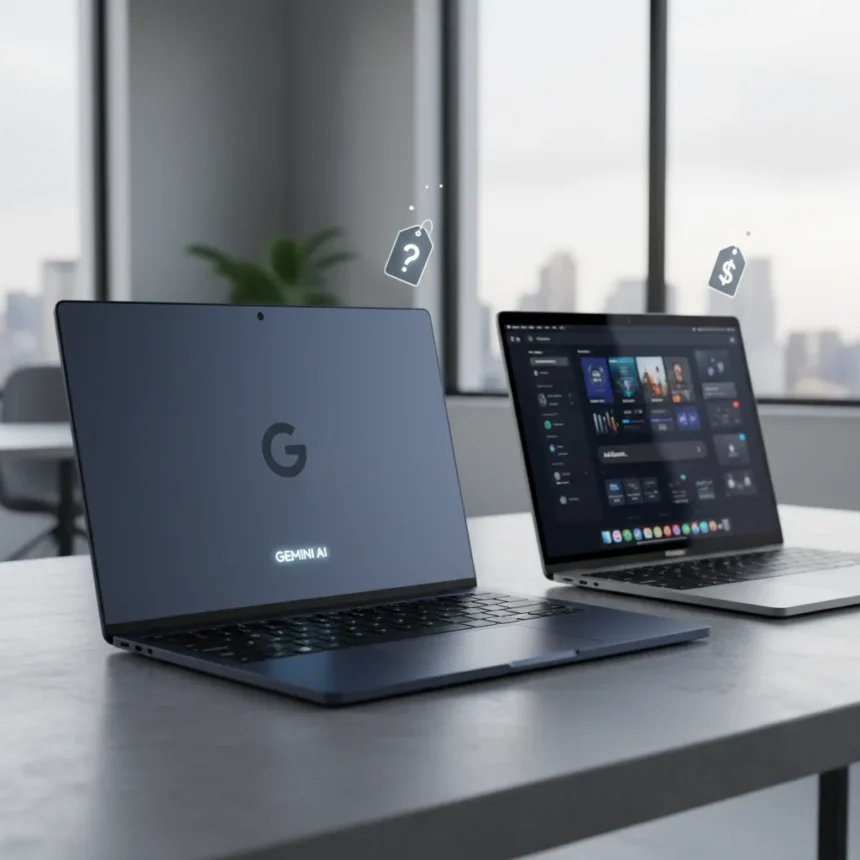
The Googlebook vs MacBook Neo debate is heating up, and it exposes a fundamental choice between two competing visions of what a premium laptop should be. Google’s hypothetical Android-powered Googlebook, powered by Gemini AI and a next-gen Tensor G5 processor, stands in sharp contrast to Apple’s rumored MacBook Neo—a budget ARM device expected around $799 with no touchscreen and locked into macOS.
Key Takeaways
- Googlebook concept features 14-inch OLED 3K display at 120Hz with 500 nits brightness, vs. MacBook Neo’s expected standard LCD screen
- Tensor G5 processor with 16GB/32GB RAM options projected to deliver 18+ hours battery life in Googlebook design
- Gemini AI integration enables on-device translation, image generation, and gesture controls unavailable on MacBook Neo
- Pricing speculation: Googlebook $999–$1,299 vs. MacBook Neo around $799; premium Chromebook segment currently under 5% of market
- Android app ecosystem plus ChromeOS plus Linux containerization offers flexibility MacBook Neo’s macOS lock-in cannot match
Googlebook vs MacBook Neo: The Core Differences
The Googlebook vs MacBook Neo comparison reveals two entirely different philosophies. Apple’s MacBook Neo is positioned as a budget ARM laptop—a stripped-down entry point to the MacBook family with an M4-derived chip, no touchscreen, and the standard macOS experience. Google’s Googlebook concept, by contrast, imagines a premium device that blends ChromeOS with Android apps, containerized Linux support, and Gemini AI baked into the hardware itself. This is not a race to the bottom; it is a clash between ecosystem conservatism and experimentation.
The Googlebook would ship with a 14-inch OLED touchscreen at 3K resolution (2880×1800) with a 120Hz refresh rate and 500 nits brightness—a display tier that MacBook Neo is unlikely to match at its expected $799 price point. The Googlebook’s ultra-thin aluminum unibody design, at just 11.9mm thick and 1.2kg, mirrors the Pixel 9 aesthetic with flat edges, a haptic trackpad, and customizable pogo pins for peripherals. It is the kind of industrial design statement that forces competitors to respond.
Processor Power and AI Capabilities
Under the hood, the Googlebook vs MacBook Neo divide widens. The Googlebook concept assumes a next-gen ARM-based Tensor G5 processor with 16GB or 32GB LPDDR5X RAM options and up to 1TB NVMe storage. Battery life is projected at 18+ hours for web browsing and video playback, backed by a 70Wh battery. The MacBook Neo, meanwhile, would rely on an M4-derived chip—proven but conventional, optimized for macOS rather than AI workloads.


Where Googlebook vs MacBook Neo becomes genuinely interesting is Gemini AI. The Googlebook concept integrates Gemini at the OS level for real-time translation, on-device image generation, predictive text, and gesture controls via its 12MP AI-enhanced webcam. The MacBook Neo offers no equivalent—Apple’s AI strategy remains fragmented across individual apps and services. For users who value productivity AI as a core feature rather than an afterthought, the Googlebook concept is the more compelling argument.
Software Flexibility and Ecosystem
The software story tilts decisively toward the Googlebook in the Googlebook vs MacBook Neo matchup. The concept envisions ChromeOS fused with native Android app support, plus Linux apps via containerization. This creates a three-tier ecosystem: web-first ChromeOS, mobile-optimized Android apps, and full Linux tools for power users. The MacBook Neo locks users into macOS, Apple’s App Store, and whatever ecosystem lock-in Apple deems necessary. For developers, creators, and power users, that constraint feels increasingly outdated.



Connectivity matters too. The Googlebook concept includes 2x USB4 ports (Thunderbolt-compatible), one USB-C 3.2, a headphone jack, and pogo pins for custom peripherals. The MacBook Neo will almost certainly follow Apple’s minimalist port philosophy—fewer options, more dongles. The Googlebook’s quad-speaker system with spatial audio also positions it as a multimedia device, not just a productivity machine.
Pricing: Where Googlebook vs MacBook Neo Gets Real
Here is where the Googlebook vs MacBook Neo story hinges entirely on execution. Speculation suggests the Googlebook would start at $999 for a 16GB/512GB configuration, climbing to $1,299 for the 32GB/1TB model. The MacBook Neo is expected around $799. On paper, MacBook Neo wins on price. In practice, the Googlebook would undercut the MacBook Air M3 at $1,099 while offering significantly more—touchscreen, Gemini AI, display quality, and software flexibility.
The risk is obvious: if Google prices the Googlebook at $1,299 and MacBook Neo lands at $799, Apple wins on cost alone. But if Google hits $999 as a starting price, the value proposition becomes nearly unbeatable. The premium Chromebook segment currently represents less than 5% of the total Chromebook market, meaning Google would be creating an entirely new category. That is ambitious but not impossible—Chromebook shipments reached 15 million units in 2025, and a premium tier could capture significant margin.
Market Context and Timing
The Googlebook vs MacBook Neo debate arrives at a moment when ARM-based laptops are growing 25% year-over-year. Windows Copilot+ PCs with Snapdragon X Elite chips are already carving out a niche, though Gemini integration gives the Googlebook concept an AI edge over Microsoft’s Recall approach. The MacBook Neo, meanwhile, represents Apple’s incremental thinking—a budget option that does not disrupt the MacBook Air or Pro lines.



Neither device exists yet. The MacBook Neo is rumored for Q1 2026 with potential shipping later that year. The Googlebook remains pure speculation, with hypothetical reveal timing at Google I/O 2026 and Q4 2026 availability. But the conceptual battle matters because it signals what premium computing could become: either Apple’s walled ecosystem at a lower price point, or Google’s open-yet-integrated approach that treats AI as a first-class citizen.
Is the Googlebook vs MacBook Neo comparison fair?
Not entirely. One device exists only in rumors; the other only in concept. But the comparison matters because it reveals what each company values. Apple prioritizes ecosystem cohesion and brand prestige. Google (in this thought experiment) prioritizes flexibility, AI capability, and display quality. For users tired of macOS constraints and hungry for real on-device AI, the Googlebook concept is the more exciting future—assuming the price does not betray the promise.
Would a real Googlebook actually compete with MacBook Air?
Yes, directly. At $999, a Googlebook would undercut the MacBook Air M3 by $100 while offering a superior display, Gemini AI, and Android flexibility. The MacBook Air would retain advantages in raw processor performance and macOS ecosystem depth, but for creators and developers who value open systems, the Googlebook would be the more compelling choice. The real question is whether Google has the courage to price it that aggressively.
The Googlebook vs MacBook Neo narrative ultimately hinges on one thing: execution and price. Apple’s budget MacBook will be competent but conservative. Google’s hypothetical Googlebook could be revolutionary—if the company resists the temptation to price it like a premium device and instead treats it as a category-killer. That is where the real battle will be decided.
Where to Buy
Edited by the All Things Geek team.
Source: T3




