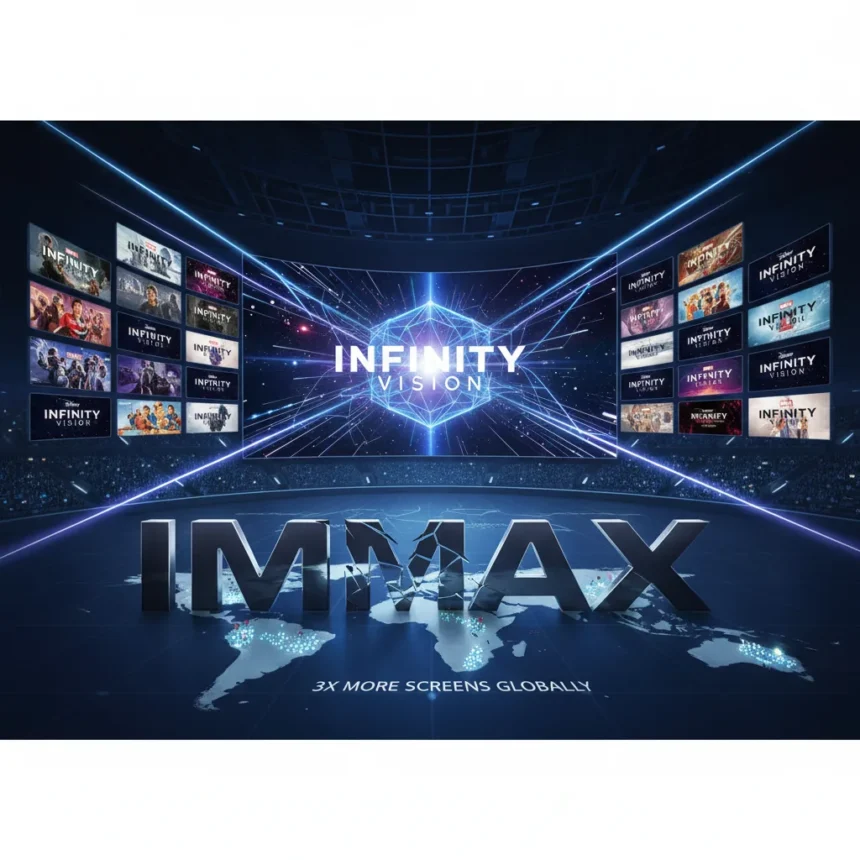
Infinity Vision certification is Disney’s new premium large format (PLF) standard for theaters, announced at CinemaCon by The Walt Disney Studios, designed to compete directly with IMAX and Dolby while offering studios vastly wider screen availability. The format requires screens at least 50 feet wide, laser projection, and Dolby’s 7.1 surround-sound system—specifications that approximately 5,500 theaters globally already meet, roughly three times the number of IMAX venues worldwide. Disney’s move signals a fundamental shift in how studios control the theatrical experience, and it comes at a moment when the traditional IMAX partnership is fracturing under the weight of competing blockbuster releases.
Key Takeaways
- Infinity Vision requires 50-foot screens, laser projection, and Dolby 7.1 surround sound, qualifying ~5,500 global theaters.
- Approximately three times more screens qualify for Infinity Vision than for IMAX, dramatically expanding Disney’s premium reach.
- Debuts September 2026 with Avengers: Endgame re-release; full rollout December 2026 with Avengers: Doomsday.
- Disney created Infinity Vision partly because IMAX exclusivity went to Warner Bros.’ Dune: Part Three instead of Avengers: Doomsday.
- Theater chains can offer Infinity Vision alongside their own premium brands (AMC XL, Regal RPX, Cinemark XD).
Why Disney Built Its Own Infinity Vision Certification Standard
Disney didn’t invent Infinity Vision out of pure ambition—it built the standard out of necessity. The Walt Disney Studios contributes more revenue to IMAX than any other Hollywood distributor, yet IMAX’s exclusivity agreements have increasingly become a liability rather than an asset. The immediate trigger was Avengers: Doomsday, Disney’s December 2026 tentpole, clashing with Warner Bros.’ Dune: Part Three over IMAX screens. IMAX honored its existing agreement with Dune, leaving Avengers: Doomsday without the premium screen guarantee Disney’s largest releases typically command. That loss of prestige and revenue exposure forced Disney’s hand: if IMAX wouldn’t guarantee exclusive access to its biggest franchise moments, Disney would create a standard that didn’t require gatekeeping through a single vendor.
The Infinity Vision certification extends that commitment to the theaters themselves, representing a shared effort between The Walt Disney Studios and the exhibition community to help audiences quickly find the very best screens in their area. Rather than fighting IMAX directly, Disney created a standard that theater operators could adopt alongside their existing premium brands—a politically savvy move that avoids the appearance of bullying while simultaneously making IMAX’s scarcity advantage irrelevant.
The Infinity Vision Certification Advantage: Scale Over Prestige
IMAX’s power has always rested on scarcity. With roughly 1,800 IMAX screens globally, studios compete fiercely for exclusive access, and audiences know that an IMAX release means a genuinely rare theatrical experience. Infinity Vision upends that equation entirely. By requiring only laser projection and a 50-foot screen width—specifications many multiplexes already meet—Disney unlocked approximately 5,500 qualifying theaters worldwide. That threefold advantage in available screens means Disney can guarantee premium theatrical rollout for its tentpoles without negotiating exclusivity deals or accepting IMAX’s scheduling demands.

Theater chains including AMC, Regal, and Cinemark can offer Infinity Vision certification alongside their own premium formats, creating a unified branding system that helps audiences identify the best available screens in their area. This flexibility is crucial: operators retain their proprietary brands (AMC XL, Regal RPX, Cinemark XD) while gaining access to a Disney-backed certification that signals quality and attracts premium ticket prices. For studios, it means no single vendor can hold their biggest releases hostage.
When Infinity Vision Launches and What It Delivers
Infinity Vision debuts in September 2026 with a re-release of Marvel Studios’ Avengers: Endgame, a calculated choice that tests the standard on an established blockbuster before the format’s major debut. The full rollout arrives in December 2026 with Marvel Studios’ Avengers: Doomsday, the tentpole that triggered Infinity Vision’s creation. Disney describes the format as delivering the biggest, brightest, and most immersive cinematic experiences, with laser projection providing superior brightness and clarity compared to traditional projection, combined with premium surround-sound immersion.



The certification solves a practical problem audiences face: identifying which theater screen in a multiplex actually justifies premium pricing. Online ticketing and in-theater signage will clearly mark Infinity Vision screens, eliminating the confusion that plagues premium formats today. For Disney, the rollout strategy is methodical—prove the concept with a beloved franchise entry, then leverage it across the Marvel slate and eventually the broader Disney catalog.
How Infinity Vision Reshapes the Studio-Theater Power Dynamic
Infinity Vision represents a fundamental power shift in theatrical distribution. Studios have long resented IMAX’s leverage: the format’s scarcity allows IMAX to demand favorable revenue splits, exclusivity windows, and premium pricing that cuts into studio margins. By creating a standard that 5,500 theaters already qualify for, Disney removed IMAX’s monopoly on premium theatrical experiences. Competing studios will inevitably follow—why accept IMAX exclusivity when they can guarantee broader premium access through Infinity Vision or develop their own competing standards?
This fragmentation actually benefits theater operators more than it benefits IMAX. Chains can now offer multiple premium tiers (IMAX, Infinity Vision, Dolby, proprietary brands) and let audience demand determine which screens generate premium revenue. The competitive pressure also forces each format to justify its premium pricing through genuine technical superiority rather than artificial scarcity. IMAX’s response will likely focus on its established prestige and the unique visual experience of its larger aspect ratios—advantages that matter deeply to cinephiles but increasingly less so to casual audiences choosing between equivalent premium screens.
Is Infinity Vision Actually Better Than IMAX or Dolby?
Disney’s promotional language—the biggest, brightest, and most immersive cinematic experiences—makes bold claims without independent verification. Infinity Vision’s laser projection does deliver genuine technical advantages: superior brightness and clarity compared to traditional xenon projection, matching IMAX’s technical prowess. The 7.1 surround sound is competitive but not unique; Dolby also offers premium audio systems. What Infinity Vision genuinely offers is not superiority but equivalence at scale. A 50-foot laser-projected screen with Dolby 7.1 audio will deliver an excellent premium experience, comparable to IMAX in most measurable ways. The difference is that Disney can guarantee that experience across thousands of screens instead of hundreds.



FAQ
When does Infinity Vision certification launch?
Infinity Vision debuts in September 2026 with a re-release of Avengers: Endgame, with full rollout in December 2026 alongside Marvel Studios’ Avengers: Doomsday.
How many screens qualify for Infinity Vision certification?
Approximately 5,500 theaters globally meet the certification requirements—50-foot screen width, laser projection, and Dolby 7.1 surround sound—roughly three times the number of IMAX venues.
Can theaters offer both Infinity Vision and their own premium brands?
Yes. Theater chains can offer Infinity Vision certification alongside proprietary formats like AMC XL, Regal RPX, and Cinemark XD, allowing operators to maintain their own branding while gaining Disney-backed certification.
Disney’s Infinity Vision doesn’t eliminate IMAX or Dolby—it neutralizes their leverage. By democratizing premium theatrical access across 5,500 screens, Disney solved a problem that has haunted studios for years: the ability to guarantee premium experiences without negotiating with a single gatekeeper. Theater operators win by offering more premium options. Audiences win by having clearer ways to identify quality screens. Only IMAX loses, and only because its scarcity advantage—the entire foundation of its business model—has suddenly become irrelevant.
Edited by the All Things Geek team.
Source: What Hi-Fi?