





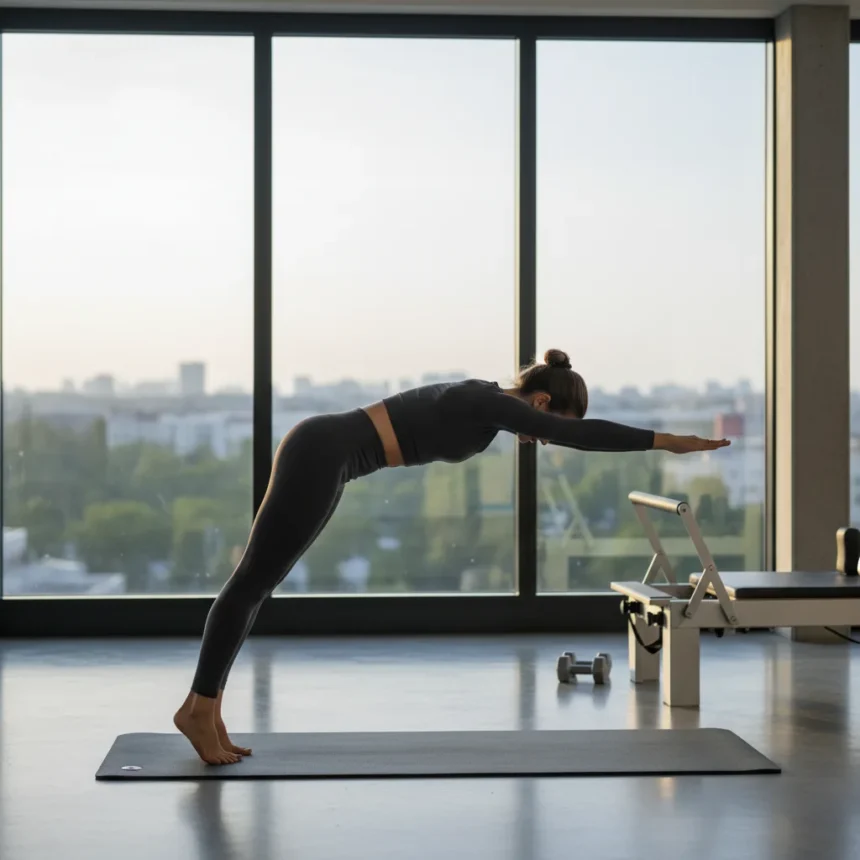
The Pilates roll-up exercise is a foundational movement in Pilates practice that targets deep abdominal muscles, hip flexors, and spinal articulation while building core strength and flexibility. Unlike traditional sit-ups, this single movement engages multiple muscle layers and provides mobility benefits that make it functionally equivalent to roughly six regular crunches.
Key Takeaways
- Pilates roll-up targets deep core stabilizers (transverse abdominis) plus superficial muscles, unlike sit-ups which focus only on surface abs.
- The exercise articulates the spine vertebra-by-vertebra, improving flexibility and reducing stiffness through controlled spinal extension and flexion.
- Beginners can modify the movement by bending knees or using hands for support without losing core engagement benefits.
- Avoid the full version if pregnant or dealing with a herniated disc due to the extreme spinal flexion required.
- Proper form demands slow, controlled movement without momentum—speed undermines the core activation and mobility gains.
Why the Pilates roll-up outperforms sit-ups
The Pilates roll-up exercise works because it requires coordinated effort from all abdominal muscles simultaneously: the rectus abdominis (visible six-pack muscles), transverse abdominis (the deep core stabilizer), and obliques (internal and external waist muscles). This multi-muscle activation is what makes the movement so effective compared to sit-ups, which primarily target only the surface-level rectus abdominis.
The rolling motion central to this exercise encourages articulation of the spine, meaning you’re essentially massaging your spine back onto the mat one vertebra at a time. Over time, this controlled spinal movement improves flexibility and reduces stiffness in ways that crunches simply cannot match. The movement also engages hip flexors, quads, and hamstrings, creating a full-body integration that strengthens stabilizer muscles often missed in isolation exercises.
Because the Pilates roll-up exercise requires eccentric control throughout the entire range of motion—both lifting up and lowering down—it builds functional strength that translates to better posture, alignment, and body awareness in daily life. The balance between flexibility, mobility, and strength is what makes this movement so functionally powerful compared to the limited range of motion in a standard sit-up.

How to perform the Pilates roll-up exercise correctly
Start by lying flat on your back on a mat with your arms stretched overhead and legs extended straight, heels together and toes apart in Pilates stance. Engage your core before you begin—this is essential for maintaining control throughout the movement.
Inhale to prepare, then exhale as you peel your spine off the mat vertebra-by-vertebra, starting from your head and cervical spine, moving through your thoracic spine, then lumbar spine. Use core control to initiate this movement—never use momentum. As you roll up, reach your arms forward toward your toes and round forward into a sitting position with your legs flat on the mat.



At the peak of the movement, sit tall with your fingers reaching toward your toes while maintaining a C-curve in your spine. Keep your hip flexors and quads engaged by maintaining dorsiflexion (feet flexed rather than pointed). Breathe deeply and hold this position briefly.
To return, inhale to lengthen your spine, then exhale as you roll back down vertebra-by-vertebra in reverse order: lumbar first, then thoracic, then cervical last. Your arms should return overhead as you complete the movement. Return to your starting position without flattening your spine abruptly against the mat. Perform 5-10 repetitions slowly with complete control, focusing on articulation rather than speed.
Key form cues to avoid injury
The Pilates roll-up exercise demands precision, and common mistakes can eliminate its benefits or create strain. Keep your shoulders away from your ears throughout the entire movement—tension in the neck and shoulders often indicates you’re pulling with your arms rather than initiating movement from your core. Your legs must remain anchored to the mat; avoid letting them pop up or shift during the roll-up phase.
Move slowly enough that you can control every vertebra as it articulates—rushing through the movement defeats the purpose and converts the exercise into a momentum-based crunch. The Pilates roll-up exercise works because of the quality of spinal articulation, not the speed of repetition. If you find yourself flattening your spine quickly or using arm strength to pull yourself up, reduce your range of motion or use a modification.



Modifications for beginners
If the full Pilates roll-up exercise feels too challenging, several modifications allow you to build strength progressively. Bend your knees to reduce hamstring tension and make the movement more accessible—this is one of the most effective entry-level modifications. You can also place your hands behind your thighs for support, using them to assist your core as you roll up and down. Another option is the half-roll-up, where you only roll up to a seated position without the full extension, then roll back down.
These modifications still engage your deep core and provide spinal mobility benefits while you build the flexibility and strength needed for the full version. The Pilates roll-up exercise serves as a diagnostic tool—it tells you exactly where you are in your body, helping you detect imbalances and areas of tightness or weakness immediately. Use this feedback to determine which modification best suits your current fitness level.
Who should avoid the Pilates roll-up exercise
Avoid the full version of the Pilates roll-up exercise if you are pregnant or dealing with a herniated disc. The extreme spinal flexion required in this movement can exacerbate these conditions. If you have a history of back pain or disc issues, consult a qualified professional before attempting even modified versions. Beginners returning from injury should start with the half-roll-up or knee-bent variation and progress gradually under professional guidance.
Can beginners do the Pilates roll-up exercise safely?
Yes, beginners can perform modified versions of the Pilates roll-up exercise safely. Start with bent knees or hand support behind the thighs, then progress to the full movement as your flexibility and core strength improve. The key is controlling the pace and using proper form rather than momentum. If you feel sharp pain (rather than muscular fatigue), stop immediately and consult a professional.
How does the Pilates roll-up exercise compare to yoga poses?
The Pilates roll-up exercise shares similarities with forward folds in yoga but differs in its focus on spinal articulation and core control. While yoga forward folds emphasize hamstring and spinal flexibility, the Pilates roll-up exercise adds deep core engagement and eccentric strength building. Both complement each other—Pilates roll-ups prepare your body for deeper yoga practice by activating hip flexors and building the stability needed for advanced poses.
The Pilates roll-up exercise deserves its reputation as one of the most efficient core movements available. It builds strength in muscles sit-ups miss, improves spinal mobility that prevents stiffness, and requires only a mat and your body weight. For anyone seeking functional core strength and better spinal health, this single movement delivers results that justify the claim that it outperforms six traditional sit-ups.
Where to Buy
$6.99 at Amazon US | $9.44 at Amazon US | $24.40 at Amazon US | $55 at Amazon US
Edited by the All Things Geek team.
Source: Tom's Guide




