






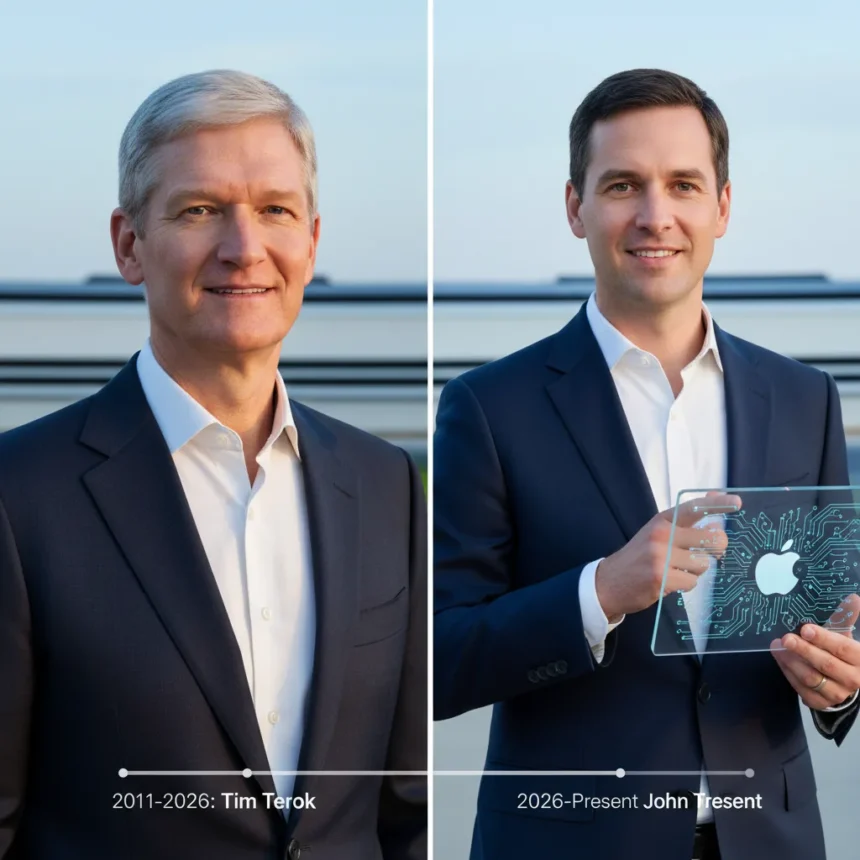
Tim Cook Apple CEO transition marks the biggest leadership shake-up at the tech giant since Steve Jobs, with the 15-year leader handing over the top role to John Ternus on September 1, 2026. The announcement, made on April 20, 2026, via Apple’s Newsroom, signals a planned succession rather than a crisis departure, with Cook moving to Executive Chairman to oversee the transition.
Key Takeaways
- Tim Cook steps down as CEO on September 1, 2026, after 15 years in the role.
- John Ternus, currently Senior Vice President of Hardware Engineering, becomes the new CEO.
- Cook transitions to Executive Chairman of Apple’s board after stepping down.
- Cook joined Apple in 1998 and has served the company for 25 years total.
- Johny Srouji assumes Ternus’s hardware engineering responsibilities immediately.
Who Is John Ternus?
John Ternus has been the architect of Apple’s hardware strategy for years as Senior Vice President of Hardware Engineering, a role that puts him at the center of every major product launch from iPhones to Macs. In his new position as CEO, Ternus inherits responsibility for steering Apple’s innovation roadmap across all product categories. Tim Cook praised Ternus in a statement, saying he has “the mind of an engineer, the soul of an innovator, and the heart to lead with integrity and with honor”. Ternus responded to his promotion with measured optimism, stating “I am profoundly grateful for this opportunity to carry Apple’s mission forward”.
The hardware engineering background is significant. Unlike Cook, who came up through operations and supply chain management, Ternus brings a product-design perspective to the CEO role. This represents a subtle but meaningful shift in Apple’s leadership philosophy—moving from operational excellence as the primary driver toward engineering innovation as the guiding force. Cook’s strength was making Apple’s supply chain legendary and scaling manufacturing globally; Ternus will be expected to push the boundaries of what Apple’s products can do.
Tim Cook’s 15-Year Legacy as Apple CEO
When Cook took over in 2011 following Steve Jobs’s resignation due to health reasons, Apple was already dominant but unproven under new leadership. Cook navigated the company through the post-Jobs era without stumbling, a feat that seemed uncertain at the time. He expanded Apple’s services business from a minor revenue stream into a $80+ billion annual engine, diversified product lines with the Apple Watch and AirPods, and maintained hardware margins that competitors still envy.

Cook’s greatest achievement was arguably stabilizing Apple’s identity after Jobs’s death. Many analysts predicted the company would falter without its visionary founder. Instead, Cook proved that operational discipline and strategic focus could sustain innovation at scale. He also expanded Apple’s geographic footprint, particularly in emerging markets, and built a supply chain resilient enough to weather global disruptions. Cook himself acknowledged Ternus’s readiness, saying “I could not be more confident in his abilities and his character, and I look forward to working closely with him on this transition and in my new role as executive chairman”.
How Does This Compare to Other Tech Leadership Transitions?
Apple’s planned succession differs sharply from crisis handoffs at other tech companies. When Steve Ballmer took over from Bill Gates at Microsoft in 2000, Gates stayed involved as Chief Software Architect; the transition was orderly but not seamless, and Microsoft spent years finding its footing in the mobile era. Sundar Pichai’s rise to Google CEO in 2019 was similarly structured but happened amid organizational restructuring. Apple’s approach—announcing the transition 16 months in advance, keeping Cook involved as Executive Chairman, and promoting from within—suggests confidence that the company’s direction is stable enough to hand off to the next generation.

The difference is strategic clarity. Apple knows what it wants to be: a premium hardware and services company with a focus on integration and privacy. Ternus inherits a company with a clear mission, not one searching for identity. That foundation, built by Cook over 15 years, gives Ternus a runway that many new CEOs lack.
What Happens to Tim Cook After September?
Cook’s move to Executive Chairman keeps him visible at Apple but shifts his role from day-to-day operations to board-level strategy and oversight. This is not a retirement. Executive Chairs at tech companies typically remain involved in major decisions, investor relations, and long-term planning. Cook will likely have significant input on product direction, major acquisitions, and Apple’s response to regulatory challenges. His 25 years at Apple—joining in 1998—means he understands the company’s culture and values in ways few outsiders ever could.
The timing also matters. Cook will oversee the transition through the summer, working closely with Ternus to ensure continuity. This is not a surprise departure. It is a choreographed handoff designed to minimize disruption and signal to investors, employees, and partners that Apple’s leadership bench is deep.
What Happens to John Ternus’s Old Role?
Johny Srouji, who has been with Apple in various engineering capacities, takes over Ternus’s position as Senior Vice President of Hardware Engineering effective immediately on April 20, 2026. This keeps the hardware pipeline intact and signals that Apple’s product roadmap continues without interruption. Srouji’s elevation suggests Apple has confidence in its next tier of leadership and is not scrambling to fill gaps.


Why Now? Why 2026?
The September 2026 date gives Apple and Ternus time to prepare without appearing rushed. Cook will have served 15 years—a respectable tenure that allows him to step down on his own terms rather than face pressure. The timing also avoids disruption to major product cycles; Apple can announce the transition in spring and execute the handoff after the summer product launch season concludes. This is deliberate succession planning, not improvisation.
Does This Change Apple’s Direction?
Not dramatically. Ternus has been shaping Apple’s hardware strategy for years in his role as SVP of Hardware Engineering. The CEO title formalizes what he has already been doing—leading product innovation. However, a hardware engineer as CEO may emphasize different priorities than Cook did. Cook focused on services, ecosystem lock-in, and shareholder returns. Ternus may tilt the company toward bolder product experimentation, new form factors, or deeper integration of AI and machine learning into hardware.
Cook’s statement that Ternus is “the right person to lead Apple into the future” and his optimism about “what we can achieve in the years to come” suggest the board sees Ternus as capable of steering Apple through the next era of computing—likely dominated by AI, spatial computing, and whatever comes after the smartphone.
Is Tim Cook really leaving Apple?
No. Cook is stepping down as CEO but becoming Executive Chairman, keeping him involved in strategic decisions and board governance. This is a role transition, not a departure. He remains an Apple executive and board member, just without day-to-day operational responsibilities.
What is John Ternus’s background?
Ternus has been Senior Vice President of Hardware Engineering at Apple, meaning he has overseen the design and engineering of Apple’s entire product line from iPhones to Macs. His promotion to CEO reflects his deep expertise in product development and his track record of delivering hardware that defines market categories. Cook’s praise for his “mind of an engineer” and “soul of an innovator” points to a leader who understands both technical constraints and creative possibility.
When does the transition happen?
Tim Cook steps down as CEO on September 1, 2026, with John Ternus officially becoming CEO on the same date. Johny Srouji assumes Ternus’s hardware engineering role immediately, as of April 20, 2026. The announcement was made on April 20, 2026, giving the company over four months to prepare for the leadership change.
Apple’s leadership transition represents confidence in its future. Cook has built a company stable enough to hand off to the next generation, and Ternus inherits a clear mission and a deep bench of talent. Whether Ternus can maintain Apple’s premium positioning and push innovation boundaries will define his early years as CEO. For now, the handoff appears as smooth as any major tech company transition can be.
Where to Buy
This article was written with AI assistance and editorially reviewed.
Source: T3