






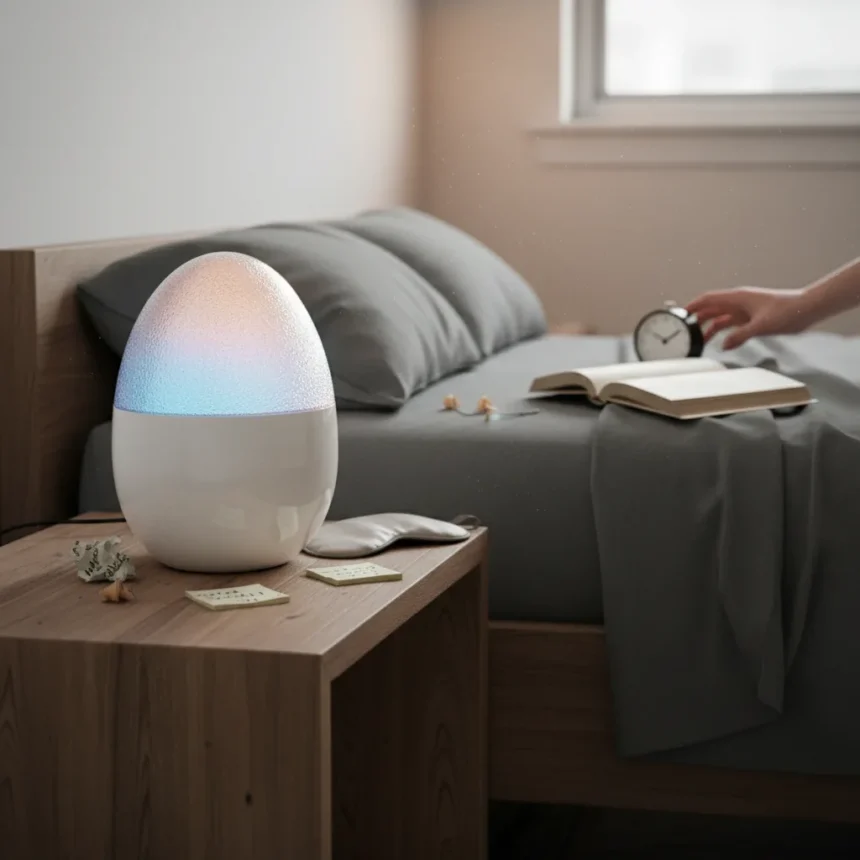
An AI sleep companion shaped like an egg has entered a crowded market of sleep-tracking devices and ambient wellness gadgets, promising to use sensors, sound, and light to improve sleep quality. The device represents a growing trend toward AI-powered sleep optimization, but the question remains: does a sleek design and sensor array actually translate to better rest, or is it another case of novelty outpacing substance?
Key Takeaways
- AI sleep companions combine environmental sensors, ambient sound, and light therapy in a single bedside device
- The market includes competing products like Sleepal AI Lamp and Slzzzp, each with different design and feature approaches
- Wearable sleep monitoring research shows sensor accuracy varies significantly across devices and sleep stages
- Premium pricing for sleep gadgets rarely correlates with measurable improvements in actual sleep quality
- Integration with sleep health platforms is becoming standard, but data privacy remains a concern for many users
What Makes This AI Sleep Companion Different?
The egg-shaped design immediately signals a departure from conventional bedside clocks and sleep trackers. Rather than a rectangular box or wristband, this AI sleep companion uses a minimalist form factor that appeals to design-conscious consumers. The device combines multiple sensing technologies—environmental monitors for temperature, humidity, and light levels—with audio playback and programmable lighting to create what manufacturers call a holistic sleep environment.
The core pitch is straightforward: sensors detect your sleep patterns and environmental conditions, then the device adjusts ambient sound and light in real time to optimize sleep stages. This approach differs from competitors like the Sleepal AI Lamp, which emphasizes light therapy alone, or Slzzzp, which focuses on sound-based sleep assistance. Each product makes different bets on which sensory input matters most.
The challenge with any AI sleep companion is proving that these adjustments actually work. Wearable sleep monitoring technology has advanced significantly, with research from Vanderbilt University and other institutions demonstrating that sensor-based detection of sleep disorders is improving. However, the leap from detecting sleep to actively improving it remains contested. Many users report that the placebo effect of a premium sleep device—the ritual of using it, the belief that it will help—may account for perceived improvements as much as the technology itself.


Sensors, Sound, and Light: Do They Actually Help?
The three pillars of this AI sleep companion’s approach deserve individual scrutiny. Environmental sensors measure the conditions around you, which is useful data but passive—the device cannot change room temperature, only monitor it. Sound generation through white noise, nature sounds, or binaural beats has genuine research backing, though effectiveness varies dramatically between individuals. Light therapy, particularly in the blue-light-blocking spectrum, shows promise for circadian rhythm regulation, but requires consistent use and proper timing.
What the marketing glosses over is that these three elements work best when coordinated with your actual sleep schedule, which means the device needs accurate sleep stage detection. This is where the technology becomes genuinely difficult. Distinguishing between light sleep, deep sleep, and REM sleep from environmental sensors alone is imprecise. Most accurate sleep tracking requires wearables like smartwatches or specialized EEG headbands, not bedside devices. An AI sleep companion that relies primarily on ambient sensing will have gaps in its understanding of your sleep architecture, potentially leading to poorly timed interventions.



The device’s AI component attempts to learn your preferences over time, adjusting sound profiles and light intensity based on reported sleep quality. This personalization is valuable, but it requires weeks or months of consistent use and accurate user feedback to become genuinely helpful. Early adopters often abandon sleep gadgets within two weeks when the novelty wears off and the marginal benefit becomes unclear.
How Does This Compare to Other Sleep Devices?
The sleep gadget market has fragmented into multiple approaches. Sleepal AI Lamp prioritizes light therapy and smart home integration, appealing to users who already own connected devices. Slzzzp focuses on audio-based sleep assistance without the light component, making it simpler and cheaper. This egg-shaped AI sleep companion attempts to do all three, which sounds comprehensive but often means none of the features are optimized as deeply as specialized competitors.
Pricing is another critical differentiator. Premium sleep devices typically cost between $150 and $400, and this egg device sits in that range. For comparison, a high-quality white noise machine costs $50 to $100, a smart light bulb costs $15 to $50, and a sleep-tracking smartwatch costs $200 to $400. The AI sleep companion bundles these capabilities, but whether the integration justifies the premium depends entirely on whether you actually use all three features consistently. Many buyers purchase one feature’s worth of functionality and ignore the rest.
Privacy and Data Concerns
Any device that monitors your sleep environment and syncs data to the cloud raises legitimate privacy questions. Sleep data is deeply personal—it reveals your schedule, your partner’s presence, your stress levels, and your health patterns. The AI sleep companion requires either local processing or cloud connectivity to learn from your patterns. Local processing is more private but limits the sophistication of the AI. Cloud processing enables better personalization but requires trusting the manufacturer with sensitive data.



The research brief mentions that sleep data platforms are emerging as a category, with companies like Ozlo building infrastructure around sleep information. This ecosystem development is positive for interoperability but amplifies privacy risks if data is shared across multiple services. Before purchasing any AI sleep companion, users should read the privacy policy carefully and understand exactly what data is collected, where it is stored, and whether it can be deleted.
Should You Buy This AI Sleep Companion?
The honest answer depends on your sleep problem. If you struggle with circadian rhythm disruption (jet lag, shift work), light therapy might genuinely help, and this device’s light component could be worthwhile. If you live in a noisy environment, the sound masking is useful. If you want to track sleep trends without wearing a device, the environmental monitoring adds value. But if you simply want to sleep better, the evidence that a premium AI sleep companion outperforms a $40 white noise machine and good sleep hygiene is weak.
The device makes sense for early adopters who enjoy experimenting with wellness technology and can afford the premium price. It makes less sense for someone on a budget or skeptical of gadget-based solutions. The real test is whether you will actually use it consistently for three months, the minimum time needed for the AI to learn your patterns. If you have abandoned previous sleep gadgets within weeks, this one likely will not break that pattern, regardless of its design appeal.
Does the egg design actually improve sleep?
No. The egg shape is aesthetic and helps the device fit on a nightstand, but it does not improve the technology inside. Design matters for user adoption—you are more likely to keep a device you find beautiful—but beauty does not replace functionality. A less attractive device with better sensor accuracy or more intuitive controls would be more useful, though less likely to trend on social media.
How long does it take for the AI sleep companion to learn my sleep patterns?
Most sleep-learning AI requires two to four weeks of consistent nightly use before it begins making meaningful adjustments. During this period, you will need to manually log your sleep quality so the device can correlate its sensor data with your actual experience. If you skip nights or do not provide feedback, the learning curve extends significantly. Patience is essential.
Can this AI sleep companion replace a sleep tracker smartwatch?
Not entirely. A bedside device captures environmental data but cannot detect your heart rate, movement patterns, or respiratory changes with the precision of a wearable. For serious sleep disorder diagnosis or detailed sleep architecture analysis, a smartwatch or medical-grade sleep tracker remains necessary. This AI sleep companion is a supplement, not a replacement, for wearable sleep monitoring.
The egg-shaped AI sleep companion is a competent device that bundles three useful sleep technologies into one attractive package. It will help some users optimize their sleep environment and develop better bedtime routines. For others, it will be an expensive nightstand decoration. The key is honest self-assessment: do you actually use sleep gadgets long-term, or do you buy them for the promise and abandon them for the reality? The answer to that question matters far more than the device’s design or specifications.
This article was written with AI assistance and editorially reviewed.
Source: T3