






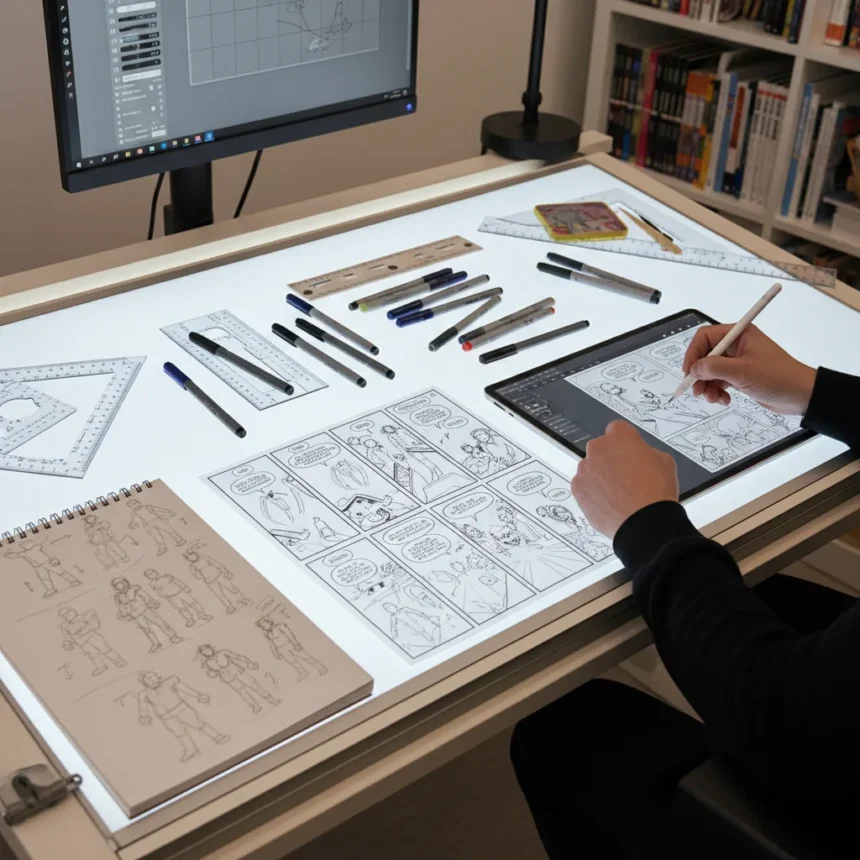
How to draw comic panels starts before you touch a pencil—it starts with understanding the story. Professional comic artists read the script multiple times to grasp narrative flow, character motivation, and pacing before committing to any visual layout. This foundational step separates artists who create panels that serve the story from those who simply fill pages with drawings.
Key Takeaways
- Read the script multiple times to understand story flow and character motivations before thumbnailing.
- Thumbnails break the script into visual units, with panel size determined by dialogue volume and story rhythm.
- Panel borders and character silhouettes establish composition; line weight and lighting define visual hierarchy.
- Treat each panel as a movie still, capturing only the most important moments without clutter.
- Manga panels use variable sizes and wider gutters between groups to guide reading order.
Step 1: Read and Understand the Script
Before thumbnailing, absorb the script completely. PJ Holden, a professional comic artist, emphasizes that reading multiple times ensures understanding of the narrative. Since your job is to communicate the script visually to the reader, confusion at this stage compounds through every subsequent layer. Identify key emotional beats, character arcs, and pacing shifts. Which moments demand visual weight? Where does the reader need to linger? These questions shape everything that follows.
How to Draw Comic Panels: Thumbnails and Layout
Thumbnails break the script into drawings that explore character placement, flow, and spatial relationships. Use a light pencil technique—the Pencil Side On tool helps avoid getting trapped in unnecessary details at this rough stage. Panel size directly correlates with dialogue volume: more dialogue requires larger panels to accommodate text without cramping the image. A panel crowded with speech bubbles suffocates the artwork and exhausts the reader.
After thumbnailing, revise for rhythm and visual variety. A tall establishing shot can dominate a page, drawing the eye first, but it should feel like a standalone unit rather than a cramped afterthought. Flip panels, recenter figures, recrop compositions, and remove borders where they add nothing. This iteration phase prevents monotonous grid layouts that bore readers.


Building Panels: Borders, Silhouettes, and Line Work
Once thumbnails lock in composition, use the Frame tool to draw clean panel borders. Block in characters as silhouettes using a Darker Pencil brush to establish mass and weight before refining details. This silhouette phase clarifies whether figures read clearly at a glance—if the outline alone confuses the eye, the finished panel will fail.
Develop line art on a fresh layer with a custom Ink Pencil brush, working lightly at first. Render lighting and basic form without committing to heavy lines. Add weight strategically: increase line weight to define flow, clarify light source, and distinguish character weight from background elements. Flat, uniform line weight creates a lifeless panel; varied weight gives the drawing presence and guides the reader’s eye through the composition.



Compositional Strategy: Panels as Movie Stills
Think of each panel as a still from a film. Derek Laufman, who has worked on Marvel and Disney properties, advises capturing only the most important moments of the story. A cluttered panel with too much action dilutes impact. Make each panel count by using positive and negative space sensibly, avoiding visual noise that distracts from the core moment. Ask yourself: what is the reader supposed to feel or understand in this single frame? If you cannot answer that clearly, the panel needs rethinking.
Understanding character motivation sharpens panel choices. Get inside your characters’ heads and understand what drives their actions. A character looking off-panel gains power if the reader knows what they are searching for or dreading. A gesture becomes poignant if the emotional subtext is clear. This psychological depth transforms mechanical composition into storytelling.
Panel Variation and Reading Order
Western comics and manga handle panel rhythm differently. Manga uses variable panel sizes and shapes without arrows, relying on gutters—the spaces between panels—to guide reading order. Wider gutters between groups of panels signal a pause or shift; misaligned internal gutters within a group create visual direction that naturally leads the eye to the next panel. This technique allows manga to feel dynamic and organic rather than rigidly gridded.
Superhero comics and dialogue-heavy graphic novels face different trade-offs. Simone Ferriero, a professional comic artist, notes that equally spaced panels work well for stories focused on dialogue and character development, while more exuberant panel shapes suit action-driven superhero narratives. Choose panel strategy based on story needs, not personal preference alone.


What makes panel layouts feel natural instead of stiff?
Rhythm and variety prevent monotony. Alternate tall panels with clusters of smaller ones, vary aspect ratios, and use negative space intentionally. A single large panel surrounded by smaller ones feels impactful; repeating the same size throughout feels mechanical.
How much detail should thumbnails include?
Thumbnails should capture placement, flow, and rough proportions only. Avoid rendering details or textures; use light, quick marks to explore composition rapidly. Detailed thumbnails slow iteration and lock you into decisions too early.
Why does dialogue volume affect panel size?
Speech bubbles occupy physical space on the page. A panel packed with dialogue needs larger dimensions to prevent text from overwhelming the image and crushing readability. Conversely, a silent, action-heavy panel can be small and punchy.
Mastering how to draw comic panels requires balancing technical skill with storytelling instinct. Read the script, explore layouts through thumbnails, build panels with clear silhouettes and varied line weight, and treat each frame as a deliberate moment in a larger narrative. The difference between competent panel work and compelling comic art lies in this discipline—understanding that every border, every line weight, every composition choice serves the story first.
This article was written with AI assistance and editorially reviewed.
Source: Creativebloq