





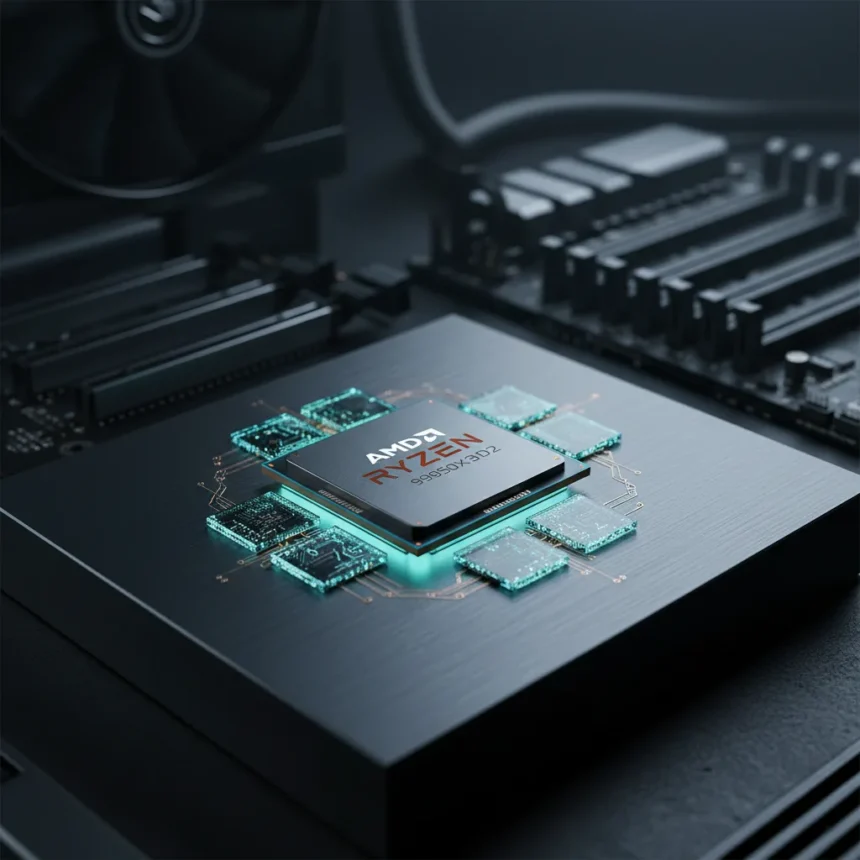
The AMD Ryzen 9 9950X3D2 is AMD’s first dual-cache X3D CPU, featuring 192MB of L3 cache stacked across both CCDs, a 5.6 GHz boost clock, and a 200W TDP. Pre-order pricing sits around $899 to $1,000, depending on retailer. This chip arrives as AMD’s answer to pushing gaming performance through cache density rather than raw frequency—but the gains tell a cautious story.
Key Takeaways
- 192MB of stacked L3 cache across both CCDs marks AMD’s first dual-cache design
- 5-12% gaming performance gains in specific workloads justify limited upgrade appeal
- 200W TDP keeps power consumption reasonable despite dual X3D implementation
- Pre-order pricing ranges from $899 to $1,000 across retailers globally
- 5.6 GHz boost clock delivers modest frequency improvements over previous X3D chips
More Cache Doesn’t Always Mean Better Gaming
The AMD Ryzen 9 9950X3D2 delivers 5-12% performance improvements in gaming and certain multi-threaded workloads. That sounds compelling on paper. In reality, the gains are narrow—specific titles benefit; others see negligible uplift. This is the trap of cache-focused design: you are buying performance for a subset of applications, not a universal leap. Gamers upgrading from a standard Ryzen 9 will notice the difference. Gamers coming from a prior X3D chip? The math becomes harder.
The dual-cache architecture is genuinely novel. By stacking X3D cache across both CCDs instead of concentrating it on one, AMD achieves higher total cache density than any consumer CPU before it. The tradeoff is complexity—and complexity often means thermal and power management challenges. The 200W TDP stays reasonable, but thermals during sustained loads remain a question the brief review data cannot fully answer.
Pricing Creates a Credibility Problem
At $899 to $1,000, the AMD Ryzen 9 9950X3D2 occupies an uncomfortable middle ground. It is too expensive to be an obvious gaming-focused purchase—high-end gaming builds have other bottlenecks. It is too specialized to be a professional workstation chip, since the cache optimization targets gaming, not rendering or scientific computing. AMD is asking enthusiasts to pay flagship prices for incremental gaming gains. That is a harder sell than marketing copy admits.


The positioning against Intel’s latest high-end offerings and AMD’s own non-X3D Ryzen 9 lineup matters here. Without comparative benchmarks in the brief, the qualitative case is that the AMD Ryzen 9 9950X3D2 is a niche product—powerful, yes, but optimized for a narrow use case. Broad appeal it is not.
Should You Buy the AMD Ryzen 9 9950X3D2?
If you are a competitive gamer chasing every frame in titles that benefit from massive L3 cache, the AMD Ryzen 9 9950X3D2 makes sense. If you are a content creator, streamer, or general enthusiast, the premium pricing is harder to justify. The 5-12% gaming uplift is real but not transformative. The 200W power envelope is clean, but you are still paying flagship money for a single-use-case chip. AMD has built a technically impressive CPU that solves a problem only a subset of buyers actually has.



What Is the AMD Ryzen 9 9950X3D2 Cache Configuration?
The AMD Ryzen 9 9950X3D2 features 192MB of L3 cache split across both CCDs with X3D stacking. This dual-cache design is the first of its kind in consumer CPUs, allowing AMD to maximize gaming performance by distributing cache density rather than concentrating it. The 5.6 GHz boost clock pairs with this cache to target frame-rate-sensitive workloads.
How Much Performance Improvement Does the AMD Ryzen 9 9950X3D2 Offer?
The AMD Ryzen 9 9950X3D2 delivers 5-12% performance gains in gaming and specific multi-threaded tasks. The range reflects variance across different titles and workloads—some applications see the full 12% uplift, while others barely register improvement. This is not a wholesale generational leap; it is a targeted optimization for cache-sensitive scenarios.
The AMD Ryzen 9 9950X3D2 is a technically accomplished chip that asks an uncomfortable question: does cache density alone justify premium pricing when gains are this narrow? For gaming purists, maybe. For everyone else, the math is less convincing.
Where to Buy
$676 | $520 | $530 | $439 | $499



Edited by the All Things Geek team.
Source: Tom's Hardware




