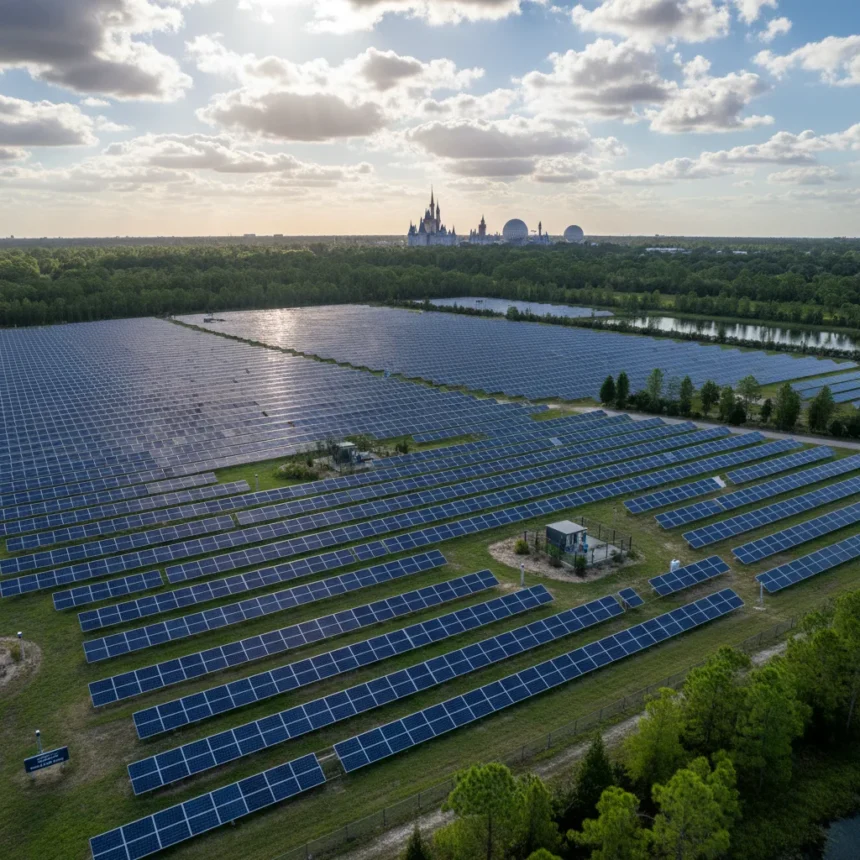
Walt Disney World’s new solar facility marks the completion of a renewable energy strategy that now supplies 100% of the daytime power needed to operate all four theme parks, transforming the resort into Florida’s largest commercial solar consumer.
Key Takeaways
- New 74.5 MW facility in Levy County spans 484 acres, equivalent to 366 football fields.
- Combined with prior solar arrays, Disney can now meet 100% daytime peak demand across all parks.
- Prior facilities include a 5 MW Mickey-shaped array near Epcot and the 52 MW Citrus Ridge Solar farm.
- 2023 additions of two 75 MW arrays brought total capacity to 40% of park electricity before the new facility.
- Disney’s solar portfolio reduces annual emissions equivalent to removing approximately 29,500 vehicles from roads.
How Disney’s Solar Facility Achieves 100% Daytime Power
The newly operational 74.5 MW facility in Levy County, Florida, completes Disney’s renewable energy architecture by providing sufficient capacity to match the resort’s peak daytime demand. The 484-acre installation—roughly the size of Monaco—works in concert with three previously commissioned solar farms to eliminate reliance on traditional grid power during peak operational hours. This is not theoretical capacity; Disney’s 2019 peak demand reached 198 megawatt-hours, and the combined portfolio now exceeds this threshold during daylight hours.
The facility’s scale reflects the engineering required to power a destination that draws tens of millions of visitors annually. At 366 football fields worth of solar panels, the Levy County site alone generates more electricity than most small cities consume, yet it represents just one piece of Disney’s broader renewable strategy.
Disney’s Multi-Year Solar Expansion Strategy
Disney did not achieve this milestone overnight. The company’s solar journey began in 2016 with a 5 MW Mickey-shaped array near Epcot, designed and operated by Duke Energy. That facility, built with 48,000 panels across 22 acres, generates approximately 10.5 million kilowatt-hours annually—enough to power roughly 1,000 homes. While symbolically important, this early installation supplied only a fraction of the resort’s needs.

The turning point came with the 2018 Citrus Ridge Solar farm, a 52 MW facility built by Origis Energy across 270 acres. This installation powers two of Disney’s four theme parks and reduces annual emissions by more than 50,000 tons—equivalent to removing about 10,000 automobiles from roads annually. By 2023, Disney added two additional 75 MW arrays in Gilchrist and Polk Counties, spanning more than 1,000 acres combined and generating 375,000 megawatt-hours in the first year of operation. These additions alone brought Disney’s renewable capacity to 40% of total park electricity consumption.
The progression from 10% to 40% to now 100% daytime capacity demonstrates Disney’s commitment to scaling renewable infrastructure rather than relying on incremental improvements. Each facility was strategically sited across Florida’s central regions, leveraging the state’s abundant sunshine and available land while distributing the environmental footprint across multiple counties.



Why 100% Daytime Power Matters for Corporate Sustainability
Daytime-only operation is not a limitation—it is a realistic engineering goal that aligns with solar physics and grid dynamics. Disney’s parks operate primarily during daylight and early evening hours, meaning peak demand coincides with peak solar generation. Battery storage and grid integration handle evening operations, but the ability to source 100% of daytime consumption from renewables eliminates the largest portion of the resort’s carbon footprint during its busiest hours.
This achievement positions Disney ahead of most major corporations in renewable deployment. Duke Energy, which operates the Epcot facility, has committed to deploying an additional 500 MW of solar across Florida by 2024, but Disney’s portfolio is already one of the largest commercial solar installations in the state. The resort’s position as Florida’s largest commercial solar consumer reflects both the scale of its operations and the seriousness of its renewable energy commitment.
What About Disney’s Broader Climate Goals?
It is worth noting that Disney’s original goal—a 50% reduction in net greenhouse gas emissions by 2020—was stated over a decade ago. The company’s current renewable energy strategy extends beyond solar, incorporating wind, geothermal, and water resources into a diversified energy portfolio. The 100% daytime solar capability represents a major milestone, but it does not mean Disney has achieved net-zero operations across all facilities. The resort still relies on grid electricity during evening peak hours, and non-power emissions from transportation, waste, and supply chains remain significant.
However, the solar facility’s completion demonstrates that Disney is willing to invest in large-scale, long-term renewable infrastructure rather than pursuing cheaper short-term alternatives. A 484-acre solar farm requires years of planning, permitting, and capital investment—this is not a marketing gesture but a genuine operational transformation.



How Does Disney’s Solar Facility Compare to Other Corporate Renewable Projects?
Disney’s approach differs from many corporate sustainability initiatives in its reliance on owned or contracted solar generation rather than renewable energy credits. The Citrus Ridge and Levy County facilities are directly tied to Disney’s operations through power purchase agreements, meaning the resort receives actual clean electricity rather than simply offsetting emissions through third-party purchases. This direct-generation model is more capital-intensive but provides greater certainty and operational control.
Duke Energy’s broader Florida solar expansion shows that Disney’s strategy aligns with industry trends toward distributed renewable generation, yet Disney’s 484-acre single facility exceeds most corporate solar projects in scale. The comparison underscores that Disney’s renewable portfolio is not just larger than typical corporate installations—it is among the largest commercial solar deployments in the southeastern United States.
Is Disney’s 100% daytime solar power claim accurate?
Disney’s claim refers to capacity during peak daytime hours, not a guarantee of 100% generation every day. Solar output varies with cloud cover, seasonal angles, and atmospheric conditions. The facility is designed to meet peak demand on an average sunny day, not during cloudy periods or severe weather. This is standard language in the solar industry—capacity ratings describe optimal conditions, not minimum guaranteed output.
How much electricity does the new Levy County solar facility generate annually?
The research brief does not specify the annual kilowatt-hour output of the Levy County facility. However, based on the 2023 arrays’ performance (375,000 megawatt-hours annually from 150 MW capacity), the new 74.5 MW facility would likely generate approximately 180,000 to 200,000 megawatt-hours per year, depending on Florida’s solar irradiance and seasonal variations.
What happens to Disney’s solar power when the parks close at night?
Excess daytime solar generation is fed into the grid, and Disney purchases electricity from the grid during evening and night operations. This is a standard arrangement for large distributed solar installations—the facility operates as both a power source during the day and a grid participant during off-peak hours. Battery storage or demand-side management could theoretically capture more daytime generation for evening use, but the research brief does not indicate Disney has deployed significant battery capacity at these facilities.
Disney’s solar facility represents a genuine shift in how major corporations approach renewable energy deployment. Rather than purchasing offsets or signing renewable energy contracts with distant wind farms, Disney invested in massive on-site solar infrastructure that directly powers its operations. The 484-acre Levy County facility is not the largest solar installation in the United States, but it is among the most visible and strategically important for a company that built its brand on innovation and environmental responsibility. Whether other corporations will follow Disney’s capital-intensive approach remains to be seen, but the resort has proven that 100% daytime renewable power is achievable at scale.
Edited by the All Things Geek team.
Source: TechRadar