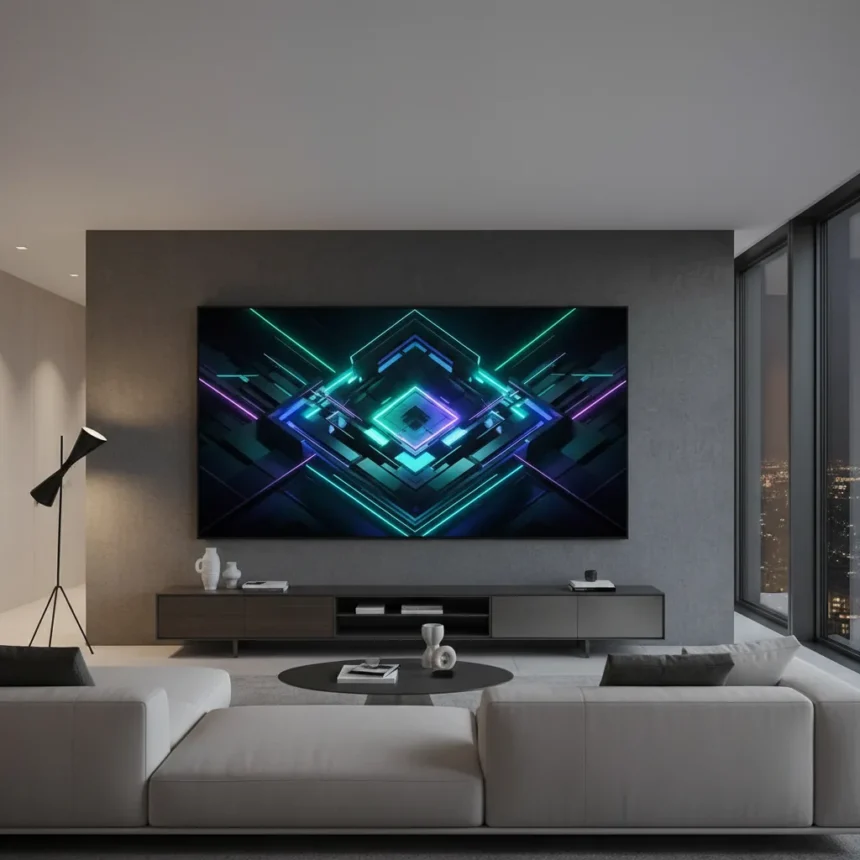
The Hisense 136-inch MicroLED TV represents a watershed moment for a technology that has lingered in the prototype phase for years. This 136-inch flagship, composed of 25 individual modules containing 24.88 million subpixels, is now available for direct consumer purchase in the US at $99,999 with free delivery, marking the shift from aspirational concept to actual product you can buy today.
Key Takeaways
- Hisense’s 136-inch MicroLED TV delivers 10,000 nits peak brightness and infinite contrast ratio for premium home viewing.
- Priced at $99,999 in the US with free delivery; launched in China at approximately $110,000 in March 2025.
- Includes custom soundbar, 120Hz refresh rate, and 95% BT.2020 color gamut coverage across its massive display.
- Undercuts competitors: LG’s 136-inch costs $300,000; Samsung’s 110-inch runs ~$155,000.
- Available for direct consumer purchase in the US; demo shown at London luxury retailer but UK availability not yet confirmed.
What Makes the Hisense 136-inch MicroLED TV Different
MicroLED technology has promised to replace OLED and traditional LED displays for over a decade, but manufacturing at scale remained prohibitively expensive. The Hisense 136-inch MicroLED TV breaks that pattern by being the first genuinely consumer-purchasable model at this scale, not a limited prototype or concept piece. At 10,000 nits peak brightness with infinite contrast, this display delivers specifications that eclipse standard OLED TVs, which typically max out around 3,000 nits.
The construction itself is remarkable. The display uses 25 separate modules that fit together smoothly, each containing millions of individually controlled red, green, and blue subpixels. This modular approach allows Hisense to manufacture at a larger scale than competitors while maintaining the precision that MicroLED demands. The included custom soundbar spans the TV’s width, integrating audio directly into the viewing experience rather than forcing buyers to source external speakers.
How the Hisense 136-inch MicroLED TV Compares to Competitors
Pricing tells the story of where MicroLED currently sits. Samsung’s 110-inch MicroLED costs approximately $155,000, while LG’s 136-inch equivalent—matching Hisense’s size—demands $300,000. TCL offers a 163-inch MicroLED at $110,000, but that model is larger and carries a similar price point. The Hisense 136-inch MicroLED TV at $99,999 undercuts LG by a factor of three while matching size and brightness specifications, making it the most aggressively priced option in this category.



The real competition, though, isn’t between MicroLED TVs—it’s between MicroLED and OLED. A high-end OLED TV costs a fraction of what these displays demand. But OLED cannot match the brightness or contrast that MicroLED delivers, and OLED screens are vulnerable to burn-in over extended use. For buyers with unlimited budgets and rooms bright enough to justify 10,000 nits of output, MicroLED offers capabilities OLED simply cannot provide.
Specs That Justify the Price Tag
The Hisense 136-inch MicroLED TV supports 120Hz refresh rate, making it viable for gaming and sports viewing despite its massive size. HDR support spans HDR10+, HDR10, HLG, and Dolby Vision, covering every major standard currently in use. The 95% BT.2020 color gamut coverage means nearly all colors available in professional broadcast and cinema production are reproducible on this display.



Perhaps most impressive is the anti-glare matte coating, which solves a problem that has plagued high-brightness displays for years. Bright displays tend to reflect ambient light, creating a mirror effect that undermines image quality. Hisense’s matte finish mitigates this without sacrificing the brightness that makes MicroLED worthwhile. The ultra-wide viewing angles mean the image remains consistent whether you sit directly in front or at an angle—critical for large displays where viewers rarely sit equidistant from the screen.
Availability and the Path Forward
The Hisense 136-inch MicroLED TV launched in China in March 2025 at 799,999 Yuan, approximately $110,000 USD. US availability came later, with direct consumer sales now active at $99,999 including free delivery. The London retailer demonstration confirms international interest, though UK pricing and availability remain unconfirmed.
This rollout strategy differs from how premium TVs traditionally launch. Rather than routing sales through distributors and retailers, Hisense is selling directly to consumers, which likely explains the $10,000 price advantage over the Chinese launch. Direct sales eliminate middleman margins and allow Hisense to price more aggressively while maintaining profitability—a model that could reshape how ultra-premium displays reach buyers.
Is the Hisense 136-inch MicroLED TV Worth $99,999?
That depends entirely on your use case. If you have a dedicated home theater room with controlled lighting, this display is unmatched. The brightness, contrast, and color accuracy create an experience no OLED can replicate. But at $99,999, you are paying for extreme specifications, not everyday utility. Most homes will never need 10,000 nits of brightness. For standard living rooms and viewing distances, a $2,000–$3,000 OLED will deliver better perceived image quality because it will be brighter relative to typical room lighting and less prone to reflections.



Will MicroLED prices drop significantly in the next few years?
Manufacturing scale typically drives down prices, and Hisense’s entry into consumer MicroLED sales suggests confidence in future volume. However, MicroLED requires precision manufacturing that OLED does not demand, making cost reductions slower. Expect MicroLED to remain in the ultra-premium segment for at least the next 3–5 years, though competition from Samsung, LG, and TCL should gradually erode pricing.
Can you buy the Hisense 136-inch MicroLED TV outside the US?
Currently, direct consumer purchase is confirmed only in the US. The London retailer demonstration indicates Hisense is exploring European markets, but no UK or EU pricing or launch date has been announced. International buyers should contact Hisense directly or monitor regional retailers for availability updates.
The Hisense 136-inch MicroLED TV is not a product for everyone, but it is a product for someone—and that matters. It proves that MicroLED has matured from lab curiosity to purchasable reality, even at stratospheric prices. For the ultra-wealthy home theater enthusiast, this display represents the pinnacle of current display technology. For everyone else, it is a sign that MicroLED’s future is coming, even if today’s pricing remains out of reach.
Edited by the All Things Geek team.
Source: What Hi-Fi?