





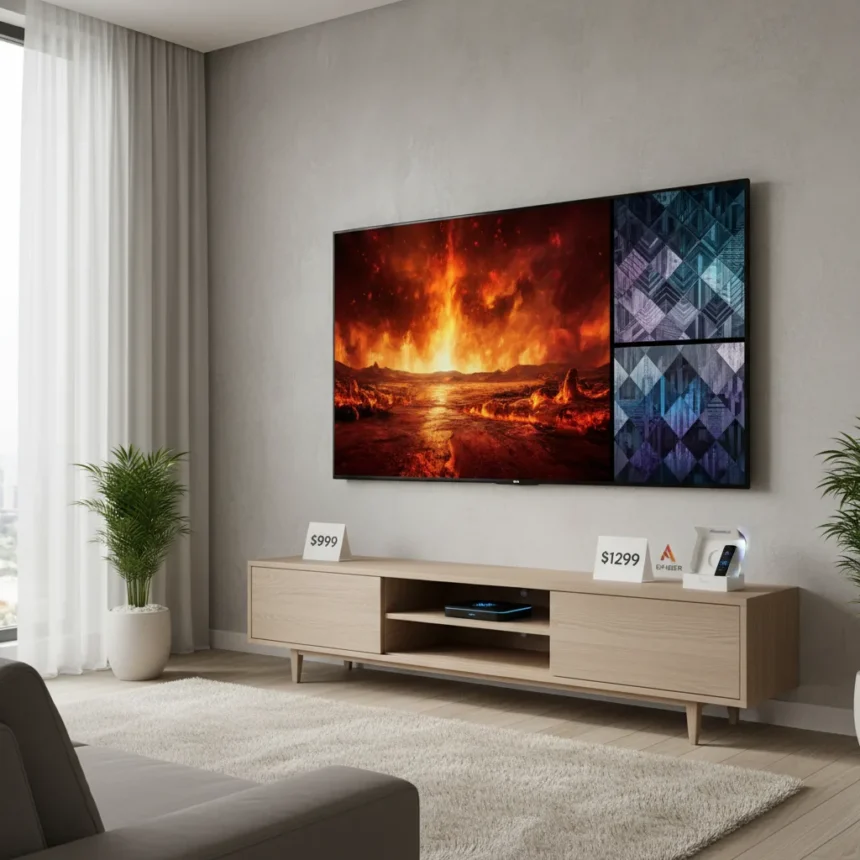
The art lifestyle TV category has stopped being Samsung’s playground. For years, The Frame dominated the space with its matte finish and Art Mode gallery. Now Amazon’s Ember Artline is launching this May at $899 for the 55-inch and $1,099 for the 65-inch—but the real story isn’t what Amazon built. It’s what cheaper competitors are already shipping with better technology underneath.
Key Takeaways
- Amazon Ember Artline arrives May 7th with QLED panels and 2,000 free artworks, but gaming is capped at 60Hz.
- Mini-LED rivals like TCL QM7K deliver 4K 144Hz gaming, brighter pictures, and better contrast at $799 for comparable sizes.
- Hisense U7Q 75-inch costs under £1,000 with Mini-LED precision and built-in free aerial channels.
- Samsung The Frame remains popular but lacks picture quality and charges subscription fees for full art access.
- The art TV market is fragmenting—2026 buyers have real alternatives beyond Frame dominance.
Why Amazon’s Ember Artline Isn’t the Safe Choice Anymore
Amazon’s Ember Artline sounds impressive on paper. It ships with a QLED panel (the same technology as Amazon’s 2025 Omni QLED), a matte anti-glare screen for art viewing, Dolby Vision and HDR10+ support, and AI-powered ‘Match The Room’ feature that adjusts artwork to your décor. The refreshed Fire TV platform launching in 2026 promises faster content access and Alexa+ integration. For a lifestyle TV, that’s solid positioning against Samsung.
But here’s the catch: gaming support maxes out at 60Hz across all four HDMI ports. If you ever want to connect a PlayStation 5 or Xbox Series X, you’re stuck at 60 frames per second. That’s a significant limitation that Amazon doesn’t advertise loudly. Meanwhile, cheaper alternatives are shipping with 144Hz gaming support, Mini-LED backlighting that delivers superior contrast and brightness, and pricing that undercuts Ember Artline by hundreds of dollars.
Mini-LED Art TVs Deliver Better Picture Quality for Less Money
The TCL QM7K and C7K series represent the real value proposition in this category. At $799 for comparable sizes—that’s $300 less than Ember Artline’s 65-inch—TCL delivers 4K 144Hz gaming, brighter pictures, vibrant colors, and refined contrast. The TCL C855 goes further with Mini-LED technology featuring thousands of dimming zones, Quantum Dot color expansion, and a 2.2.2-channel Onkyo sound system with Dolby Atmos and DTS Virtual:X support. It’s rated 5-stars for value and includes Google TV rather than Fire TV.


Hisense’s 2025 U7Q offers another compelling angle. The 75-inch model costs under £1,000 and features Mini-LED backlighting for precision and brightness, plus built-in Freely for aerial-free channels—no subscription required. Smaller Hisense models are discounted further. These aren’t niche products; they’re mainstream TVs that happen to work brilliantly as art displays while excelling at everything else.
The architectural difference matters here. Mini-LED backlighting divides the screen into thousands of independently controlled zones, allowing the TV to brighten specific areas (like a portrait) while keeping the background dark. QLED can’t match that precision. For art display, that translates to gallery-quality presentation. For gaming and movies, it means deeper blacks and more dynamic contrast.



Samsung The Frame Remains Popular But Shows Its Age
Samsung’s The Frame still dominates the lifestyle TV conversation, but 2026 reveals its weaknesses. The matte finish is genuinely excellent for art viewing—it eliminates glare and reflection in ways glossy screens can’t. But The Frame’s picture quality lags behind mini-LED competitors, and accessing the full 1,400-artwork Art Store requires a monthly subscription or uploading your own images via Google Photos. There’s no free tier equivalent to Ember Artline’s 2,000 included artworks.
LG’s Gallery+ feature offers a cheaper alternative without The Frame’s matte finish, integrating art, game images, cinematic moments, and Google Photos directly into many LG TVs at lower price points. It’s not a perfect substitute—the glossy screen reflects room light—but for budget-conscious buyers, it’s a legitimate option.
The Real Shift: Competition Beyond Samsung
What changed in 2026 is the competitive landscape. For years, if you wanted an art TV, you bought Samsung or accepted compromises. Now TCL, Hisense, LG, and Amazon all offer viable alternatives, each with different strengths. Amazon’s Ember Artline targets buyers who want deep Alexa integration and free artwork access. TCL and Hisense target gaming enthusiasts who also want art mode. LG targets budget buyers who don’t need a matte screen.
The art lifestyle TV category isn’t a gimmick anymore—it’s a legitimate segment with real engineering behind it. That competition benefits everyone. A 75-inch Hisense U7Q under £1,000 with Mini-LED technology would have been unthinkable three years ago. A $799 TCL with 144Hz gaming and art mode integration didn’t exist. Amazon’s entry forced the category to mature faster.



Should You Buy the Amazon Ember Artline?
If you’re heavily invested in Alexa and Fire TV, and you don’t care about gaming beyond 60Hz, Ember Artline makes sense. The 2,000 free artworks and AI room-matching feature are genuinely useful. But if you want a TV that excels at everything—art, gaming, movies, brightness—mini-LED alternatives deliver more for less money. The gaming limitation alone is a dealbreaker for many households.
What’s the difference between art mode and a regular TV with art apps?
Art mode on lifestyle TVs uses special software, matte screens, and optimized color profiles designed specifically for displaying artwork. Regular TVs can run art apps like Google Photos or Artsy, but glossy screens reflect room light and color calibration isn’t optimized for paintings and photography. A matte screen makes a real difference in how artwork looks in a living room environment.
Do you need a subscription for art access on lifestyle TVs?
It depends on the brand. Amazon Ember Artline includes 2,000 artworks free with no subscription. Samsung The Frame requires a subscription for the full 1,400-artwork Art Store, though you can upload your own images for free. TCL and Hisense don’t emphasize art libraries—they focus on general TV quality. LG Gallery+ integrates Google Photos directly without additional cost.
Is Mini-LED better than QLED for art display?
For art specifically, Mini-LED’s thousands of dimming zones deliver superior contrast and precision compared to QLED’s broader backlight zones. This means darker blacks behind artwork and brighter highlights on portraits. For everyday TV watching, both technologies are excellent, but Mini-LED edges ahead in picture quality when budget allows.
The art lifestyle TV market in 2026 is no longer a two-player game. Amazon’s Ember Artline is a solid entrant, but it arrives into a category where cheaper, more feature-rich alternatives already exist. If you’re shopping for an art TV, compare the TCL QM7K, Hisense U7Q, and yes, Amazon Ember Artline—but don’t assume the newest brand name means the best value. In this category, mini-LED technology and gaming support matter as much as art mode does.
Where to Buy
Samsung 55 The Frame | Amazon Ember Artline is £949 | LG OLED evo AI C5 55-inch TV 2025 | Amazon Fire TV Omni QLED 55-inch
Edited by the All Things Geek team.
Source: T3




