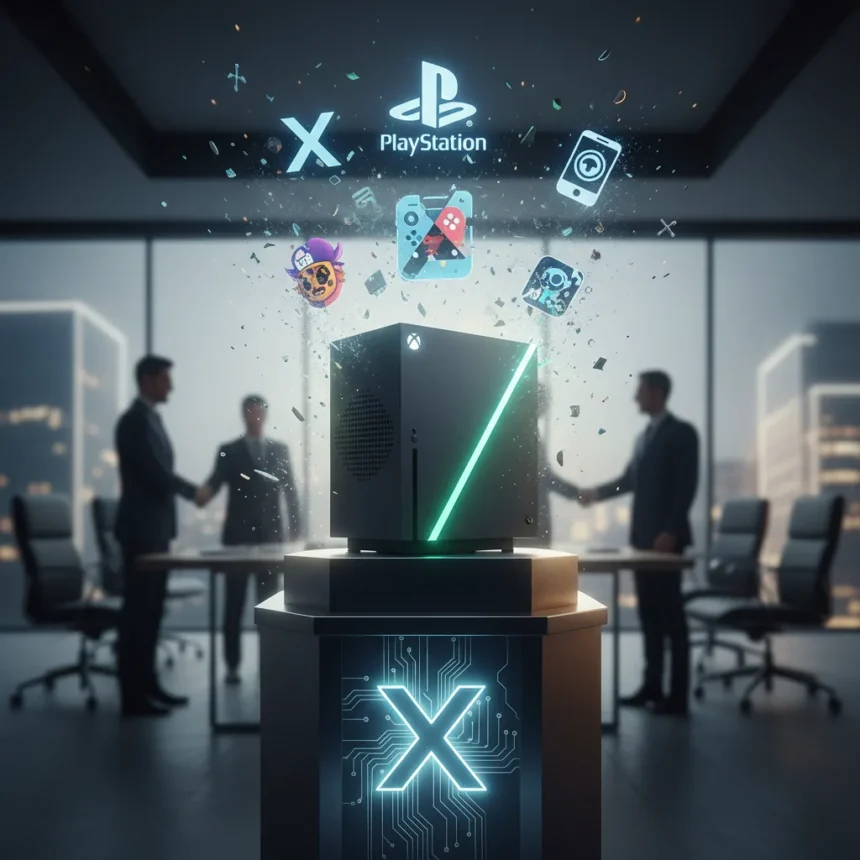
Xbox’s return strategy is now official. CEO Asha Sharma and Chief Creative Officer Matt Booty have detailed a sweeping manifesto that marks a sharp reversal from Microsoft’s previous multi-platform direction, confirming the company is actively hunting for acquisitions and doubling down on console hardware as the centerpiece of Xbox’s future.
Key Takeaways
- Xbox CEO Asha Sharma confirms active pursuit of acquisitions to fuel console and game strategy.
- Project Helix, the next-generation Xbox console, targets 2027 launch with custom AMD processor and advanced ray tracing.
- Xbox return strategy prioritizes three commitments: great games, console hardware investment, and understanding the reinvention of play.
- Xbox mode rolling out to Windows starting April 2026 for consistent cross-device experience.
- Backward compatibility extended across four generations of Xbox games for 25th anniversary in 2026.
The Three Pillars of Xbox’s Reinvention
Sharma’s vision rests on three explicit commitments that represent a deliberate course correction. First, great games—not just any games, but titles with what she calls “deep emotional resonance” and a “distinct point of view.” She cited indie title Firewatch as an example of the kind of emotionally resonant storytelling Xbox wants to champion, signaling a shift toward curation over volume. Second, the return of Xbox itself, with console hardware as the anchor. This is the most significant pivot: after years of “Xbox everywhere” strategy that emphasized cloud and multi-platform releases, Sharma is explicitly committing to console investment. “I am committed to returning to Xbox and that starts with console, that starts with hardware,” she stated.
The third pillar—understanding the “reinvention of play”—reflects Sharma’s background in AI and platform building. She emphasized that “nothing is off the table” regarding strategy, a phrase that hints at potential reversals of recent multi-platform day-one releases and possible returns to exclusivity or timed exclusivity windows. This directly contradicts the direction under previous leadership, which had pushed Xbox games to PlayStation and other competing platforms to broaden reach. The internal memo signals that era is closing.
Project Helix: Next-Generation Hardware Powers the Return
The centerpiece of Xbox’s hardware future is Project Helix, a next-generation console deep in development that promises significant performance leaps. The system will be powered by a custom AMD SoC and will support both Xbox and PC games natively, addressing one of Xbox’s persistent challenges—the fragmentation between console and PC gaming experiences. The hardware includes FSR Next upscaling, advanced DirectX improvements, and what Microsoft describes as an “order-of-magnitude” leap in ray tracing capability.


Most intriguingly, Project Helix integrates AI directly into the graphics and compute pipeline to generate more realistic game worlds with improved efficiency. This addresses Sharma’s stated commitment to “no tolerance for bad AI” while acknowledging AI’s legitimate role in game development. Matt Booty previously envisioned AI running “dozens or hundreds of instances” of game builds overnight for automated bug testing—a use case that remains relevant. Alpha hardware kits will ship to developers beginning in 2027, with a potential consumer launch as early as 2027, though semiconductor shortages driven by AI investments globally may push timelines.
Acquisitions and the Console-First Pivot
Microsoft’s confirmation that Xbox is “once again looking into acquisitions” marks a strategic return to the studio-buying spree that defined the company’s approach under previous leadership. The timing is crucial: with Xbox console sales declining and the company facing criticism for diluting its own hardware’s value through day-one multi-platform releases, acquisitions of exclusive-focused studios could rebuild the game library that drives console adoption. Sharma’s emphasis on games with “distinct points of view” suggests Microsoft is seeking studios with strong creative vision rather than simply expanding headcount.
This represents a fundamental rejection of the “Xbox everywhere” philosophy that had dominated strategy discussions. That approach—releasing games on PlayStation, Nintendo, and mobile platforms—had been defended as necessary for growth but faced internal resistance and external criticism for undermining Xbox hardware’s value proposition. The new leadership appears to have concluded that competing on content breadth across all platforms is less effective than rebuilding console exclusivity and hardware-driven differentiation.
Windows Integration and the Broader Ecosystem
While console takes priority, Xbox mode is rolling out to Windows starting April 2026 in select markets, creating a unified Xbox experience across Microsoft’s operating systems. This differs from the previous multi-platform strategy by keeping the experience firmly within Microsoft’s ecosystem rather than extending it to competing platforms. The goal is to reduce device divides between console and PC while helping developers “build once and show up across hardware”—a practical advantage for studios but one that keeps players within the Xbox/Windows universe.
Backward compatibility will extend across four generations of Xbox games, a feature that few competitors match. For Xbox’s 25th anniversary in 2026, the company plans “new ways to play iconic past games,” suggesting remasters, collections, or enhanced versions that leverage Project Helix’s improved hardware. This commitment to legacy content differentiates Xbox from PlayStation’s more limited backward compatibility and reinforces the console as a vault of playable history.
What This Means for the Gaming Industry
Xbox’s return strategy signals that the “everything everywhere” model of game distribution, once heralded as the future, has limits. By committing to acquisitions, console hardware investment, and potential exclusivity, Microsoft is essentially admitting that multi-platform saturation weakens rather than strengthens a platform’s identity. The timing—coinciding with Sharma’s appointment and a broader leadership reset—suggests this is not a minor adjustment but a fundamental strategic reorientation.


For developers, the shift creates both opportunity and uncertainty. Studios acquired by Microsoft can expect resources and platform priority, but the “nothing is off the table” language around exclusivity suggests terms may be more restrictive than they were under the previous regime. For players, the return of exclusive-focused strategy could mean fewer Xbox games on rival platforms but potentially stronger reasons to own Xbox hardware.
When Will Project Helix Launch and What Should We Expect?
Project Helix alpha dev kits ship to developers in 2027, with a potential consumer launch as early as 2027, though global semiconductor shortages from AI investments may delay availability. Microsoft will share more details at the Game Developers Conference in March 2026 and the Xbox Games Showcase in spring 2026. Pricing and final specs remain unannounced, but the custom AMD processor and integrated AI suggest a premium positioning.
Is Xbox Abandoning Multi-Platform Releases Entirely?
Not necessarily, but the priority has shifted. Sharma stated “nothing is off the table,” which leaves room for selective multi-platform releases, but the emphasis on console hardware and exclusivity suggests day-one multi-platform launches are unlikely to be the default strategy going forward. Existing commitments to PlayStation ports may continue, but new acquisitions will likely prioritize Xbox exclusivity or timed windows.
What Does the Return to Acquisitions Mean for Game Quality?
Acquisitions alone do not guarantee quality, but Sharma’s explicit focus on games with “distinct points of view” and “deep emotional resonance” suggests Microsoft is prioritizing creative vision over pure output volume. The reference to indie games like Firewatch indicates openness to smaller, artistically driven projects alongside larger franchises. Success depends on whether acquired studios retain autonomy and creative direction rather than being absorbed into a homogenized development pipeline.
Xbox’s return strategy is a high-stakes gamble. By re-emphasizing console hardware, pursuing acquisitions, and potentially restricting multi-platform releases, Microsoft is betting that exclusivity and hardware differentiation matter more than ubiquity. Whether this pivot can reverse Xbox’s sales decline and rebuild the platform’s cultural relevance will become clear once Project Helix launches and the first wave of acquired studio games ship. For now, Sharma’s manifesto represents the clearest signal yet that the multi-platform era of Xbox is ending and the console-first era is beginning.
Where to Buy
Edited by the All Things Geek team.
Source: Windows Central