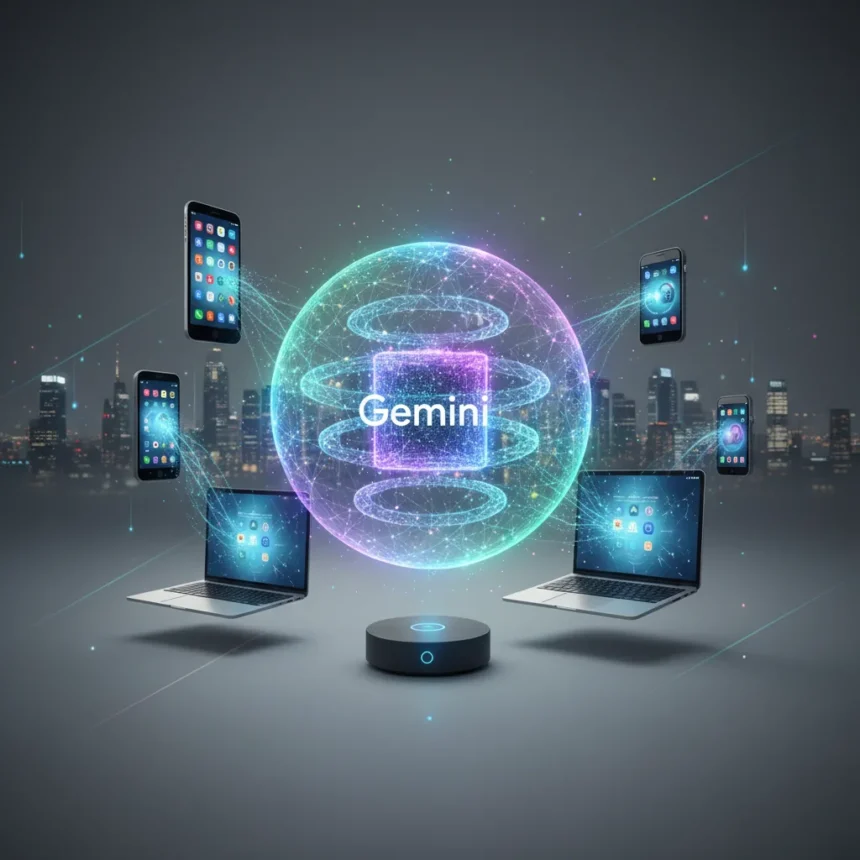
Google’s AI layer strategy represents a fundamental shift in how devices work. Rather than launching separate AI features bolted onto existing apps, Google is positioning Gemini as the primary interface that sits above everything—handling tasks across apps and devices in a conversational, context-aware way. This approach, demonstrated at Google I/O, signals that the rigid app-based interface users have relied on for over a decade is about to transform.
Key Takeaways
- Gemini replaces Google Assistant as the default AI layer, already rolling out on new Android phones throughout the year
- Ask Maps in Google Maps interprets vague requests like “restaurant” beyond simple searches, understanding mood and preference context
- Gemini’s Personal Intelligence features can browse Google Photos to adapt responses and generate AI images based on your photos, with permission
- Competitors like Amazon’s Alexa+ and Meta AI are pursuing similar layered AI approaches across devices
- Always-on AI layers risk crossing from helpful to intrusive, raising questions about when assistance becomes surveillance
Google’s AI Layer Strategy Moves Gemini to the Center
Google’s AI layer strategy positions Gemini as the operating system’s intelligent backbone rather than a feature you launch separately. This means Gemini understands what you’re trying to accomplish, remembers context from previous interactions, and routes your request to the right app—or handles it directly—without forcing you to navigate menus or type precise commands. The transition from Google Assistant to Gemini is already underway on many new Android phones and will continue throughout the year. Users who cling to the older Assistant may find themselves relearning interactions later when the shift completes.
What makes this different from previous AI assistant upgrades is the depth of integration. Ask Maps, powered by Gemini, exemplifies this shift. Instead of typing “Italian restaurants near me,” you can ask conversational questions about atmosphere, mood, or vibe—and Gemini interprets the intent behind your words. This feels less like querying a database and more like asking a knowledgeable friend. The app itself doesn’t change; the layer above it does the thinking.
Personal Intelligence and the Privacy Trade-off
Gemini’s Personal Intelligence features add another dimension to Google’s AI layer strategy. With permission, Gemini can browse your Google Photos library to understand your visual preferences, personality quirks, and aesthetic tastes. It then uses this knowledge to generate AI images that reflect your style and preferences. This capability makes the AI feel genuinely personal—it knows you, not just your search history.



But this intimacy comes with a trade-off. An AI layer that truly understands your preferences must observe your behavior at scale. The question is whether the convenience of context-aware assistance justifies the depth of data collection required to deliver it. Amazon’s Alexa+ pushes this further, promising proactive suggestions that anticipate your needs before you ask—lighting adjustments, heating tweaks, recommendations based on your habits. That’s powerful, but it also means the AI is constantly watching, deciding when to intervene. There’s a fine line between helpful anticipation and creepy surveillance.
How Google’s AI Layer Strategy Compares to Competitors
Google isn’t alone in this vision. Amazon’s Alexa+, launching in the UK, promises an AI layer over smart home devices, offering context-aware, proactive assistance across lights, heating, and other connected gadgets. Meta AI, upgraded with its Muse Spark model, excels in social-media-rooted interactions, reflecting its ecosystem strength. Each competitor is pursuing the same architectural goal: making AI the primary interface rather than a secondary tool.



The difference lies in ecosystem depth. Google‘s AI layer strategy benefits from integration across Android, Maps, Photos, Search, and Gmail—services billions use daily. Amazon’s strength is smart home control; Meta’s is social engagement. Google’s advantage is that it touches more of your digital life, which means Gemini can understand more context and make smarter decisions. But it also means Google collects more data to train that understanding.
What This Means for Apps and Developers
If Google’s AI layer strategy succeeds, traditional app design may need to evolve. Apps built around rigid navigation structures—tap here, swipe there, find the setting you need—become less relevant when an AI layer can interpret intent and route actions intelligently. Developers will need to think differently about how their apps integrate with Gemini rather than assuming users will navigate the interface manually.
This doesn’t mean apps disappear. Instead, they become services that the AI layer orchestrates. You ask Gemini to book a flight, and it might pull data from multiple apps—Calendar to check availability, Maps to see airport locations, your payment methods to process the booking—without you switching between them. The app still does the work; the AI layer just makes the experience seamless.
Is Google’s AI layer strategy just marketing hype?
The tech industry has a long history of overstating AI capabilities. Every gadget from toothbrushes to televisions now claims to be “AI-powered,” often meaning nothing more than basic automation. Google’s AI layer strategy is more substantive than most—Gemini genuinely understands context better than previous assistants—but it’s worth remaining skeptical. An AI layer that truly anticipates your needs without becoming intrusive is harder to build than marketing suggests.


Will Gemini replace all my apps?
No. Gemini orchestrates apps and handles routine tasks, but specialized applications—photo editing, banking, gaming—will remain as dedicated experiences. The shift is about the interface layer, not app replacement. You’ll still use apps; you’ll just access them differently through Gemini’s conversational mediation.
What happens to my privacy with an always-on AI layer?
An AI layer that understands your preferences, location, photos, and behavior patterns requires significant data collection. Google’s approach includes permission controls—you can disable Personal Intelligence features if you prefer—but the underlying architecture collects more data than previous assistant designs. The privacy implications depend on whether you trust Google’s data handling and whether the convenience justifies the observation.
Google’s AI layer strategy represents a genuine inflection point in how people interact with devices. The shift from command-based interfaces to conversational, context-aware AI is already happening across Google, Amazon, and Meta. What matters now is whether these systems deliver on the promise of genuine helpfulness without crossing into intrusiveness—and whether users feel they’ve gained convenience or lost privacy in the bargain.
Edited by the All Things Geek team.
Source: TechRadar