





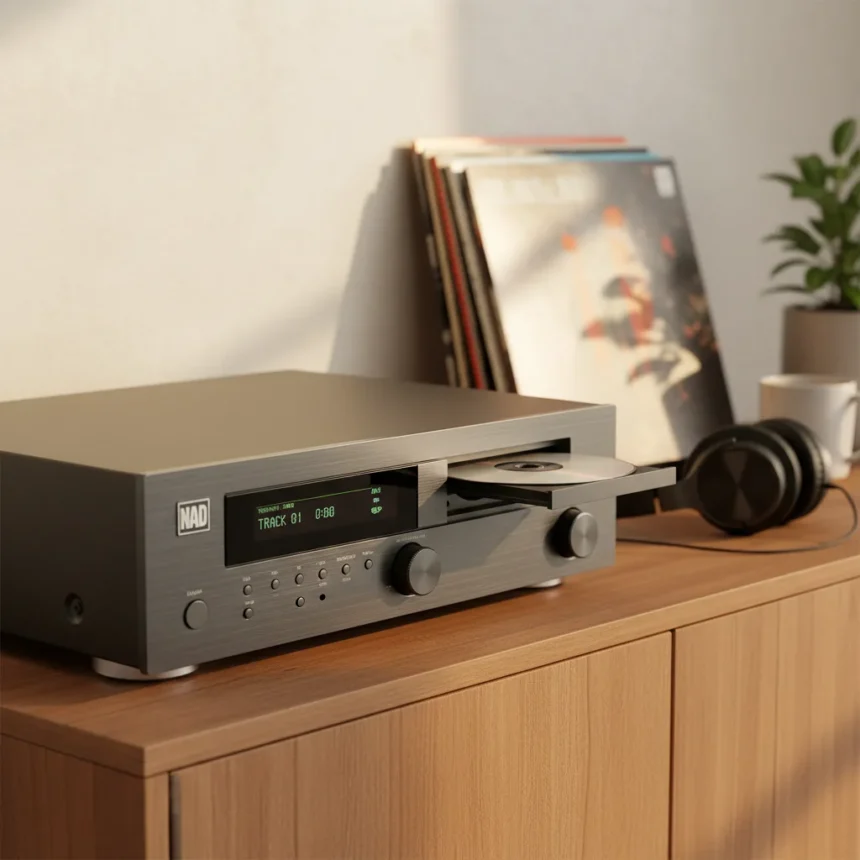
NAD’s precision-engineered CD player uses advanced digital filtering to deliver a lifelike and precise sound that challenges the assumption that compact discs are a dead format. In an era when streaming dominates and vinyl commands cult status, NAD is betting that audiophiles still value the clarity and reliability that well-engineered CD playback can provide.
Key Takeaways
- NAD’s CD player employs precision engineering and advanced digital filtering for analog-like warmth
- The device targets audiophiles seeking high-fidelity playback without streaming compromises
- CD playback remains relevant for listeners prioritizing sound quality and format stability
- Advanced filtering technology reduces digital harshness traditionally associated with CD audio
- NAD positions CD players as a counterpoint to both streaming convenience and vinyl complexity
Why NAD’s Precision-Engineered Approach Matters Now
The NAD CD player precision-engineered design arrives at a peculiar moment in audio history. Streaming services have made physical media seem obsolete, yet a dedicated audience of listeners still values the tangible, skip-free experience of loading a disc and hearing a complete album without compression artifacts. NAD’s engineering philosophy rejects the notion that CD playback is merely nostalgia—instead, the brand argues that a well-designed CD player can extract more musical information from the format than casual listeners assume possible.
The precision-engineered construction focuses on reducing the distortion and digital artifacts that plagued earlier CD players. By implementing advanced digital filtering, NAD addresses one of the format’s most persistent criticisms: the perceived harshness or clinical quality of digital audio. This filtering approach aims to restore the warmth and musicality that analog playback naturally delivers, making the NAD CD player precision-engineered specifically to bridge the gap between digital convenience and analog character.
Advanced Digital Filtering and Sound Quality
At the core of NAD’s design lies the advanced digital filtering technology that separates this player from budget CD decks. Digital filtering in CD players works by processing the data stream before it reaches the audio amplification stage, smoothing out the stepping artifacts that cause digital audio to sound thin or brittle. NAD’s implementation goes beyond basic filtering, employing precision-engineered circuits that maintain signal integrity while reducing high-frequency noise that human ears register as harshness.



The lifelike sound signature that NAD promises stems directly from this filtering philosophy. Rather than presenting music as a technically accurate but emotionally cold reproduction, the precision-engineered approach prioritizes musicality. This means prioritizing how listeners actually perceive sound—the sustain of a piano note, the decay of cymbals, the body of a vocalist’s tone—over raw technical metrics. Audiophiles who have grown frustrated with streaming’s lossy compression often gravitate toward CD playback precisely because the format preserves these subtleties, and NAD’s filtering ensures those details remain audible rather than buried under digital noise.
CD Players in a Streaming-Dominated Market
Positioning a premium CD player in 2025 requires confidence bordering on stubbornness. Spotify, Apple Music, and Tidal have trained listeners to expect instant access to millions of tracks, making the act of inserting a physical disc feel antiquated. Yet the NAD CD player precision-engineered for discerning listeners addresses a real gap in the current audio ecosystem: streaming services compress audio to reduce bandwidth, and even high-fidelity tiers like Tidal’s HiFi+ cannot match the bitrate of a CD-quality source.



This is where the precision-engineered design becomes strategically important. NAD is not arguing that CDs are superior to all streaming—that argument lost years ago. Instead, the brand targets listeners who maintain physical music collections, who value the ritual of album listening, or who simply refuse to accept lossy compression as acceptable for their favorite recordings. The advanced digital filtering ensures that when these listeners do choose to play a CD, the experience justifies their preference for the format.
How NAD’s Approach Compares to Modern Alternatives
Comparing a dedicated CD player to streaming-only or vinyl-only approaches reveals different priorities. Streaming offers unmatched convenience but sacrifices bitrate and requires constant internet connectivity. Vinyl delivers warmth and ritual but demands careful maintenance and offers lower dynamic range than digital formats. The NAD CD player precision-engineered approach occupies a middle ground: the stability and accuracy of digital playback combined with the musicality that advanced filtering can achieve.
Against other high-end CD players, NAD’s precision-engineered design competes on the philosophy that good engineering should be audible. Rather than chasing exotic materials or extreme price points, NAD focuses on the fundamental task of extracting music from the disc without introducing unnecessary coloration. This practical approach appeals to listeners skeptical of audio marketing hype—the kind of person who trusts measurement and transparency over brand prestige.
Is CD Playback Still Worth Pursuing?
For the average listener scrolling through Spotify, the answer is clearly no. But for the subset of audio enthusiasts who own substantial CD collections, who record their own music, or who simply refuse to rent their music library from a subscription service, the answer becomes more nuanced. NAD’s precision-engineered CD player represents a genuine engineering effort to make the format sound as good as its technical specifications allow. The advanced digital filtering is not marketing fiction—it addresses a real sonic limitation of the CD format and applies legitimate engineering to solve it.



The question is not whether CDs are the future of music distribution. They are not. The question is whether a precision-engineered player justifies its cost for listeners who already own the discs and want to hear them at their best. For that audience, NAD’s approach makes sense.
FAQ
What makes NAD’s digital filtering different from standard CD players?
NAD’s advanced digital filtering is precision-engineered to reduce the high-frequency artifacts and harshness that budget CD players introduce. By processing the data stream before amplification, the filtering preserves musicality while maintaining the technical accuracy that digital playback offers, creating a warmer, more lifelike sound than typical CD playback.
Should I buy a CD player if I already use streaming services?
Only if you own a substantial CD collection and value lossless audio quality. Streaming services compress music to reduce file size, while CDs preserve the full bitrate. A NAD CD player precision-engineered for high-fidelity playback makes sense for listeners who refuse lossy compression and already maintain a physical music library.
How does NAD’s precision-engineered design affect long-term reliability?
Precision engineering typically improves reliability by reducing component stress and using higher-quality materials. However, all CD players eventually face laser degradation—a mechanical limitation of the format itself. NAD’s focus on sound quality does not eliminate this eventual maintenance issue, but it ensures the player sounds excellent throughout its usable lifespan.
The NAD CD player precision-engineered for advanced digital filtering represents a deliberate choice: in a world obsessed with convenience, some listeners still prioritize sound quality and format ownership. Whether that philosophy resonates with you depends entirely on whether you value the ritual and fidelity of CD playback over the frictionless access that streaming provides.
Edited by the All Things Geek team.
Source: What Hi-Fi?




