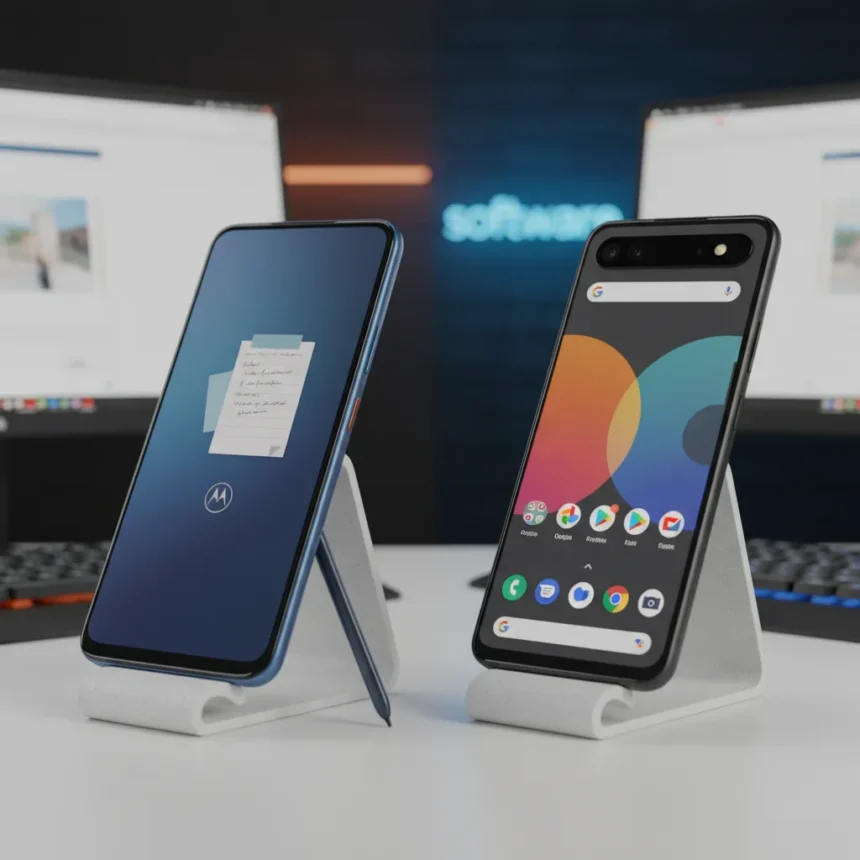
The Moto G Stylus 2026 vs Pixel 10a debate defines the $500 smartphone sweet spot in 2026. Motorola just launched its stylus flagship at $499, while Google holds its Pixel 10a at $500—both claiming the crown for best phone under $500. But they chase different priorities. One gives you a pressure-sensitive stylus and a massive AMOLED screen. The other promises seven years of software updates and proven computational photography. For most buyers, that choice matters far more than raw processing power.
Key Takeaways
- Moto G Stylus 2026 features active stylus with pressure and tilt detection at $499, up $100 from 2025 model.
- Google Pixel 10a offers 7+ years of OS updates until Android 23 (2033) versus Moto’s 2-year support.
- Moto’s 6.7-inch AMOLED display reaches 5,000 nits peak brightness; Pixel 10a’s 6.3-inch Actua pOLED maxes at 3,000 nits.
- Pixel 10a weighs 183g with flat design and no camera bump; Moto is heavier with traditional camera placement.
- Moto G Stylus 2026 excels at productivity and note-taking; Pixel 10a wins on camera quality and long-term software commitment.
Display and Design: Size Versus Substance
The Moto G Stylus 2026 dominates on screen real estate and brightness. Its 6.7-inch AMOLED panel delivers 1220 x 2712 resolution at 120Hz with up to 5,000 nits peak brightness and Water Touch technology—a feature that lets you use the stylus in wet conditions. That’s a genuinely impressive display for the price. Google’s Pixel 10a counters with a more compact 6.3-inch Actua pOLED screen running 1080 x 2424 resolution at 60-120Hz, peaking at 3,000 nits. The Pixel is noticeably smaller and lighter at 183g, with flat sides and zero camera bump, making it feel more premium in hand despite the lower brightness ceiling.
Design philosophy splits these phones cleanly. Moto prioritizes the stylus workflow—a bigger canvas demands a bigger screen. Pixel prioritizes portability and aesthetic minimalism. If you commute by hand or prefer one-handed use, the Pixel’s 153.9 x 73 x 9mm frame wins. If you sketch, annotate, or take notes constantly, Moto’s extra 0.4 inches of screen space justifies the bulk.
The Stylus Question: Active vs. None
The Moto G Stylus 2026’s most significant upgrade over its 2025 predecessor is the shift to an active stylus with pressure sensitivity and tilt detection—capabilities that rival Samsung’s S Pen approach, just at half the Galaxy S26 Ultra’s price. This is not a passive stick. You get real responsiveness in note-taking apps, drawing software, and handwriting-to-text features. Motorola also bundles Moto AI tools like Photo Enhancement System and Motorola Signature Style, leaning into productivity and creativity.


The Google Pixel 10a has no stylus at all. For buyers who never touch a stylus, this is irrelevant—and Pixel’s focus on Gemini AI and Google’s computational photography may feel more valuable. But if you’re torn between these two phones and stylus functionality appeals to you, Moto’s active pen is a significant shift that Pixel cannot match. There is no middle ground here: you either want a stylus or you don’t.
Cameras: Computational Power Versus Hardware
Google’s Pixel 10a brings a 48MP wide camera with optical image stabilization and a 13MP ultrawide with OIS, plus a 13MP front camera. Pixel phones are legendary for computational photography—Google’s image processing can extract detail and correct exposure in ways that raw megapixels cannot. The Pixel 10a carries this legacy forward, even though it reuses the Tensor G4 chip from its predecessor.


Moto’s 50MP main and 13MP ultrawide setup looks competitive on paper, but the brief reveals a critical weakness: the Moto G Stylus 2026 struggles with low-light performance and 4K video, undermining its overall camera appeal. For everyday shots and social media, both phones deliver. For night photography or video work, Pixel’s computational approach pulls ahead. This is one area where the Pixel’s software heritage shows its value.
Software Support: The Long Game
Here, Google’s advantage is staggering. The Pixel 10a receives updates through Android 23 in 2033—that is 7+ years of guaranteed OS upgrades and security patches. Motorola’s Moto G Stylus 2026 offers Android 16 with just 2 OS upgrades, meaning support likely ends by 2028. For a phone you might keep for three to five years, this difference is enormous. Pixel owners get peace of mind. Moto owners face a ticking clock.
This is where Motorola’s $100 price jump from the 2025 model ($399 to $499) feels questionable. You are paying more for a stylus and brighter screen, but sacrificing years of software longevity. If longevity and security matter to you—and they should—Pixel’s commitment is worth the premium in the long run, even if the upfront cost is identical.
Performance and Processor: Where Both Stumble
Both phones use recycled processors. The Moto G Stylus 2026 keeps the Snapdragon 6 Gen 3 from its 2025 sibling, while the Pixel 10a carries over the Tensor G4 from its predecessor. Neither phone represents a generational leap. For everyday tasks—messaging, browsing, social media, light gaming—both are more than adequate. But if you are hoping for a mid-range phone that pushes performance boundaries, both disappoint. Motorola and Google are betting you care more about stylus capability or software support than raw speed, and for most users, they are right.



Durability and Battery
The Moto G Stylus 2026 earns IP68 and IP69 water and dust resistance—the best in its class. The Pixel 10a matches IP68 with Gorilla Glass 7i protection. Both are splash-proof and dustproof. Moto’s dual rating suggests more aggressive water resistance testing, though real-world differences are minimal for typical users.
Battery capacity slightly favors the Pixel 10a at 5,100mAh with 23W wired and 10W wireless charging. Moto’s battery is slightly larger than the 2025 model but exact capacity is unspecified; both promise all-day life and fast charging. Neither phone is a battery champion, but both clear the threshold for typical daily use.
The Verdict: Stylus Productivity or Software Longevity?
Moto G Stylus 2026 vs Pixel 10a is a choice between two valid philosophies. Choose Moto if you actively use a stylus, value a larger and brighter screen, and do not mind replacing your phone in two to three years. The active stylus is genuinely useful, and the 5,000-nit display is stunning. Choose Pixel if you want a compact phone with superior camera processing, a flat design, and the peace of mind that comes with seven years of updates. The Pixel 10a is the safer long-term investment, even if it feels less flashy on the spec sheet.
Does the Moto G Stylus 2026 justify its $100 price increase?
Not entirely. The active stylus is a genuine upgrade, and the brighter AMOLED screen is nice. But the Snapdragon 6 Gen 3 is identical to the 2025 model, and two-year software support is still short. You are essentially paying $100 more for stylus pressure sensitivity and extra brightness, while losing nothing on processing power. For stylus users, yes—it is worth it. For everyone else, the 2025 model or the Pixel 10a may offer better value.
Which phone has better battery life?
Both deliver all-day battery life with similar real-world endurance. The Pixel 10a’s 5,100mAh capacity is slightly larger, but Moto’s battery is also upgraded from the 2025 model. Neither is a battery powerhouse, but both handle a full day of moderate to heavy use without drama.
Can you expand storage on either phone?
The Moto G Stylus 2026 supports microSD card expansion, giving you room to grow. The Pixel 10a offers 128GB or 256GB storage with no expandable option, forcing you to choose your capacity at purchase. If you shoot lots of video or store media locally, Moto’s expandability is a practical advantage.
The Moto G Stylus 2026 vs Pixel 10a matchup reveals that the $500 sweet spot is no longer about raw power—it is about what you value most. A stylus and brightness, or a camera and long-term software support. Both phones are solid. The question is which philosophy aligns with how you actually use a phone every day.
Where to Buy
Edited by the All Things Geek team.
Source: Android Central