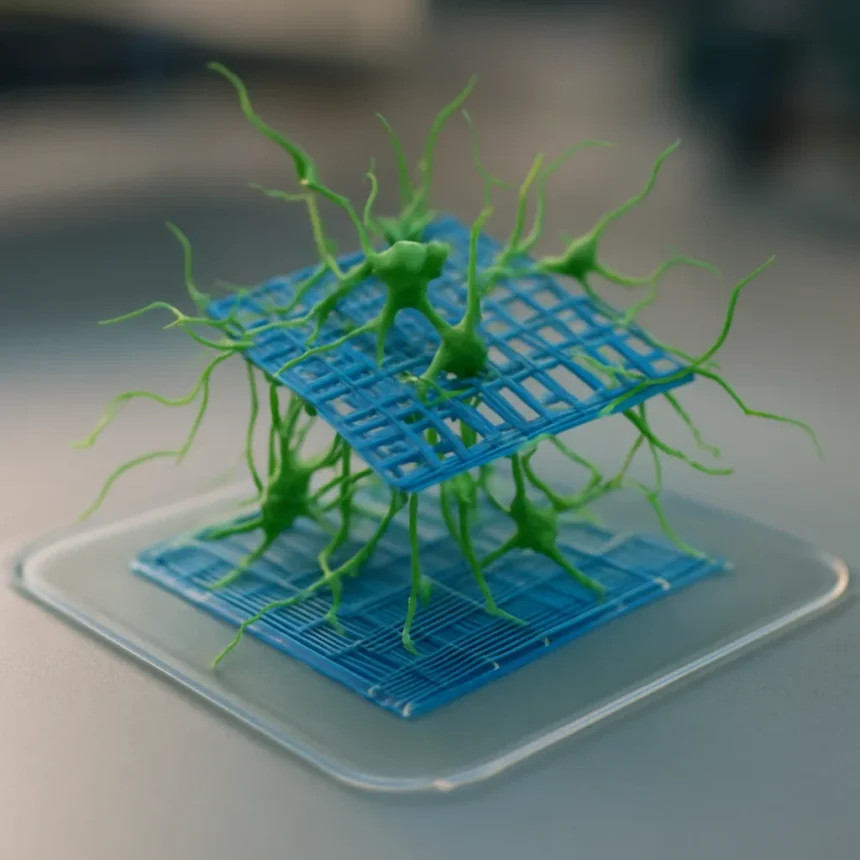
A bioelectronic brain mesh is a 3D device that integrates living neurons with flexible electronics to perform computational tasks, developed by Princeton University researchers and published in Nature Electronics on April 23, 2026. The breakthrough challenges the conventional separation between biological and electronic systems, embedding thousands of neurons within a microscopic scaffold of metal wires and electrodes to achieve what previous approaches could not: sustained, fine-grained control over neural activity for pattern recognition tasks.
Key Takeaways
- Princeton’s bioelectronic brain mesh uses a 3D scaffold of metal wires and flexible epoxy coating to interface with tens of thousands of cultured neurons
- The inside-out design embeds electrodes within the neural network rather than probing from outside, enabling finer-scale recording and stimulation
- Researchers successfully tracked and stimulated the network for over six months, demonstrating long-term stability
- The system was trained to recognize both spatial and temporal patterns of electrical pulses
- This architecture represents a fundamental departure from 2D petri dish cultures and externally probed 3D clusters
How the bioelectronic brain mesh actually works
The device operates through a precise sequence of biological and electronic integration. Researchers fabricate a 3D mesh of microscopic metal wires and electrodes, then coat it with thin epoxy to provide the flexibility needed for soft neural tissue to grow around and through the scaffold. Neurons cultured into this environment naturally extend their connections throughout the mesh, creating a vast three-dimensional network of tens of thousands of cells. Once the neural network is established, the embedded electrodes allow researchers to record electrical activity and deliver stimulation at a finer scale than previous brain-on-chip approaches.
What makes this architecture fundamentally different is the inside-out philosophy. Past attempts at 3D neural computing either relied on 2D cultures in petri dishes or created 3D clusters that were probed from the outside, limiting the precision of signal capture and control. By embedding the electrodes directly within the network itself, the bioelectronic brain mesh achieves bidirectional communication with neurons at multiple points throughout the tissue, not just at the surface.
Pattern recognition and training capabilities
The system was trained to recognize patterns of electrical pulses, successfully distinguishing among distinct spatial patterns and temporal patterns. This demonstrates that the bioelectronic brain mesh can learn, adapt, and perform computational tasks that require pattern recognition—a core capability in both biological and artificial intelligence. Researchers manipulated connections between key neurons over time, effectively training the network to respond to specific input sequences.



The six-month tracking period is particularly significant. Maintaining stable, functional neural networks for extended periods has been a persistent challenge in bioelectronics. The fact that this device sustained both recording and stimulation capabilities over such a timeframe suggests the scaffold design and materials are genuinely compatible with living tissue, not merely a short-term proof of concept.
Why bioelectronic brain mesh differs from competing approaches
The commercial landscape includes alternatives like Cortical Labs’ CL1, a biological computer using living human cells on silicon chips, and Northwestern University’s work on flexible printed artificial neurons that communicate with real brain cells. However, these systems operate under different constraints. The bioelectronic brain mesh’s 3D inside-out design provides architectural advantages for scale and control that 2D silicon-based systems cannot match, while its embedded electrode approach offers finer granularity than external probing methods. The device is not a faster or more efficient computer in the traditional sense—it is a research platform that explores whether living neural tissue can be harnessed as a computational substrate in ways we have not yet fully understood.



What this means for the future of computing
The bioelectronic brain mesh raises profound questions about the intersection of biology and electronics. If living neurons can be trained to recognize patterns and perform computational tasks within a hybrid device, the implications extend beyond conventional computing into neuroscience, medicine, and bioengineering. Researchers led by Tian-Ming Fu, James Sturm, and Kumar Mritunjay have demonstrated that the architecture works at scale and over time—two prerequisites for any technology that moves from laboratory curiosity to practical application.
The device does not replace silicon-based computers for conventional tasks. It is not faster, smaller, or more power-efficient in the ways that matter for consumer electronics. Instead, it opens a new frontier: biological computing systems that might eventually model neural disease, test pharmaceutical compounds on living tissue, or explore questions about consciousness and computation that pure electronics cannot address.
Is the bioelectronic brain mesh a commercial product?
No. The bioelectronic brain mesh is a research platform developed at Princeton University and published in an academic journal. It is not available for purchase or consumer use. The device serves as a proof of concept that may inform future commercial bioelectronic systems, but commercialization would require significant additional development, regulatory approval, and engineering refinement.
How long can the bioelectronic brain mesh maintain neural activity?
Researchers successfully tracked and stimulated the network for over six months. This extended stability period demonstrates that the device’s scaffold materials and electrode design are compatible with living neurons over meaningful timescales, moving beyond the hours or days typical of earlier brain-on-chip prototypes.


What are the practical applications of bioelectronic brain mesh technology?
Potential applications include disease modeling, drug testing on living neural tissue, and fundamental research into how neurons encode and process information. The bioelectronic brain mesh could also advance understanding of neural plasticity and learning at scales that are difficult to study with conventional electrophysiology tools. However, these applications remain in the research phase—the device is not yet deployed in clinical or pharmaceutical settings.
The bioelectronic brain mesh represents a genuine inflection point in how researchers think about interfacing biology with electronics. By embedding computation inside living tissue rather than treating neurons as black boxes to be observed from a distance, Princeton’s team has opened a path toward hybrid systems that could reshape neuroscience and bioengineering for decades to come. Whether this technology eventually reaches practical impact depends on whether the fundamental advantages of the inside-out architecture—finer control, longer stability, and genuine integration—can be scaled and refined without losing the simplicity that makes the current design elegant.
Edited by the All Things Geek team.
Source: Tom's Hardware