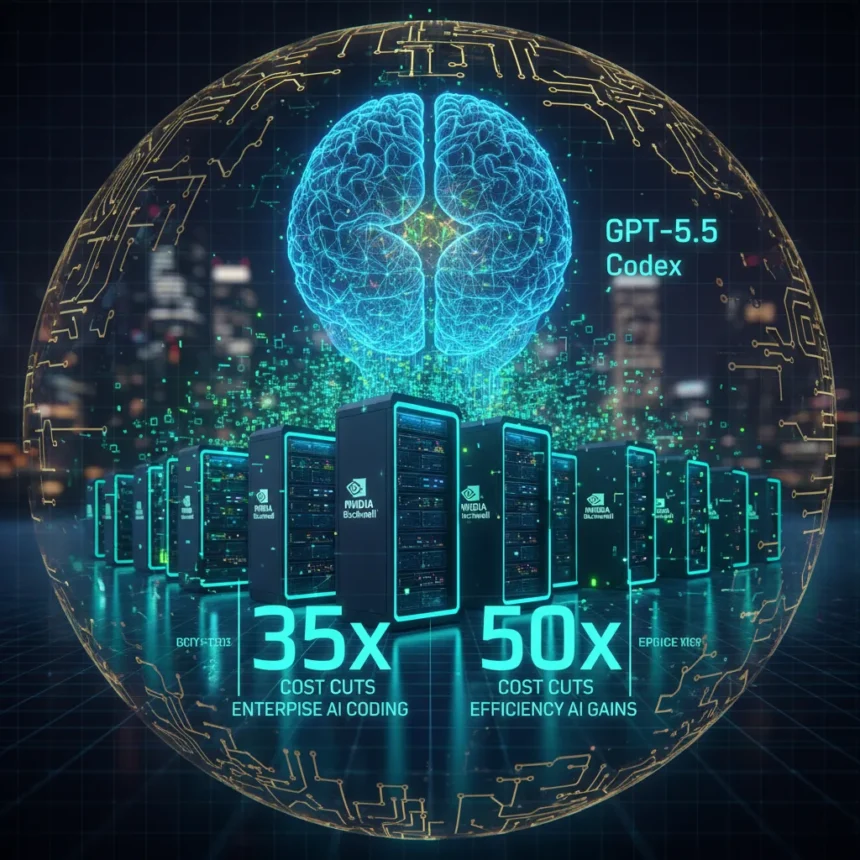
GPT-5.5 Codex enterprise deployment on Nvidia Blackwell systems marks the first frontier AI model co-designed from training to inference for production-scale coding work, delivering a 50x efficiency boost and 35x cost reduction that fundamentally reshapes the economics of agentic AI. OpenAI launched GPT-5.5 Codex on April 23, 2026, after weeks of early access to over 10,000 Nvidia employees across engineering, product, legal, marketing, finance, sales, HR, operations, and developer programs. The collaboration between OpenAI and Nvidia, which dates to 2016, has culminated in a system where the model itself analyzed production traffic to improve serving infrastructure by 20% token generation speed.
Key Takeaways
- GPT-5.5 Codex reduces debugging cycles from days to hours and multi-file code experimentation from weeks to overnight.
- Nvidia GB200 NVL72 systems deliver 50x higher token output per second per megawatt compared to prior-generation hardware.
- Model uses approximately 40% fewer output tokens than GPT-5.4 for identical Codex tasks while matching per-token latency.
- Over 85% of OpenAI employees use Codex weekly, with 10,000+ Nvidia staff reporting significant efficiency improvements.
- GPT-5.5 achieves 84.9% on GDPval benchmarks, outperforming Claude Opus 4.7 at 80.3% and Gemini 3.1 Pro at 67.3%.
How GPT-5.5 Codex Transforms Enterprise Coding Workflows
The core advantage of GPT-5.5 Codex enterprise deployment lies in its ability to compress development cycles dramatically. Debugging tasks that previously consumed days now complete in hours. Complex multi-file code experimentation that once stretched across weeks now finishes overnight. These are not marginal gains—they represent a fundamental shift in how teams approach software development at scale. Nvidia employees describe the results as mind-blowing and life-changing, though the most compelling evidence comes from concrete workflow acceleration.
The infrastructure enabling this speed is Nvidia’s GB200 NVL72 rack-scale system, which the model was co-designed alongside. This hardware-software co-optimization approach allows GPT-5.5 Codex to deliver 50x higher token output per second per megawatt, a metric that directly translates to cost efficiency and deployment feasibility at enterprise scale. The 35x cost reduction in per-million-token pricing makes running agentic coding systems economically viable for large organizations where previous-generation infrastructure would have been prohibitively expensive.
Performance Benchmarks: GPT-5.5 Codex vs. Competitors
GPT-5.5 Codex demonstrates measurable advantages across multiple coding evaluation frameworks. On the GDPval benchmark, it scores 84.9%, surpassing Claude Opus 4.7’s 80.3% and Gemini 3.1 Pro’s 67.3%. Terminal-Bench 2.0 shows similar dominance, with GPT-5.5 Codex at 82.7%, leading both competing models. On OpenAI’s Expert-SWE evaluation—which tests performance on 20-hour median human time tasks—GPT-5.5 Codex achieves 73.1%, up from GPT-5.4’s 68.5%, indicating meaningful progress on complex engineering challenges.



A critical efficiency metric distinguishes GPT-5.5 Codex from its predecessors: the model generates approximately 40% fewer output tokens than GPT-5.4 when completing identical Codex tasks, while maintaining the same per-token latency. This token efficiency is particularly valuable in enterprise environments where inference costs scale with token volume. The Artificial Analysis Intelligence Index confirms this advantage, showing that GPT-5.5 Codex either completes more tasks at the same token budget or achieves equivalent performance with fewer tokens compared to Claude Opus 4.7.
The Cost Trade-Off: Price Increases Offset by Efficiency Gains
OpenAI doubled the per-token API price for GPT-5.5 compared to GPT-5.4, a significant increase that demands scrutiny. However, the model’s token efficiency—using 40% fewer output tokens for the same work—partially offsets this price jump. For short prompts and straightforward tasks, net Intelligence Index cost remains roughly flat. For longer, more complex queries, costs increase by approximately 20% despite the doubled per-token rate. This pricing structure reflects the reality that frontier models demand higher computational resources, but the efficiency gains make the trade-off economically defensible for enterprises running Codex at scale.



Adoption Across Nvidia and Beyond
The deployment across Nvidia’s 10,000+ employees represents the largest single-organization rollout of GPT-5.5 Codex. Over 85% of OpenAI’s own staff use Codex weekly, indicating strong internal confidence in the system. Nvidia CEO Jensen Huang emailed employees about early access, signaling executive-level commitment to the integration. Teams report significant improvements in work efficiency, though quantified metrics beyond time-to-completion remain limited in public statements.
Security considerations were addressed through cloud virtual machines provisioned for each employee, ensuring code isolation and compliance with enterprise security requirements. This infrastructure choice reflects the sensitivity of deploying agentic AI in environments handling proprietary code and confidential business logic.
Technical Innovation: Model Self-Improvement and Hardware Co-Design
One of the most striking aspects of GPT-5.5 Codex enterprise deployment is that the model itself participated in optimizing its inference infrastructure. By analyzing production traffic patterns, GPT-5.5 identified bottlenecks and improvements that boosted token generation speed by 20%. This self-directed optimization suggests a maturity in how frontier models can contribute to their own deployment efficiency—a capability that compounds the 50x efficiency gains from hardware alone.
The co-design relationship between GPT-5.5 and Nvidia’s GB200/GB300 NVL72 systems distinguishes this deployment from typical model-on-hardware scenarios. Rather than training a model and then adapting it to existing infrastructure, OpenAI and Nvidia shaped both simultaneously, ensuring architectural alignment from the ground up. A demonstration of this capability showed GPT-5.5 Codex generating a complete 3D action game in TypeScript and Three.js, including combat mechanics, enemies, a heads-up display, and textures—a task that illustrates the model’s ability to manage complex, multi-system code generation.



Broader Implications for Enterprise AI Adoption
The headline claim that GPT-5.5 Codex makes AI viable at enterprise scale hinges on the 35x cost reduction. For organizations previously priced out of continuous agentic AI workflows, this efficiency milestone opens new possibilities. Debugging, refactoring, and code generation tasks that required human developer time can now run at marginal cost, freeing skilled engineers for higher-level design and architecture work. The question is whether the doubled per-token API price will stabilize or continue climbing as demand scales—a factor that will determine whether enterprise adoption accelerates or plateaus.
Is GPT-5.5 Codex available for public use?
GPT-5.5 Codex launched on April 23, 2026, with early access granted to 10,000+ Nvidia employees weeks prior. OpenAI has indicated that public release is imminent following the employee access period, though no specific date has been announced. Organizations interested in early adoption should monitor OpenAI’s official channels for availability announcements.
How does GPT-5.5 Codex compare to Claude Opus 4.7 for coding tasks?
GPT-5.5 Codex outperforms Claude Opus 4.7 on multiple benchmarks: 84.9% vs. 80.3% on GDPval, and 82.7% vs. competing performance on Terminal-Bench 2.0. Additionally, GPT-5.5 Codex achieves higher scores while using fewer output tokens, making it more cost-efficient per task completed.
What makes Nvidia Blackwell hardware essential for GPT-5.5 Codex?
The GB200 NVL72 systems deliver 50x higher token throughput per megawatt and enable 35x cost reduction in per-million-token pricing. GPT-5.5 was co-designed with this hardware, meaning the model’s architecture and the infrastructure were optimized together rather than adapted after the fact.
GPT-5.5 Codex enterprise deployment represents a watershed moment for agentic AI economics. The 50x efficiency gain and 35x cost reduction transform what was previously a luxury capability into a standard tool for large organizations. Whether adoption accelerates depends partly on API pricing stability and partly on how quickly other enterprises can replicate Nvidia’s infrastructure investments. For teams with access to Blackwell systems, the case for immediate deployment is compelling.
Edited by the All Things Geek team.
Source: TechRadar